





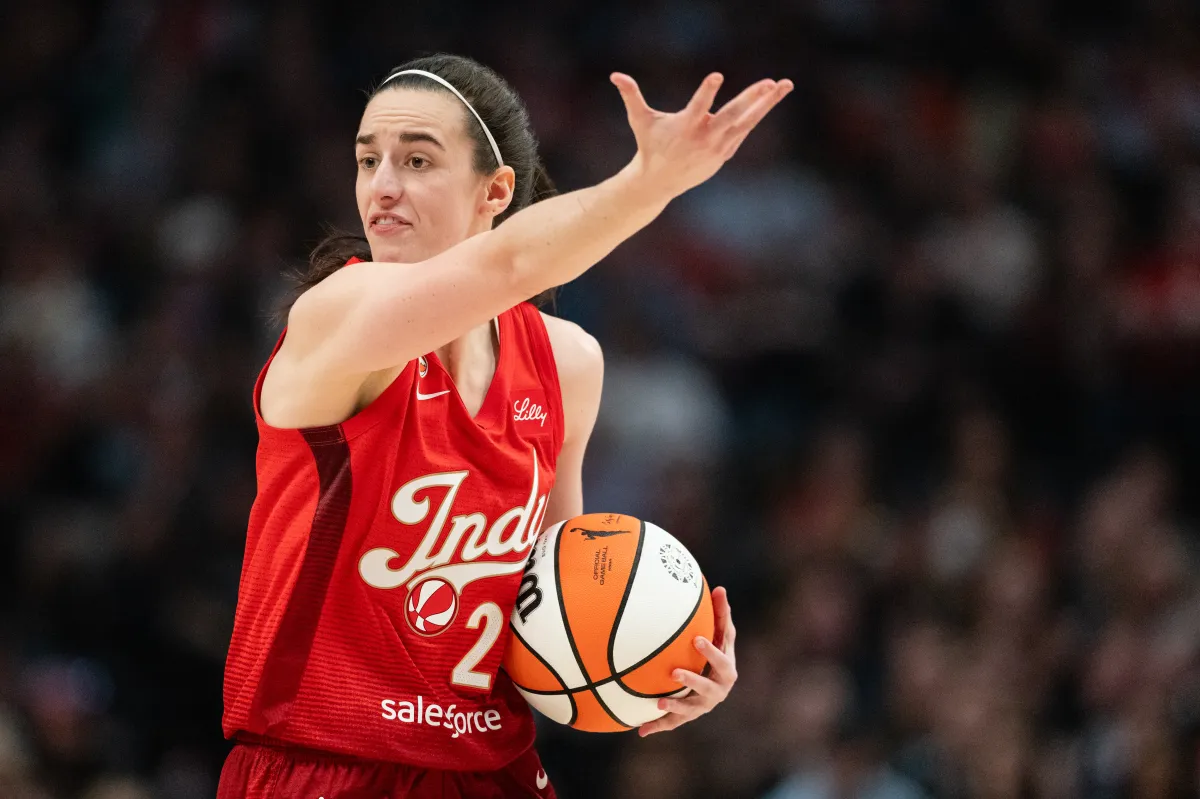
The journey of a professional athlete is rarely a straight line of triumphs, even for those destined for greatness. For Caitlin Clark, the brilliant young guard of the Indiana Fever, the intense spotlight of the WNBA has served as both a stage for unprecedented brilliance and a harsh magnifier of the inevitable growing pains that come with professional transition. On a rainy Thursday night, the basketball world witnessed a classic paradox of her young career: a moment of historic individual excellence eclipsed by the frustrating reality of a team defeat. Clark etched her name into the league’s history books by reaching 500 career assists faster than any player before her, a testament to her vision, basketball IQ, and ability to elevate those around her. Yet, the milestone tasted bittersweet, if not outright sour, as the Golden State Valkyries snatched a narrow 90-88 victory on the Fever’s home court. Clark struggled to find her rhythm all night, finishing with a season-low 16 points while shooting a dismal 25% from the field. It was a stark reminder that in the professional ranks, milestones are small comfort when the final buzzer sounds on a loss, leaving an elite competitor alone with her thoughts, evaluating the misses rather than celebrating the records.
The disappointment of Thursday night, however, was merely a prelude to a much harsher lesson in Portland on Saturday. Playing before a raucous, sold-out crowd that had gathered in anticipation of seeing Clark’s signature offensive masterclass, the Indiana Fever instead ran directly into a buzzsaw. The Portland Fire dominated the contest from the opening tip, exposing defensive gaps and suffocating Indiana’s offense to build an insurmountable 87-62 lead by the end of the third quarter. For Clark, the evening was a masterclass in frustration, defined not by heroic deep three-pointers, but by the stifling whistle of the officials. Burdened by foul trouble, she entered the final period with five personal fouls, effectively neutralizing her aggressiveness and forcing her to watch long stretches from the sidelines. Stripped of her usual rhythm and the freedom to dictate the pace of the game, she was held to just six points on a painful 1-for-7 shooting display, missing both of her three-point attempts, while managing six assists. The final whistle of the 100-84 blow-out left the young star physically spent and emotionally drained, facing the cold reality of a performance that fell far short of her own lofty standards.
To understand the emotional weight of Clark’s night in Portland, one must look at where it sits in the broader landscape of her rookie season. This was not just a bad game; it was her second-lowest shooting percentage from the floor, a meager 14.3%, and her second-lowest scoring output since embarking on her professional career. The only performance that ranks lower on her personal ledger of struggles was an icy outing on June 2, 2024, during the WNBA Commissioner’s Cup, when the New York Liberty dismantled the Fever 104-68 and held Clark to a mere three points on 10% shooting. For an athlete who spent her collegiate career rewriting scoring records and captivating millions with her effortless offense, these statistical valleys are more than just bad nights at the office—they are deeply humanizing moments of vulnerability. The transition to the WNBA demands a grueling physical toll, requiring young rookies to adapt to stronger defenders, faster defensive rotations, and a relentless schedule, all while carrying the immense burden of saving a franchise and carrying the league’s skyrocketing popularity on their shoulders.
This latest setback leaves the Indiana Fever hovering at an even 4-4 record on the season, a mediocre standing that reflects a young team still trying to discover its identity and build consistent chemistry. The road ahead offers no immediate relief, nor does it allow any time for self-pity or quiet reflection. The life of a professional basketball player is a relentless cycle of travel, scout film, and recovery, and the Fever are about to enter one of the most demanding stretches of their season. As they return home to regroup, the coaching staff faces the daunting task of rebuilding their young star’s confidence while adjusting their offensive schemes to better counter the aggressive blitzes and physical trapping defenses that opponents are using to limit Clark’s influence. The chemistry between Clark and her frontcourt teammates remains a work in progress, a delicate puzzle of timing and spacing that can only be resolved through the shared trauma of tough losses and the collective resolve to improve.
The immediate future promises to test that resolve to its absolute limits, beginning with a highly anticipated, emotionally charged home game against the Atlanta Dream on Thursday night. This matchup carries a narrative weight that extends far beyond the standings, representing the first time Clark will share a WNBA laboratory with her long-time collegiate rival, Angel Reese, since Reese’s high-profile trade from the Chicago Sky to Atlanta. The rivalry between Clark and Reese has become the defining narrative of their generation, a compelling clash of styles, personalities, and backgrounds that has captivated casual sports fans and purists alike. Now, with the Dream boasting a formidable 5-2 record and Reese finding her footing in her new southern home, the game promises to be an intense, high-stakes spectacle. For Clark, it represents an immediate opportunity for redemption on a massive stage, a chance to silence the skeptics and reassert her dominance against an opponent who knows her game intimately and will spare no effort to disrupt it.
Following the emotional crucible of the Atlanta game, the Fever’s schedule intensifies further as they embark on a demanding road trip to face two formidable Eastern Conference opponents. On Saturday, they travel north to face the New York Liberty, a seasoned squad currently sitting at 5-4 and eager to replicate the defensive blueprint that stymied Clark earlier in June. From there, the road leads to the nation’s capital for a Monday night clash with the Washington Mystics, a scrappy 3-4 team always dangerous on their home court. Crucially, all three of these upcoming contests are designated as part of the WNBA Commissioner’s Cup, a mid-season tournament that holds special significance for Indiana as the tournament’s reigning champions. Defending that title will require the Fever, and Clark in particular, to summon a level of consistency, resilience, and maturity that has eluded them in recent games, proving that a couple of rough nights in the Pacific Northwest were merely minor speed bumps on the long road to establishing a sustainable winning culture.