



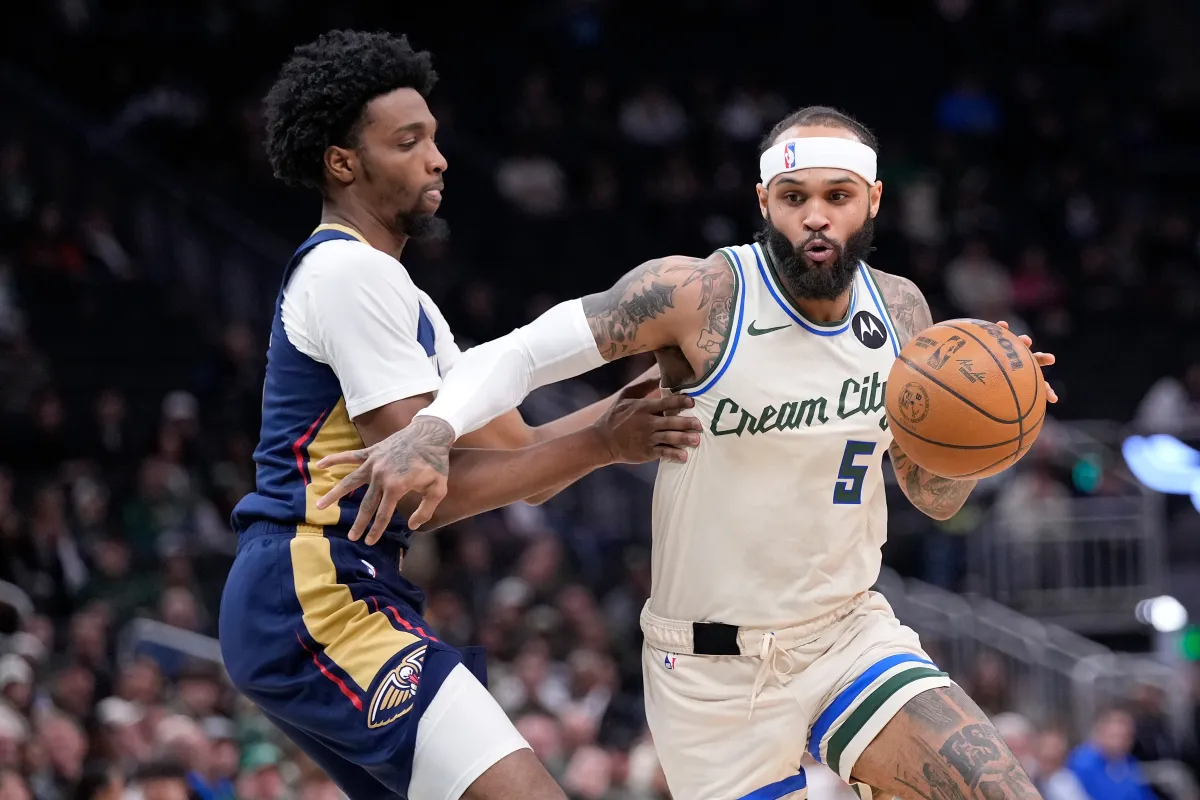
The post-Giannis Antetokounmpo era has officially arrived in Milwaukee, and the Bucks are wasting no time reshaping their identity. In a move that signaled both commitment and a gamble on potential, the franchise secured guard Gary Trent Jr. with a lucrative four-year, $64 million contract extension, as reported by ESPN’s Shams Charania. This investment raises eyebrows given Trent’s recent dip in production, where he averaged just 8.1 points, 1.2 assists, and a single rebound over 65 games last season. However, the front office is clearly banking on a return to his previous form. Just a year prior, Trent was a much more dynamic asset, contributing 11.1 points and 2.3 rebounds per game. By anchoring him with the fifth-highest salary on the team for the 2025-2026 season, the Bucks are hoping he can rediscover that spark and become a cornerstone of their new-look backcourt.
To understand where Trent fits, one must look at the financial hierarchy of this reconstructed roster, which is topped by Tyler Herro. Acquired as the marquee centerpiece of the blockbuster trade that sent Giannis packing, Herro represents the team’s offensive future after averaging an impressive 20.5 points, 4.8 rebounds, and 4.1 assists in 33 games with the Miami Heat last year. Following Herro on the payroll is big man Myles Turner, who brought stability to Milwaukee last season with averages of 11.9 points and 1.6 blocks. Forward Kyle Kuzma occupies the third spot on the cap sheet as a versatile forward who chipped in 13 points and 4.5 rebounds, while swingman Caris LeVert sits just ahead of Trent in earnings. This veteran core represents a massive pivot toward depth and versatility over singular superstar dominance.
The financial commitment to Trent is a classic low-risk, high-reward bet on track records. While Trent and LeVert both experienced down years recently—with LeVert averaging a modest 7.4 points in Detroit and Trent slipping into single digits—both players have spent the bulk of their careers as reliable double-digit scorers. LeVert had scored at least ten points per game every year since 2017, while Trent had been a model of consistent offensive output since his breakout in 2020. The Bucks are hoping that placing these two proven scorers in a fresh, collaborative environment will reignite their competitive fires and provide the team with the multi-dimensional scoring punch they desperately need to stay relevant in a highly competitive Eastern Conference.
Despite the optimism, the sheer volume of guards on the roster raises questions about how head coach Doc Rivers will distribute playing time. With Herro and LeVert locked into substantial contracts and expected to carry heavy offensive loads, the luxury of guaranteed minutes for Trent is far from certain. The bench is also teeming with young talent hungry for opportunities. Kevin Porter Jr. and Ryan Rollins both logged over 30 minutes per game last season and will push hard during training camp for significant roles. Additionally, the sharpshooting A.J. Green, who emerged as a reliable rotation piece while averaging nearly 30 minutes a night, remains a favorite to command consistent floor time.
This logjam leaves the Bucks in a delicate position with their newly paid guard. Paying a player $16 million annually only to have him buried on the bench would be a tough pill to swallow for a front office trying to prove they can build a contender without their former MVP. If Trent struggles early or fails to beat out the younger guards in training camp, his contract could quickly transition from a bold investment into a challenging cap obstacle. Conversely, if he can weaponize his perimeter defense and return to his historic shooting averages, he could easily become the team’s best value contract.
Ultimately, the upcoming season will be a fascinating study in roster construction and minute management for Milwaukee. The Bucks have transitioned from a top-heavy powerhouse built around a generational superstar to a deep, guard-oriented squad with questions to answer. How the coaching staff balances the development of their younger prospects with the financial obligations to veterans like Trent will dictate the true success of this new era. For Trent, the pressure is on to prove that his lean years are behind him and that he is fully worth the front office’s massive financial leap of faith.