





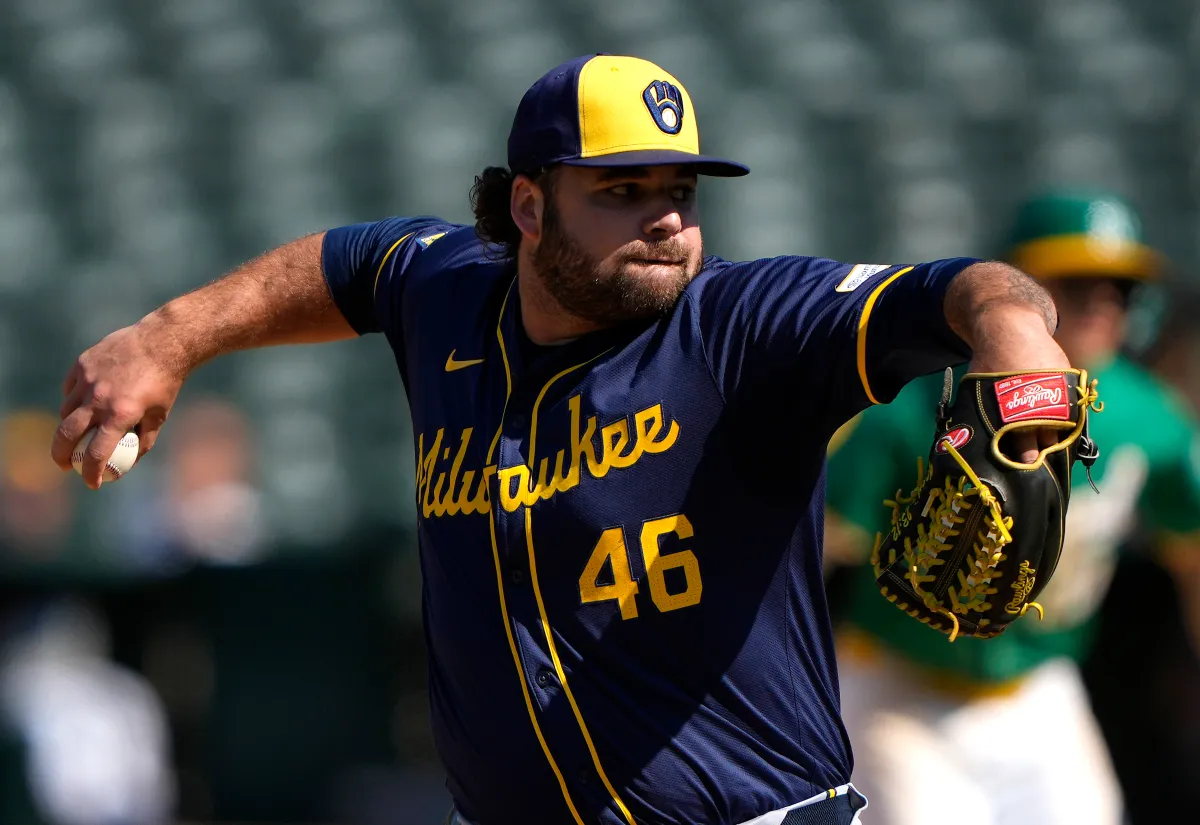
The Milwaukee Brewers have brought back pitcher Bryse Wilson on a one-year contract, just days after designating him for assignment. In a move that speaks to the often bizarre, circular nature of a Major League Baseball roster, Wilson will now return to the same club that recently let him go. To make room on the 40-man roster, the Brewers have designated pitcher Lyon Richardson for assignment. For Wilson, this is the latest turn in an already dizzying season that has seen him bounce among multiple organizations. The transaction is one of those quiet midseason moves that rarely makes national headlines, but for the player involved, it is the kind of emotional whiplash that defines the life of a professional athlete. Baseball is a game of routine, but for a pitcher without a guaranteed role, the routine often includes packing bags, answering phone calls from agents, and waiting to learn if you are going to a new city or returning to an old one. In Wilson’s case, the answer turned out to be the same city he just left.
Wilson had been with the Brewers before the designation, appearing in six games this season and posting a 0-0 record with a 2.63 ERA, ten strikeouts, and 13.2 innings pitched. Those numbers are more than respectable, especially for a reliever often asked to eat innings in a middle-relief role. But respectable numbers do not always guarantee a spot on a big-league roster, and the Brewers made the difficult decision to take Wilson off the 40-man roster to create flexibility. After he elected free agency rather than accepting an outright assignment to the minors, Wilson seemed likely to land elsewhere. Instead, he is staying put. It is an unusual path, but not unheard of in baseball, where the transaction wire is filled with names repeating like echoes. Earlier this season, Wilson also made three appearances split between the Philadelphia Phillies and Chicago Cubs, meaning he has now worn at least three uniforms this year, with the Brewers stint being the most substantial. For a 6-foot-2 right-handed pitcher, this season has been a marathon of travel, unfamiliar bullpens, new teammates, and constant uncertainty. Humanizing his experience means understanding that every time he lands somewhere, he has to prove himself all over again. He cannot get too comfortable. He cannot assume the locker room is his for the long term. He simply takes the ball when his name is called and hopes it will be called again.
Looking at the broader arc of Wilson’s career, it becomes clear that he has become something of a survivor in the game. Over nine seasons and 172 career major league appearances, he has pitched for the Atlanta Braves, Pittsburgh Pirates, Chicago White Sox, Philadelphia Phillies, Chicago Cubs, and now the Brewers. In that time, he has compiled a 20-23 record with a 4.79 ERA and 351 strikeouts. Those are not Hall of Fame numbers, but they are the numbers of a pitcher who has found a way to stick around, which in many ways is an achievement of its own. There are hundreds of players drafted and signed who never make it to the majors, and thousands who appear briefly and disappear. Wilson, by contrast, has made a career out of being useful. He has been a spot starter, a long reliever, an opener, a mop-up man, and a bridge to the late innings. He has been asked to do thankless jobs at awkward moments, like entering a game after an early exit or pitching on back-to-back days. He has done them without complaint and without making excuses. His ERA may not be as low as a lockdown closer’s, but his value cannot be measured simply in runs allowed. It is also measured in flexibility, durability, and professionalism. The fact that he keeps getting signed, even when he is designated for assignment, suggests that teams see something in him. They see a pitcher who will not fall apart under pressure, who will compete, and who can be trusted to handle an innings load. He may not be the star of the game, but he is one of those names that baseball fans recognize and managers appreciate.
The process that led to Wilson’s brief exit and quick return can be confusing to casual fans. When a player is designated for assignment, he is immediately removed from the 40-man roster. This is not the same as being released outright. It is more like being placed in baseball’s version of limbo. For a short period of time, the team can trade him, place him on waivers, or attempt to assign him to the minor leagues. If the player has enough major league service time, he can refuse an outright assignment and elect free agency instead. Wilson, with his long service history, chose that option. In theory, that should have ended his time in Milwaukee. But in a league where roster needs can change from one day to the next, a door that closes can reopen almost immediately. The Brewers, perhaps realizing they needed Wilson’s depth and experience more than they initially thought, re-signed him. For Wilson, the experience must have been strange. One day he is told he is no longer part of the plan. The next day, he is told he is back. In the real world, being fired and rehired in the same week is disorienting, but for baseball players, it is just another part of the job. They learn not to take rejection personally because the same organizations that designate them are often the ones that call them back. Humanizing Wilson means recognizing his perspective. He has been in this game long enough to understand that transactions are not about emotion. They are about doing what is best for the team. Still, there has to be a hint of relief in returning to a club he already knows, with coaches who know his delivery, a bullpen catcher who knows his signs, and a clubhouse where he has already earned the trust of his teammates.
Then there is the other side of the news: Lyon Richardson. The Brewers had to make room for Wilson, and Richardson was the one chosen to be designated for assignment. It is a brutally unfair part of baseball, but it also is the reality. Richardson appeared in just one game for the Brewers this season, and in that outing, he did not allow a run and struck out one batter. His line was clean, but in a numbers game, sometimes one appearance is not enough to secure a foothold. For Richardson, the disappointment is probably sharp. He got a taste of the majors, delivered a scoreless inning, and now finds himself off the roster. Yet this is not the end of his story. Being designated for assignment means Richardson will either be traded, claimed by another team, or kept in Milwaukee’s organization if he clears waivers and accepts an assignment. In some cases, a DFA is just a speed bump. For a young pitcher with promise, it can be the beginning of a new opportunity with another organization. It may feel like a setback, but in a career marked by setbacks, resilience is often the only way forward. Richardson should not be defined by this moment. He is still young, still developing, and still capable of earning his way back. The harsh truth of the game is that roster spots are precious and every transaction creates collateral damage. Wilson’s return is possible only because Richardson was moved aside. That is the calculus of the front office, and it is cold by design. But for the players themselves, each decision carries real weight. One man’s hopeful return is another man’s sudden uncertainty.
In the end, the Brewers are making a simple bet. They believe Wilson, despite being designated just days ago, is the better option right now. Perhaps they want an experienced arm for a stretch run, a pitcher who can absorb innings and steady a bullpen that has seen a fair amount of turnover. Wilson gives them that. He is not a flashy signing, but he is a comfortable one. For Wilson, this new deal represents more than just a paycheck. It represents the chance to stay in one place for a little while, to establish a rhythm, and to shut down the questions about whether he still belongs. In every clubhouse, there are players who have to fight for their jobs every week. Wilson knows he is one of them. He also knows that fighting is something he has been doing his entire career. The numbers, the teams, the demotions, the calls that never came, the flights to cities he never expected to visit. All of that has shaped him into the pitcher he is now. The Brewers are betting that his experience is worth more than the occasional rough outing. Richardson, meanwhile, will have to wait and see what comes next. It is possible he will resurface in the majors soon, or it is possible he will spend time in the minors before finding another opening. That is the nature of professional sports. But his story is not over, and for every player who gets a second chance, there is a young pitcher watching and waiting for the day his own chance comes around. The baseball calendar moves quickly. The only certainty is that things will change again. For now, Wilson is back where he has spent a good portion of this season, wearing a Brewers uniform and preparing for his next appearance. He has been here before, and he will be here again. And that, in a strange way, is exactly why he is still here.