





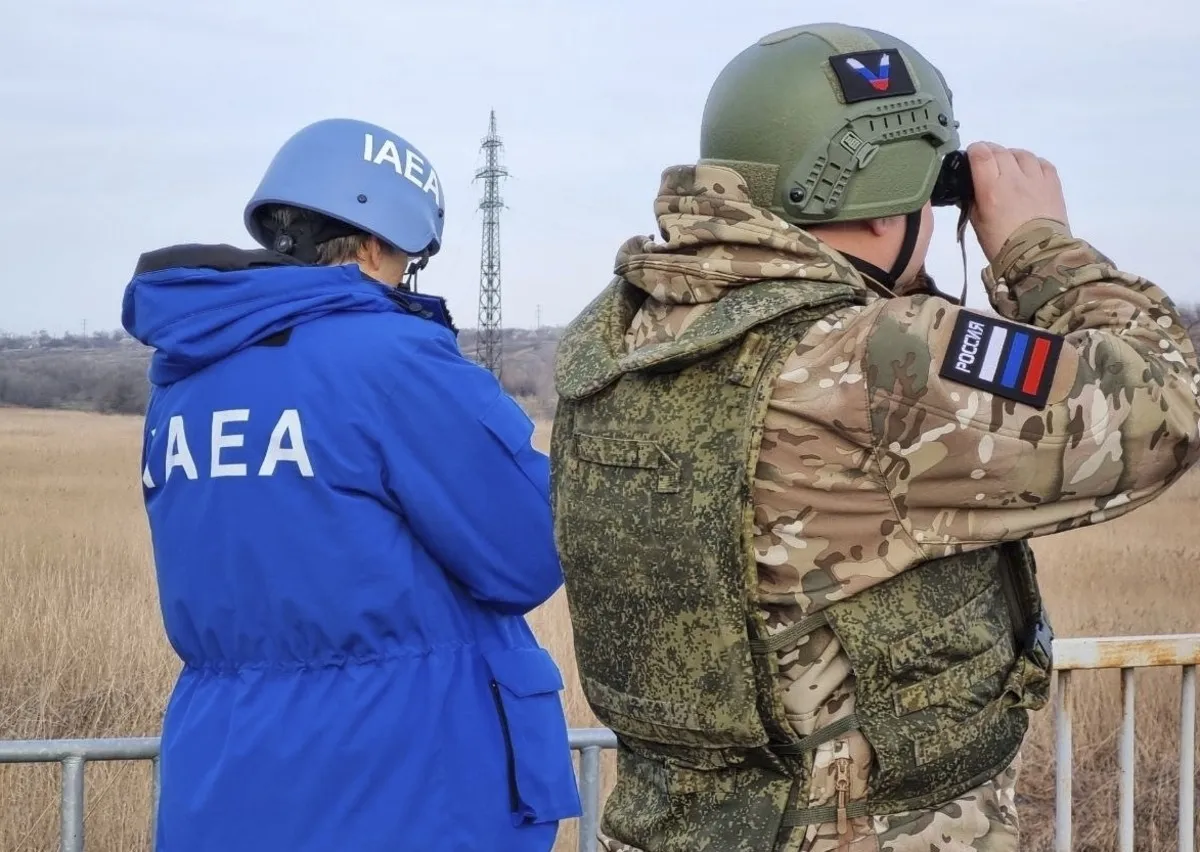
The international community was once again shaken by a chilling reminder of the catastrophic risks brewing in southern Ukraine, as the United Nations’ nuclear watchdog issued a haunting warning that humanity is “playing with fire.” This urgent distress call from the International Atomic Energy Agency (IAEA) followed terrifying reports of a drone strike within the perimeter of the Russian-controlled Zaporizhzhia nuclear power plant. Rafael Grossi, the chief of the IAEA, expressed profound and serious concern over the incident, which occurred on a tense Saturday. If fully confirmed by independent observers, this event would mark the first time since April 2024 that a hostile drone has penetrated the immediate boundaries of Europe’s largest nuclear power station. The strike has reignited a fierce and familiar blame game, with Russia accusing Ukrainian forces of deliberately targeting the highly sensitive facility, while Kyiv has vehemently rejected the allegations, labeling them as nothing more than a cynical Russian “propaganda ploy.” As the fog of war thickens, the immediate threat of an atomic crisis looms over millions of ordinary citizens throughout Europe, who can do nothing but watch in silent terror as a military conflict plays out on the doorstep of a nuclear giant.
Behind the clinical terminology of military reports and geopolitical statements lies an ongoing human tragedy for the plant’s workforce, who have become hostages to the radioactive titans they operate. When Russian forces seized control of the facility and the neighboring town of Enerhodar in March 2022 during the chaotic opening weeks of the full-scale invasion, the lives of these Ukrainian operators changed forever. For over two years, these brave engineers and technicians have continued to perform their highly demanding duties under the constant, suffocating pressure of military occupation. They must navigate their daily responsibilities under the watchful eyes of heavily armed Russian soldiers, knowing that a single misstep or a momentary lapse in concentration could result in a humanitarian disaster of global proportions. The psychological burden carried by these workers is unimaginable; they are desperately trying to protect their homeland and families from an invisible monster, all while being caught in the crossfire of a war that shows no signs of relenting. International experts have repeatedly voiced their admiration and deep concern for these operators, warning that chronic fatigue, intense stress, and the constant threat of violence significantly elevate the risk of a catastrophic operational error.
The existential dread surrounding the Zaporizhzhia facility is framed by a dark and painful chapter of Ukrainian history—the collective trauma of the Chernobyl disaster. Just last month, the nation marked the solemn 40th anniversary of the 1986 meltdown, an event that remains etched into the cultural DNA of the Ukrainian people. That historic tragedy, which occurred north of Kyiv during the Soviet era, claimed at least thirty lives in its immediate, agonizing aftermath and exposed millions of innocent people to dangerous levels of radioactive fallout, leaving vast swathes of land permanently uninhabitable. In a cruel twist of historical irony, the ghost towns of Chernobyl briefly fell under Russian control during the initial invasion of 2022, reminding the world that modern warfare respects neither the sanctities of the past nor the safety of the present. For the people of Ukraine, the threat at Zaporizhzhia is not an abstract, theoretical scenario discussed by scientists in distant capital cities; it is a vivid, terrifyingly familiar nightmare of poisoned soil, shattered lives, and displaced generations that they are desperate to avoid repeating.
Compounding this immediate fear is a fundamental misunderstanding of how nuclear plants function during wartime, as many assume that a facility in a state of shutdown is entirely safe. In reality, the danger at Zaporizhzhia has been quietly compounding behind the scenes, particularly regarding its reliance on external power. Since February 2022, the war has severed the plant’s connection to the off-site electrical grid more than a dozen times, with the most recent critical blackout occurring in mid-December. Although the facility’s reactors are not currently operational or generating electricity, they still require a continuous, uninterrupted supply of power to run the vital cooling systems that prevent the highly radioactive spent fuel from overheating and melting down. Whenever the external power grid fails, the plant is forced to rely on emergency diesel generators—a fragile, temporary safety net that stands as the thin line defense between stability and absolute catastrophe. The silent, ticking clock of these generator fuel reserves represents a nerve-wracking reality for the engineers on-site, who know that if the diesel runs out before the grid is restored, a meltdown becomes an inevitability.
In the chaotic theater of modern information warfare, the truth about who possesses responsibility for these near-misses is regularly swallowed by propaganda. Mikhail Ulyanov, a senior Russian envoy based in Vienna—the home of the IAEA—announced that UN experts were actively inspecting the damaged areas of the plant following the latest drone incident, while the IAEA confirmed it had requested immediate access to verify the claims. Yet, as both sides trade furious accusations, the international public is left in a state of paralysis, struggling to discern whether the strike was an act of sabotage, a reckless Ukrainian probing mission, or a calculated false-flag operation designed by Moscow to justify further militarization of the zone. This manipulation of narrative weaponizes the global fear of nuclear radiation, turning a collective human threat into a routine public relations battle. In this hostile environment, the actual safety of the facility is treated as a secondary concern, while the primary objective of both warring states remains the manipulation of international sympathy and the allocation of blame.
In a desperate bid to establish some semblance of order amid the madness, the IAEA has repeatedly championed its “seven indispensable pillars” of nuclear safety, alongside five concrete principles designed explicitly to safeguard Zaporizhzhia. These guidelines, drafted in the wake of the 2022 invasion, forbid any military action directed against or originating from the plant, specifically emphasizing that its nuclear reactors must never be targeted or used as military outposts. They also stress the absolute necessity of maintaining secure external power connections at all times, a directive that has been repeatedly ignored by combatants on both sides of the front line. Rafael Grossi’s passionate pleas for sanity serve as a reminder that radiation knows no borders, respects no sovereignty, and shows no mercy to victor or vanquished alike. As the war continues to grind forward, the international community’s inability to enforce these basic safety principles exposes a terrifying vulnerability: that in the pursuit of geopolitical dominance, humanity is willing to gamble with the very habitability of the planet, turning the promise of peaceful atomic energy into a weapon of self-destruction.