





As the blistering midsummer heat settles over the training camp fields, there is a comforting, almost rhythmic sense of familiarity returning to the Kansas City Chiefs’ offense. At the heart of this football machine is Patrick Mahomes, moving with the effortless, fluid grace that has defined a generation of gridiron dominance, his health fully intact and his vision as sharp as ever. Alongside him stands Travis Kelce, the veteran tight end whose connection with Mahomes has transcended mere chemistry to become something akin to kinetic telepathy on the grass. Adding to this offensive resurgence is the encouraging return of Rashee Rice; after a grueling offseason navigating the painful road of knee surgery recovery, his gradual integration back into full-contact practices has injected a palpable wave of energy into the coaching staff. Supported by a heavily reinforced and highly motivated offensive line, the Chiefs’ coaching staff is quietly building a units-based strategy designed to terrorize opposing coordinators. The sheer joy of watching these athletes operate at the peak of their powers is a stark reminder of why Kansas City remains the gold standard of modern football, transforming the grueling monotony of summer practices into a masterclass of offensive innovation and human resilience.
Yet, just across the scrimmage line, the defensive side of the ball tells a much different, far more anxious story of transition, departure, and quiet reinvention. The NFL is a cold business where championship success inevitably demands a high financial toll, and this offseason, the Chiefs paid that tax in full as several beloved pillars of their defense packed their lockers for the final time. The secondary was hit hardest, feeling the immediate absence of All-Pro cornerback Trent McDuffie, whose lockdown capabilities anchored the defense, alongside the departures of dependable defensive backfield companions Jaylen Watson and safety Bryan Cook. Up front, the losses were equally devastating to the team’s physical identity; linebacker Leo Chenal and edge rusher Charles Omenihu chose to take their talents east to the Washington Commanders during the spring free-agency frenzy, while the relentless Mike Danna departed north to join the Buffalo Bills. This massive exodus did not just erase statistical production from the depth chart; it tore away a shared brotherhood and a collective defensive intuition that had taken years to cultivate. For defensive coordinator Steve Spagnuolo, the empty spaces left on the field during early camp sessions represented a daunting challenge, leaving fans and analysts alike wondering who would step forward to inherit the mantle of leadership in the trenches.
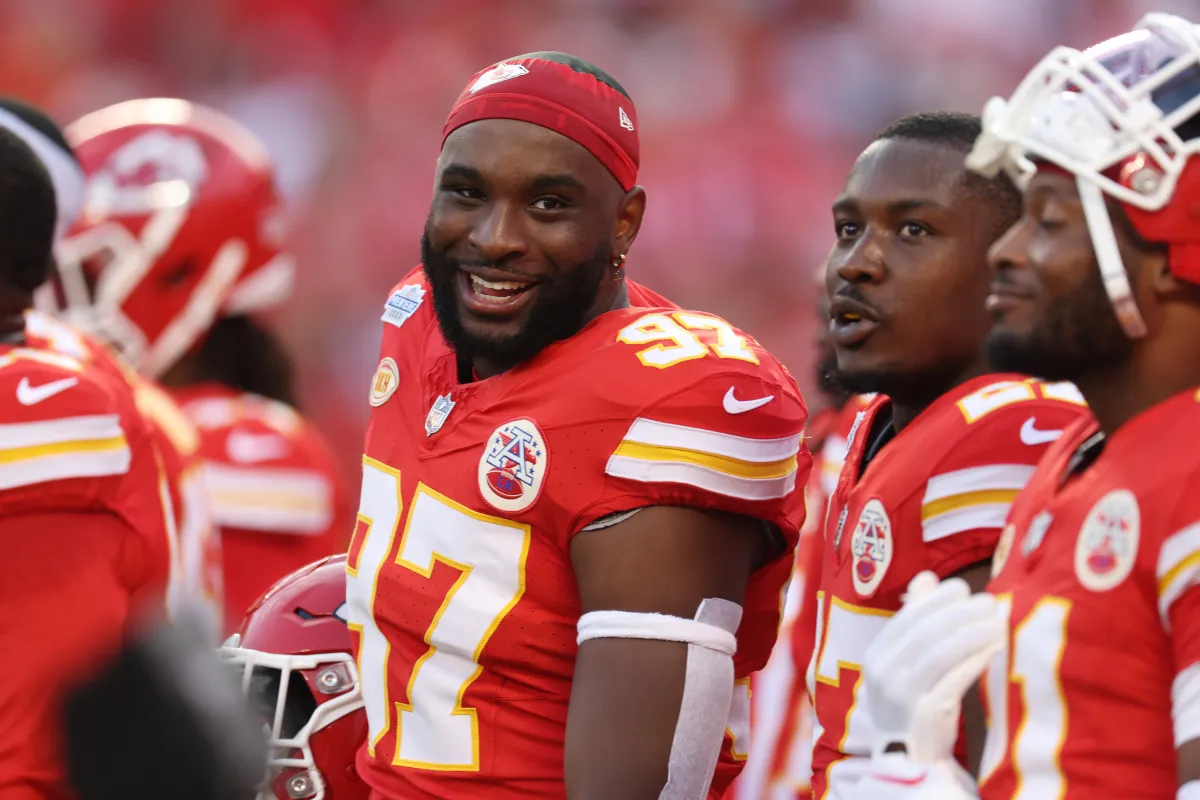
In the theater of professional sports, however, one player’s misfortune or departure is inevitably another’s golden opportunity, and this summer, that spotlight has fallen squarely on the shoulders of Felix Anudike-Uzomah. The former 2023 first-round draft pick has suddenly found himself thrust into the pressure-cooker environment of the first-team defense, a promotion accelerated by a camp injury to defensive lineman Ashton Gillotte. Instead of shrinking under the intense glare of coaches and media, Anudike-Uzomah has embraced the moment with a quiet, fierce determination that has quickly become the talk of training camp. Every snap has become a personal crusade for the young edge rusher, who spent the entirety of the previous season trapped in the agonizing limbo of the injured reserve list. The psychological toll of being a highly touted rookie forced to watch your teammates chase glory from the sidelines while battling a devastating, stubborn hamstring injury is a lonely experience that can break even the strongest athletes. Now, finally free from the medical tent, Anudike-Uzomah is playing with the desperate, explosive hunger of a man who knows exactly what it feels like to have the game he loves stolen away from him.
This transformation has not gone unnoticed by the veteran eyes of head coach Andy Reid, who offered glowing, highly specific praise for the young defensive end following a particularly grueling afternoon practice session. Reid, a master evaluator of human talent, pointed directly to the physical evolution in Anudike-Uzomah’s game, highlighting his exceptional explosive “get-off” at the snap of the ball as his most lethal asset. Yet, as Reid wisely noted, speed alone is a parlor trick in the NFL; true greatness at the defensive end position requires the raw, unadulterated power to physically dismantle an offensive tackle and disrupt the geometry of a play. Anudike-Uzomah has clearly spent his rehabilitation hours in the weight room, learning how to channel his natural athleticism into a violent, devastating bull-rush that can collapse pockets from the edge. When questioned by reporters about his sudden resurgence, the young athlete spoke with a mature humility that mirrored his head coach’s sentiments, expressing a profound gratitude just to be sweating on a football field again. “I feel good, so I’m rolling,” he said with a genuine, weary smile, acknowledging that while adversity is an inevitable part of the human condition, the only thing that truly defines a person is how they choose to stand back up and respond to the challenge.
To understand the immense weight of expectation currently resting on Anudike-Uzomah’s shoulders, one must look back to his glorious collegiate career at Kansas State, where he reigned as one of the most dominant defensive forces in college football. As a local hero, he captured the hearts of fans across the region, earning back-to-back Big 12 Defensive Lineman of the Year awards and cementing his legacy as a consensus first-team All-American. His senior year was a spectacular display of defensive mastery, culminating in him being named the Big 12 Defensive Player of the Year—a resumes that made him an absolute dream target for the Chiefs, who gleefully selected him with the 31st overall pick to keep him in his home state of Kansas. However, the transition to the professional ranks proved to be a harsh, unforgiving reality check, as his first two seasons in the league yielded a meager statistical output of just 41 combined tackles and three sacks over 34 games. The gap between collegiate dominance and professional reality can feel like an ocean, and when the hamstring injury completely derailed what was supposed to be his breakout sophomore season, the whispers of him being a “draft bust” began to grow dangerously loud in the sports talk radio circuits.
Now, entering what is undeniably a pivotal, make-or-break contract year, the stakes could not possibly be higher for the 6-foot-4, 255-pound edge defender. With the defensive roster stripped of its veteran depth, the Chiefs do not just want Anudike-Uzomah to succeed; they desperately need him to become the dominant, disruptive force they envisioned when they turned in his draft card three years ago. The pressure of a contract year can paralyze some athletes, filling their minds with financial anxiety and fear of failure, but for Felix, it represents the ultimate opportunity for redemption and self-discovery. His journey is a deeply human story of resilience, illustrating the thin line between professional heartbreak and athletic triumph that defines the lives of modern gladiators. As the regular season approaches, the eyes of the entire franchise will be watching to see if this young man can convert his summer promise into autumn production, proving to the world—and perhaps more importantly, to himself—that he belongs among the elite in the National Football League.