


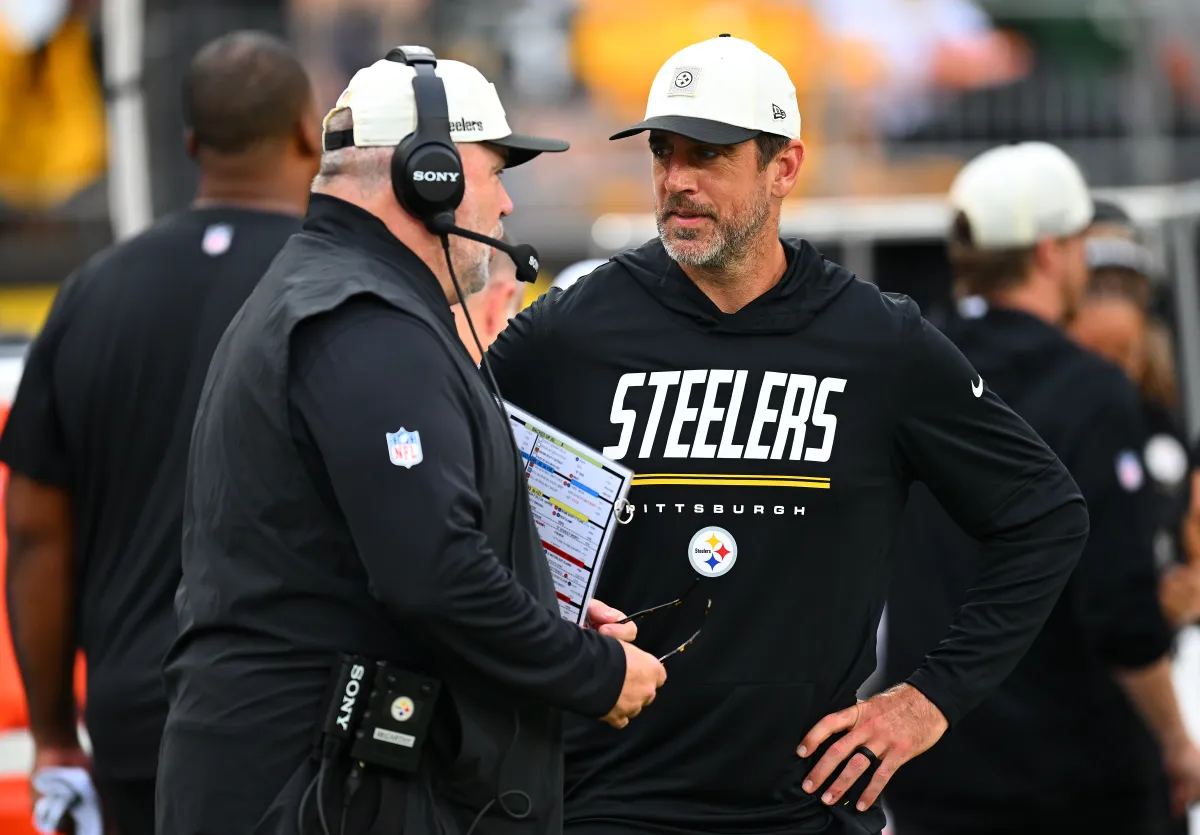
The simmering tension between Pittsburgh Steelers quarterback Aaron Rodgers and head coach Mike McCarthy has been an open secret for weeks, but after the team’s embarrassing 20-3 loss to the New England Patriots in Week 2, it spilled into the public consciousness with unmistakable clarity. Rodgers, a perfectionist known for his preternatural football IQ, did not hide his frustration during the postgame press conference. Instead of offering the typical platitudes about execution and self-improvement, he delivered a carefully aimed dart at his head coach. While Rodgers stopped short of calling out McCarthy by name, the message was unmistakable: the play-calling was not adequate, the flow of the game was broken, and the offense was being handicapped by decisions made before the snap. He suggested that the responsibility was shared but immediately pivoted to a request for better communication between the quarterback’s room and the coaching staff. In essence, Rodgers was publicly asking McCarthy to tell him what the plan was, and more importantly, to trust the quarterback’s understanding of what actually works on the field. It was a moment that stripped away the usual diplomacy of sports media and revealed the fault line running through the team’s most important relationship.
That Week 2 loss was not an isolated incident but rather the culmination of a building frustration that had been growing behind closed doors for months. Rodgers is a player who demands absolute clarity and structure at the line of scrimmage, but he also craves the freedom to improvise, the autonomy to change plays at a moment’s notice, and the kind of symbiotic partnership that turns a quarterback-coach pairing into a seamless extension of one another’s thoughts. McCarthy, on the other hand, is a meticulous play-caller who prefers to establish the rhythm of the offense from the sideline, sending in the call and expecting the quarterback to execute it with precision. This philosophical mismatch is not a new development; it has been a quiet undercurrent in the franchise for years. But under the bright lights of a short NFL season, when every mistake is magnified and every failed drive feels like a referendum on the team’s identity, that friction turns from a slow burn into an open flame. The defeat to the Patriots was humiliating in its lopsidedness, and for a hot-tempered competitor like Rodgers, swallowing that loss without pushing back would have meant accepting a version of the offense that he fundamentally does not believe in.
The frustration was on full display again during Week 4’s Thursday Night Football showdown against the division rival Cleveland Browns, a game that did more than just test the team’s resolve on the field—it exposed the fractured reality of the relationship between the franchise’s two most powerful offensive minds. With the game still in its early stages, the Amazon Prime Video cameras caught a scene that felt almost unscripted in its raw awkwardness. Rodgers, standing outside the huddle, raised his arms in a gesture of utter confusion while waiting for the play call to come in from the sideline. The silence from the coaching staff was deafening. As the seconds ticked away and the play clock wound down, the pressure cooker finally burst. Rodgers, visibly seething, unleashed a profanity-laced outburst directed at his head coach, shouting words that were impossible to lip-read but devastatingly easy to interpret: “What the f***? Call it.” It was a moment that transcended Xs and Os—a desperate, public plea for leadership, decisiveness, and the kind of clarity that a team needs in the heat of battle. The broadcast, to its credit, did not shy away from the moment. The cameras lingered on Rodgers’s face, then swung over to McCarthy, who reacted with a strange, unsettling grin while mouthing what appeared to be another expletive. It was the kind of exchange that teammates usually keep behind closed locker room doors, and its visibility made the dysfunction impossible to ignore.
Al Michaels, the legendary play-by-play commentator, was quick to contextualize the moment for viewers, noting that this was not a one-off incident. He pointed out that Rodgers had experienced the same issues the previous week, during Pittsburgh’s narrow 30-27 victory over the Cincinnati Bengals. On multiple occasions, Rodgers had to look toward the sideline with an almost childlike impatience, waiting for McCarthy’s signal, tapping his helmet, foot-stamping in frustration, trying to galvanize an offense that was falling out of rhythm. The problem, as Michaels observed, was becoming a pattern. It was no longer the occasional hiccup or a single miscommunication. It was a systemic failure—a breakdown in the very machinery that should have been the team’s greatest strength. When a quarterback of Rodgers’s caliber has to beg for the play call, the entire rhythm of the offense is compromised. The defense knows the offense is in disarray. The offensive line becomes restless. The receivers lose their timing. And the quarterback, the most important player on the field, is forced to be the one to pull the team together while simultaneously fighting his own sideline. It is an impossible situation, and the emotional toll was written all over Rodgers’s face as he stalked the turf, his helmet gleaming under the lights, his body language broadcasting every ounce of his disappointment.
Beyond the immediate tactical damage, this public dysfunction has profound implications for the Steelers’ locker room and their overall identity as a football team. A franchise like Pittsburgh has always built its reputation on stability, toughness, and a no-nonsense culture. Yet here was the starting quarterback, openly questioning the competence of the coaching staff, and the head coach, responding not with a calming gesture or a corrective action but with a smirk that betrayed equal parts contempt and amusement. This exchange shredded the carefully maintained illusion of unity. Players notice everything; when they see their leader at war with their head coach, they start to lose faith in both. The offense becomes hesitant, second-guessing whether the call is truly the one they should be running. The defense, meanwhile, is left to carry a unit that cannot sustain drives, which inevitably tires out the players on the wrong side of the ball. Morale is a fragile thing in professional sports, and moments like this—where the dysfunction is caught on camera and replayed on every network—have a way of seeping into every corner of the facility. Whether the team likes it or not, they now face a weekly narrative carnival, where every camera angle and every sideline interaction will be scrutinized for signs of further decay.
In the end, the clash between Aaron Rodgers and Mike McCarthy is not just a conflict between two strong-willed men; it is a collision of two philosophies about how football should be played and commanded. Rodgers represents the modern, quarterback-driven era—where the signal-caller is the extension of the coaching staff on the field, capable of processing information at blistering speed and adjusting in real time. McCarthy represents the traditionalist school, where the coach is the supreme authority, and the system is designed to function regardless of who is under center. Both approaches can work in isolation, but together, they create friction, redundancy, and ultimately, paralysis. The saddest part is that both men clearly want the same thing: to win. No one works harder than Rodgers in the film room; no one obsesses over game plans more than McCarthy. But somewhere in the translation of that shared ambition, trust was lost. The inevitable question now hangs over the season: can two proud, brilliant, and stubborn men find common ground before the division crown slips away, or will this relationship continue to erode until the offense is beyond repair? The cameras will be watching, the fans will be debating, and somewhere in the depths of the facility, the only thing louder than the noise will be the silence of a partnership that was once thought unbreakable.