




Patriots vs. Colts Preseason Showdown: A Night of Mixed Signals in Foxborough
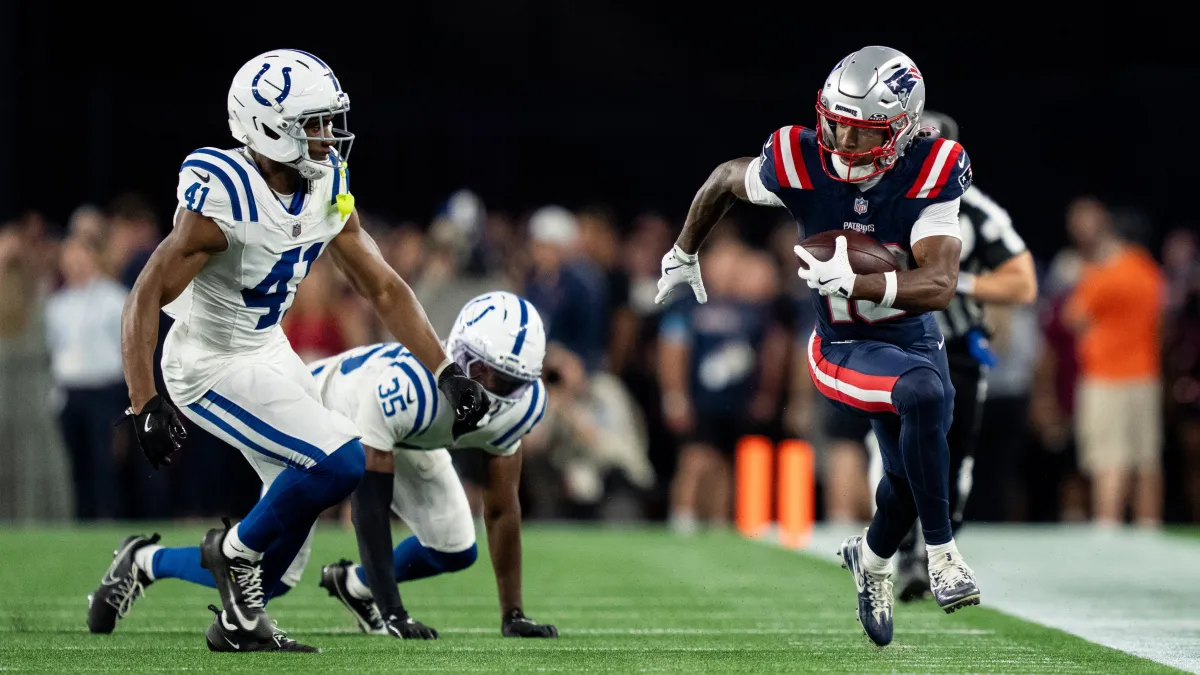
The New England Patriots and Indianapolis Colts delivered exactly what you’d expect from a mid-August preseason matchup: a 13-13 tie that left more questions than answers, with both teams clearly prioritizing player evaluation over victory. The stands at Gillette Stadium were filled with fans hoping to catch a glimpse of the future, but many of the Patriots’ most anticipated players—including quarterback Drake Maye, cornerback Christian Gonzalez, and wide receiver AJ Brown—spent the evening in street clothes, relegated to cheerleading duties from the sideline. For those hoping to see the starting units build chemistry or showcase their offseason improvements, this was not the night. However, despite the absence of marquee names, the contest offered plenty of substance for those willing to dig beneath the surface, revealing important details about the team’s depth, positional battles, and potential vulnerabilities that could shape the upcoming regular season.
The story of the evening centered largely on Tommy DeVito, who was named the starting quarterback for the night and delivered a solid performance that should give the coaching staff confidence in their backup situation. DeVito moved the offense efficiently, showing good poise in the pocket and making smart decisions with the football, even if he didn’t light up the scoreboard. Meanwhile, cornerback Kindle Vildor made a compelling case for a roster spot, snatching an interception that demonstrated his ball-hawking instincts and ability to read the quarterback’s eyes. These individual performances, while not headline-grabbing, provide the kind of depth that separates successful teams from those that falter when injuries inevitably strike. Yet the most consequential storyline of the night came from an unexpected source: kicker Andy Borregales, whose struggles from distance sent ripples of concern through the organization and drew pointed commentary from head coach Mike Vrabel that suggested patience is wearing thin.
The Kicking Conundrum: Borregales on Thin Ice
The kicking game proved to be the most dramatic subplot of the evening, with Borregales delivering a performance that can generously be described as inconsistent. The young kicker connected on attempts from 40 and 52 yards, showing legitimate range and accuracy when everything aligned properly. However, his three misses—from 56, 55, and 49 yards—told a different story, one of a player struggling to find consistency under game conditions. It would be easy to dismiss those long-range attempts as difficult kicks that any kicker might struggle with, but Vrabel wasn’t interested in excuses. He made his expectations crystal clear in his postgame comments, emphasizing that professional kickers are expected to convert these opportunities, pointing out that league-wide, kickers are routinely converting attempts from 60 yards and beyond. His reference to the two kickers on the roster served as a not-so-subtle reminder that roster spots are never guaranteed and competition is always welcome.
Complicating matters for Borregales was the injury to long snapper Julian Ashby, which forced backup Nalo Lalos into duty and could have disrupted the timing and rhythm that kickers rely on so heavily. Yet Borregales refused to lean on that as a crutch, instead accepting responsibility and committing to reviewing the film to identify what went wrong. His maturity in handling the situation is admirable, but it won’t matter if he can’t deliver when it counts. The Patriots organization has shown historically that they value reliability in their kicking game, having enjoyed excellent production from their specialists over the years. If Borregales continues to struggle with misses from medium-to-long range, the front office may have difficult decisions to make as roster cutdowns approach. The position remains firmly in flux, and Thursday’s performance did nothing to solidify Borregales’s standing beyond question.
Defensive Aggression: Bringing the Pressure
Defensive coordinator Zak Kuhr has been a fascinating study throughout his young coaching career, having been thrust into his position under less-than-ideal circumstances last season when he was asked to call plays for the very first time just three years into his tenure as a defensive assistant. The crash course in play-calling often led to an over-reliance on simulated pressure and blitz packages, a strategy that eventually proved costly in the Super Bowl when opponents adjusted and exploited the aggressive approach. But Thursday night suggested that Kuhr is fully embracing his identity as an aggressive play-caller, and the early returns were promising. The Patriots not only dialed up pressure consistently but also ran a variety of stunts and games along the defensive line that kept the Colts’ offense off balance all evening. This relentless approach forced four turnovers from Indianapolis quarterbacks, a statistic that speaks to the effectiveness of the scheme and the execution of the players within it.
The defensive line’s ability to generate pressure without needing to send additional defenders is particularly encouraging, as it suggests the Patriots can manufacture consistent chaos while still dropping seven into coverage. This balance is crucial for sustainability over a long season, as predictable blitz-heavy schemes tend to get exposed once opponents have enough film to study tendencies. The rotational depth on the defensive line was also on full display, with multiple players contributing meaningful snaps and making plays. While it’s important not to overreact to preseason production, the scheme’s viability and the players’ comfort within it are legitimate positives. If this defensive pressure translates to the regular season, opposing quarterbacks will face a unit that provides no comfort, no rhythm, and no easy answers, a formula that could elevate the entire defense to elite status even against superior competition.
The Slant Game: Offensive Philosophy Takes Shape
Josh McDaniels’s return to the Patriots’ offensive coordinator role was always going to be one of the most compelling storylines of the season, given his history of success with the franchise and his reputation as one of the league’s sharper offensive minds. Thursday night offered an early glimpse into his offensive philosophy for this iteration of the team, and the signs point toward a heavy emphasis on quick, decisive passing concepts designed to neutralize pressure and keep the quarterback clean. The Patriots called an abundance of slant routes throughout the evening, a strategic choice that maximizes the skill set of their receiving corps, which features several larger pass-catchers capable of winning contested catches in tight windows. AJ Brown, Mack Hollins, and Kayshon Boutte—all of whom stand at least six feet tall and weigh at least 200 pounds—are ideally suited for this type of physical, timing-based passing game that rewards size and catch radius over pure speed.
With those three expected to be the primary targets during the regular season, Thursday night’s showcase fell to backup receivers like Kobe Prentice, Tejhaun Palmer, and Nick DeGennaro, who had mixed results executing the same concepts. The discrepancy in production was notable but hardly surprising, as the second and third string receivers don’t possess the same physical tools or experience as the starters. The larger point is that McDaniels appears committed to building an offense around quick reads and short-to-intermediate throws that get the ball out fast, reducing the chances of sacks and negative plays. This approach also complements the team’s ground game philosophy, keeping the offense ahead of the chains and putting the defense in predictable down-and-distance situations. The emphasis on protecting the quarterback was a clear organizational priority during the offseason, and the coaching staff is implementing that philosophy through scheme rather than simply relying on personnel changes.
The Running Back Competition: Miller Stakes His Claim
One of the clearest takeaways from Thursday’s contest was the emergence of rookie running back Jam Miller as the frontrunner for the third-string role behind Rhamondre Stevenson and TreVeyon Henderson. Miller’s performance was efficient and physical, averaging nearly four yards per carry while running decisively between the tackles and showing the vision to find cutback lanes. Perhaps most telling was his usage pattern: Miller was pulled after only a few series, a clear indication that the coaching staff already views him as a player they don’t want to risk injury to in meaningless exhibition action. This treatment, typically reserved for established veterans or players whose roster spots are essentially locked in, speaks volumes about how the organization currently views Miller’s standing on the depth chart.
In contrast, the rest of the running back group—Lan Larison, Hassan Haskins, and JaMycal Hasty—received extensive playing time well into the fourth quarter, and the results were decidedly underwhelming. Combined, they managed a paltry 1.6 yards per carry, failing to generate any consistent push against a Colts defense that was likely playing deeper reserves at that point. This performance gap creates an interesting roster dilemma for the front office. The team’s best chance of maintaining depth at the position might involve keeping one of the younger, less experienced backs on the active roster while attempting to secure the services of one of the veterans through the practice squad. However, veterans are often reluctant to accept practice squad assignments, preferring to explore free agency or opportunities with other teams. The dynamics of this competition will be fascinating to monitor as the preseason progresses, but as things stand following the first contest, Miller has clearly established himself as the player to beat for that crucial third-string role.
Depth Concerns: Protecting the Quarterback and Building Wide Receiver Depth
The Patriots’ offensive line depth emerged as a significant concern following the contest, with both Ben Brown and Andrew Rupcich—the two primary backup options on the interior—suffering injuries that forced them from the game. Vrabel’s postgame comments were cautiously optimistic, indicating that initial evaluations don’t suggest anything too serious, but he was careful not to speculate until additional tests could be performed. The Patriots are dangerously thin on the interior offensive line, with the depth chart featuring mostly rookies and former undrafted free agents without substantial NFL experience. This becomes particularly problematic when considering that the starting trio—Alijah Vera-Tucker, Jared Wilson, and Mike Onwenu—have each dealt with significant injuries in recent seasons. If any of them were to miss extended time, the team could find themselves scrambling to fill holes with players who aren’t ready for meaningful NFL snaps.
Beyond the offensive line concerns, the wide receiver position presents an interesting roster question, with the potential for New England to carry seven pass-catchers. AJ Brown, Kayshon Boutte, Romeo Doubs, and DeMario Douglas all sat out Thursday’s game, essentially guaranteeing their roster spots. Hollins appears close to a lock as well. The intrigue surrounds Kyle Williams and Efton Chism III, both of whom have made compelling cases through practice and the early preseason. Williams brings an elite speed element that no one else on the roster matches, a valuable asset that can stretch defenses and open up underneath routes. Chism showed improvement throughout last season and has continued to develop during training camp. Given the team’s relative lack of depth at running back and tight end, carrying an extra receiver makes sense from a roster construction perspective. If forced to choose, Williams’s unique speed advantage might give him the edge, but both have legitimate claims to roster spots as the competition continues to unfold.