





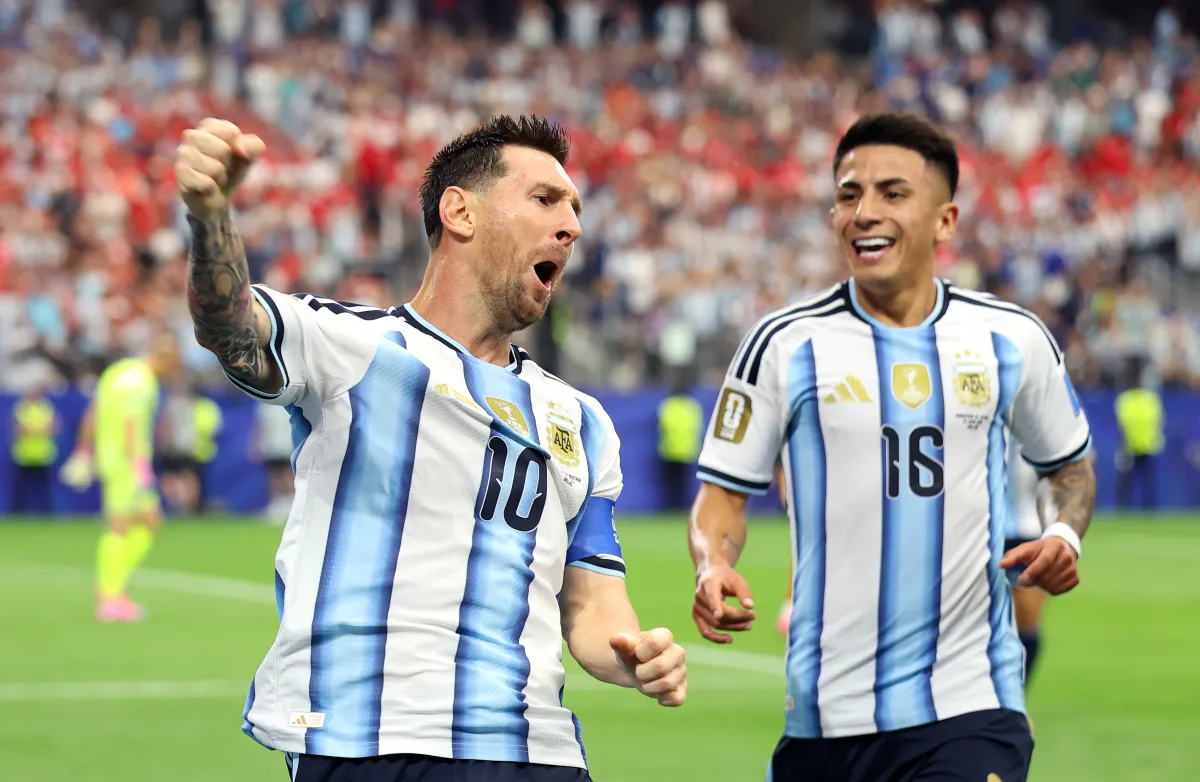
On a cool Monday evening, the soccer world stopped spinning once more to bear witness to yet another masterclass by Lionel Messi. In Argentina’s commanding 2-0 victory over Austria, the legendary mercurial forward did not just help his team secure a win; he rewrote the very history books of the sport he has dominated for nearly two decades. The match itself felt like a living canvas of his entire career, punctuated by two moments of sheer brilliance. In the 38th minute, with the pressure building, Messi broke the deadlock with a clinical finish that sent the stadium into a frenzy. Then, deep into stoppage time in the 95th minute, he put the final stamp on the game with his second goal of the night, securing his fourth career multi-goal game on the world stage. With these two goals, Messi officially surpassed German icon Miroslav Klose, elevating his career World Cup tally to 18 goals across his storied journey. To put his astonishing influence into perspective, sports analytics reveal that Messi has single-handedly scored an unbelievable 11% of all the goals Argentina has ever produced in the history of the tournament, cementing him as the heart and soul of his football-crazy nation.
What makes this chapter of Messi’s journey so compelling is the sheer longevity required to achieve it. He stands as one of only two players to have ever graced the pitch in six separate World Cups, a rare club he shares with his eternal rival, Portugal’s Cristiano Ronaldo. Yet, while their decade-long rivalry has defined modern sports, Messi’s efficiency on the grandest stage has set him apart in this twilight era of his career. He has now scored more than double the World Cup goals of Ronaldo, who sits at eight. Messi’s consistency across the years is almost mythic; he has managed to find the back of the net in every single World Cup tournament he has played in, save for a solitary, agonizingly scoreless campaign in South Africa back in 2010. This steady evolution from a passing prodigy to a ruthless, veteran finisher illustrates not just physical peak but a profound mental resilience that has allowed him to adapt as his body ages and the game changes around him.
Beyond the goals, the sheer weight of Messi’s presence on the field is reflected in the numbers of survival and triumph. The victory over Austria marked his 18th career World Cup match win, a towering milestone that no other player in the history of the sport has ever reached. Monday’s appearance also marked his 28th cap, extending his record for the most tournament appearances since its inception in 1930. According to Guinness World Records, Messi has now clocked an astonishing 2,489 minutes on the World Cup pitch. If you close your eyes, you can almost feel the physical toll of those minutes: the bruised Ankles, the exhausting extra-time periods under humid skies, the heavy burden of carrying the hopes of forty-five million Argentines on his shoulders for more than 40 hours of high-stakes, pressure-cooker football. It is an endurance test that would have broken lesser athletes, but Messi has somehow turned this grueling marathon into his personal theater of joy.
Yet, despite his lethal scoring ability, Messi has always been a creator at his core, a player who finds as much joy in the assist as he does in the goal. This altruistic genius is highlighted by the fact that he is now tied with the late, great Diego Maradona for the most assists in World Cup history with eight. Entering the match against Austria, Messi had already created a record-shattering 74 goal scoring chances for his teammates over 26 games, underlining his vision and spatial awareness. He also joined the legendary Cameroonian striker Roger Milla as the only two players aged 38 or older to score four or more goals in a single FIFA World Cup tournament. As Messi prepares to celebrate his 39th birthday on June 24, he continues to defy the biological clock, proving that while his explosive pace may have softened, his footballing intellect remains sharper and more devastating than ever.
Messi’s greatness, however, is not a story of flawless perfection, and that is perhaps what makes him so deeply human and beloved. Amidst his history-making night, he equaled a record held by legends Just Fontaine (1958) and Jairzinho (1970) by scoring in six successive tournament appearances. Yet, the same match saw him make a bit of frustrating, unwanted history. When he stepped up to the penalty spot and missed, he became the first player in World Cup history to miss three penalty kicks during his career. It was a stark reminder of his mortality, a brief crack in the armor of a sporting god. But even in failure, there is a testament to his courage and status: he has taken seven penalty kicks in his World Cup career, the most of any player in history. It shows a leader who never shies away from the ultimate responsibility, willingly putting himself in the crosshairs of criticism over and over again.
Looking at the grand tapestry of his career, it is almost terrifying to imagine what the sporting world would look like had Messi stuck to his emotional decision to retire from international football back in 2016. That brief retirement, born out of the heartbreak of consecutive final losses, could have been the final chapter. Instead, his return sparked a golden era of redemption, leading Argentina to a Copa América victory and their first World Cup trophy since 1986 under the desert skies of Qatar. It is a cinematic narrative of perseverance that may never be replicated in our lifetime. As the celebrations from the Austria win begin to fade, the focus shifts to the road ahead. The legendary number 10 and his Argentine brothers are already preparing for their next test, a highly anticipated matchup with Jordan on June 27 under the bright lights of Dallas, Texas, where fans will once again gather to watch the greatest of all time write another page of his endless legacy.