





While the eyes of the international community remain transfixed on high-profile geopolitical battlegrounds stretching from Eastern Europe to the Middle East, a human catastrophe of staggering, unprecedented proportions is quietly consuming Sudan. Behind the clinical statistics of the conflict lies an agonizing reality: more than 14 million human beings—mothers, children, fathers, and elders—have been violently uprooted from their homes, forced to flee with nothing but the clothes on their backs. According to the International Rescue Committee, nearly 34 million people, representing an astonishing ten percent of the entire world’s global humanitarian needs, are now in desperate survival mode. What began as a localized power struggle has evolved into a devastating regional war that threatens to destabilize the entire Horn of Africa, drawing in neighboring states and various Middle Eastern powers. Yet, as Alan Boswell of the International Crisis Group points out, world leaders continue to relegate this crisis to the margins of foreign policy, delegating the catastrophe to subordinates while the human toll mounts exponentially day by day.
To understand the sheer magnitude of this betrayal, one must look at the shattered hopes of the Sudanese people, who only years ago marched in the streets demanding democracy and a brighter future. The current civil war, which ignited in April 2023, is the tragic consequence of a fractured alliance between two powerful military figures: General Abdel Fattah al-Burhan, leader of the Sudanese Armed Forces (SAF), and General Mohamed Hamdan Dagalo, widely known as “Hemedti,” who commands the paramilitary Rapid Support Forces (RSF). Once uneasy partners, these two men aligned in 2019 to depose Sudan’s long-standing dictator, Omar al-Bashir, who had ruled the nation with an iron fist since 1989. However, instead of honoring the democratic aspirations of the civilian population, the two generals executed another joint coup in 2021, toppling the fragile interim civilian government. This cynical grab for absolute power eventually turned inward, exploding into a direct, cannibalistic military confrontation that has transformed Sudan’s cities and villages into active killing zones, leaving the civilian population to pay the ultimate price for the generals’ unchecked ambitions.
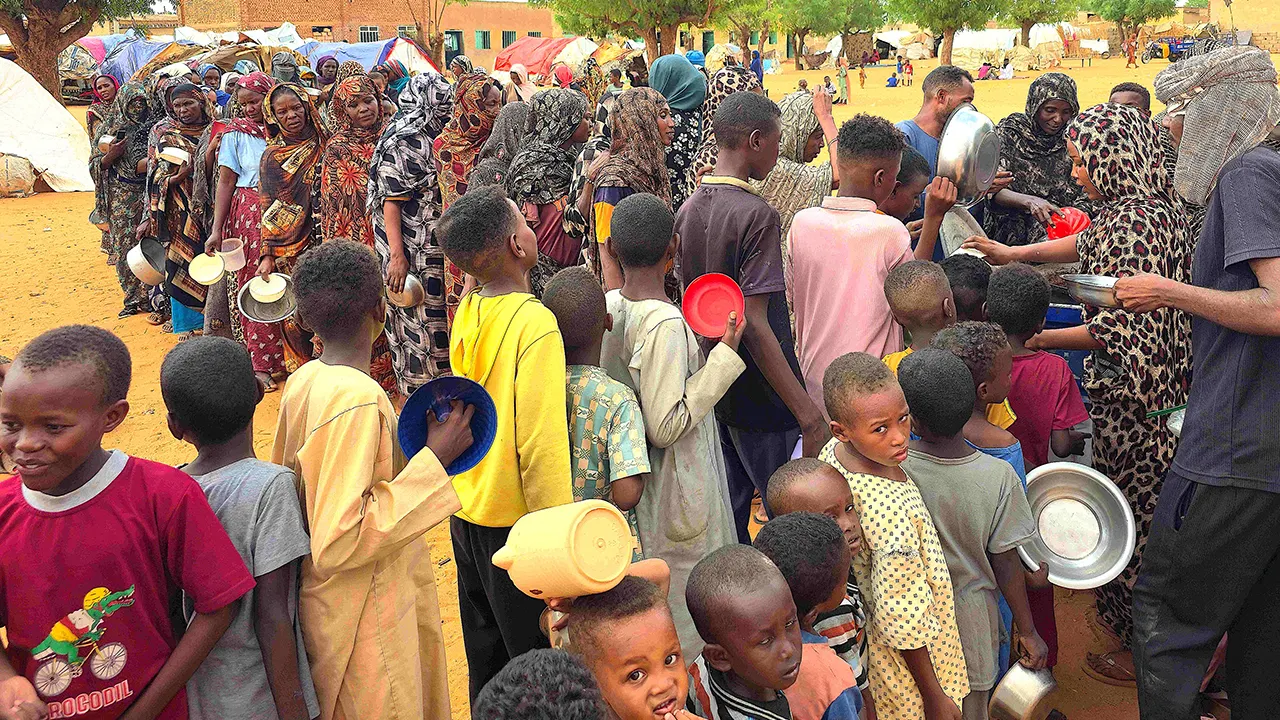
The physical and psychological suffering of those caught in the crossfire is perhaps most painfully visible in cities like El-Obeid, located in North Kordofan state. Here, more than 100,000 displaced people are crammed into makeshift camps, facing a slow and painful death by starvation. The United Nations reports that a staggering 19.5 million people across the nation are experiencing acute, life-threatening hunger, while 4.5 million have been forced to flee the country entirely as refugees. Humanitarians on the ground are working under highly volatile and dangerous conditions; Abdallah Alwardat of the World Food Programme has emphasized the desperate, urgent need to scale up operations far beyond current capabilities to stave off mass starvation. For these displaced families, daily survival is a grueling test of endurance, characterized by the constant search for clean water, basic medical supplies, and even a single meal to feed crying children, all while the sound of heavy artillery echoes in the distance.
The brutality of this war has reached horrifying dimensions in the Darfur region, particularly in the besieged city of El Fasher, where the RSF took control and unleashed a campaign of terror that claimed the lives of more than 6,000 people in the initial siege alone. Reports from the United Nations High Commissioner for Human Rights paint a chilling picture of systematic, weaponized sexual violence utilized against women and young girls, some as young as 12 years old. Survivors have recounted nightmare scenarios of mass gang rapes, abductions, physical beatings, and women being bound and driven away to unknown fates. International human rights organizations have concluded that the RSF is perpetrating ethnically targeted attacks that meet the legal definitions of genocide, deliberately inflicting conditions designed to eradicate entire communities. These acts of violence are not merely collateral damage of war; they are calculated, systematic efforts to terrorize and dominate the civilian population through the destruction of their physical safety and human dignity.
The atrocities, however, are not confined to a single faction, as the Sudanese Armed Forces are also accused of committing severe war crimes. A United Nations report detailed how the SAF has targeted civilian populations, executed suspected enemy sympathizers, and destroyed critical public infrastructure. The level of warfare has disintegrated to such an extent that the United States recently imposed new sanctions on the SAF following credible allegations that they utilized chemical weapons, a direct violation of the Chemical Weapons Convention, though the Sudanese government vehemently denies the claims. Despite the gravity of these accusations, the primary diplomatic focus of major world powers remains localized elsewhere. The Trump administration, actively engaged in trying to broker peace in Ukraine, mediate the war in Gaza, and preserve a precarious ceasefire with Iran, has left Sudan’s nightmare largely unaddressed, allowing the generals to run amok with impunity while the international response remains sluggish and fragmented.
Ultimately, Sudan represents a profound moral test for the modern world—one that humanity is currently failing. For over three years, humanitarian agencies like the International Rescue Committee, led by figures like Richard Data, have issued urgent alarms that have gone virtually unanswered by the global community. The silence surrounding Sudan is not just a diplomatic failure; it is a tragedy of empathy, proving that some lives are deemed more worthy of global attention and intervention than others. As millions of children face starvation and millions of women suffer unspeakable violence, the ongoing neglect of this crisis threatens to leave an indelible stain on the collective conscience of humanity. Addressing this disaster requires more than just economic sanctions or occasional statements of concern; it demands high-level diplomatic engagement, a unified global front to halt the flow of weapons to both factions, and a massive mobilization of humanitarian aid to restore the basic human dignity that the people of Sudan so richly deserve.