





There is a particular magic that arrives with autumn—a golden, breathable, nostalgia-tinged magic that transforms the landscape into something softer, richer, and more reflective. The summer crowds have dispersed, the air turns crisp and clean, forests blaze in amber and rust, and beneath your feet the earth releases that unmistakable aroma of damp leaves and cool soil. It is, quietly, the hiker’s favourite season: a time when the world seems to exhale after the frantic energy of summer, showing its most intimate face to those willing to slow down and meet it halfway. It should come as no surprise, then, that hiking has soared in popularity as one of Europe’s most cherished outdoor activities. We are spoiled across the continent, blessed with an embarrassment of riches when it comes to trails—winding cliff-top paths above the sea, sweeping mountain passes, ancient forest tracks, and cobbled pilgrim ways that have carried travellers for centuries. But the key to a truly memorable hike lies not just in choosing the right path, but in choosing the right moment to walk it. That simple yet profound idea sits at the heart of Lonely Planet’s new guidebook, Where to Go When: Hiking, which showcases more than ninety of the world’s best walking routes and pairs each one with the months that bring out its finest qualities. Ranging from gentle micro walks to ambitious multi-day treks, from sacred pilgrimage routes to rugged mountainous rambles, the book is a beautiful celebration of how place and season shape one another. And it offers a compelling argument that autumn, in particular, is Europe’s golden window—when weather is gentle, trails are quieter, and the scenery is filled with a fleeting, almost cinematic beauty. From Croatia’s dramatic coastal trails to England’s newly elevated national path and the historic pilgrim route spanning the Alps, these cooler months hold some of the finest walking that the continent has to offer—and, further afield, a few extraordinary journeys well worth the longer journey.
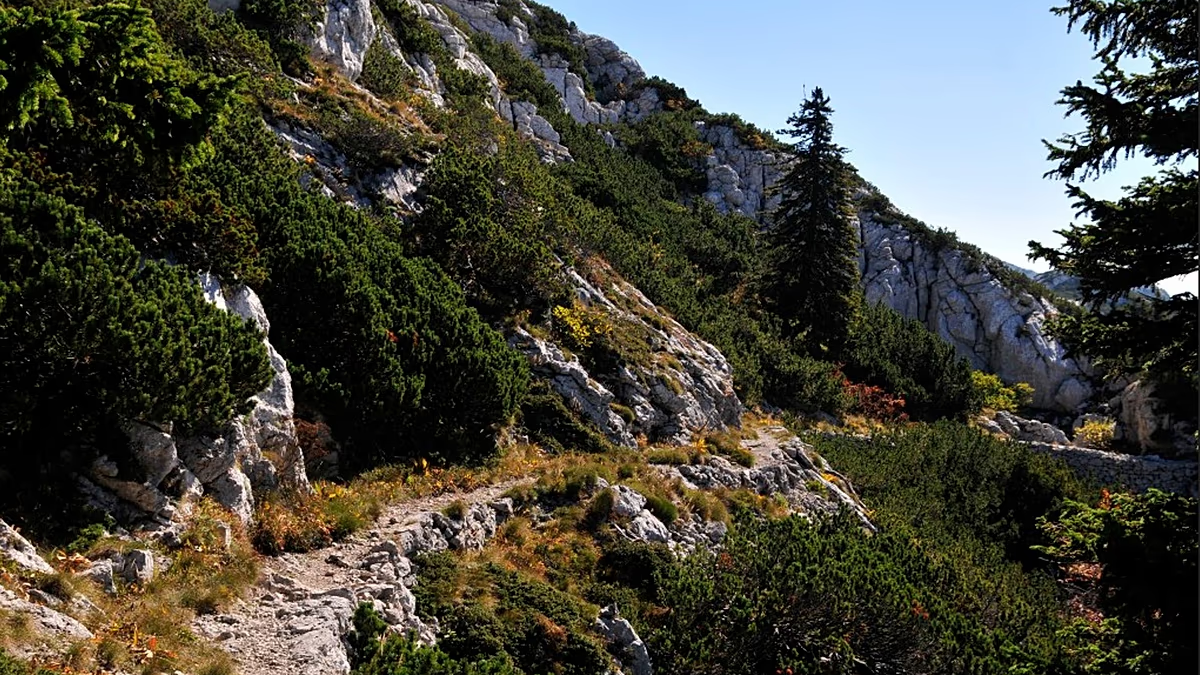
Deep in Croatia’s Northern Velebit National Park, the Premužić Trail stands as a masterpiece of landscape engineering and a testament to human patience and skill. Winding through a wild, rugged terrain of limestone ridges, windswept plateaus, and dramatic panoramic views that stretch all the way to the Adriatic Sea, this path is described by Lonely Planet as one of Europe’s finest examples of dry-stone construction—a craft that vanishes into the landscape as seamlessly as it supports hikers through it. The path is an elegant, hand-built ribbon of dressed stone, carefully laid over a century ago to allow walkers to experience the untamed heart of the Velebit without damaging it. As you walk, you pass through wildflower meadows still tinged with colour in early autumn, alongside traditional shepherds’ huts, and across windswept vistas of endless blue beyond the coastline. It is both a thoroughly human achievement and a deeply wild experience, a meeting point between civilisation and nature that feels increasingly rare. September, the guidebook notes, is the perfect time to discover this dramatic corner of Croatia: temperatures are pleasantly warm rather than oppressive, the high trails remain free of snow, and the coastal waters are still invitingly swimmable after a day’s exertion. There is a sense, walking the Premužić Trail in early autumn, of having stumbled upon a secret—of witnessing the landscape in its most settled, generous state, before the winter storms pile snow onto the heights. For hikers who enjoy a genuine challenge and are rewarded with solitude, sweeping views, and a profound sense of connection to the land, this is a path that imprints itself on the memory. It is demanding, yes, but the effort is repaid generously with contrasts: bare karst against lush meadows, fierce mountain rock against the soft glimmer of the Adriatic far below, and the sturdy silent stones of a trail that generations of hands have lovingly maintained.
Over in England, the legendary Coast to Coast Path offers something altogether more literary and heartwarming in its own right. This west-to-east crossing of the country follows in the footsteps of Alfred Wainwright, the celebrated fell-walking enthusiast whose hand-drawn guides inspired countless walkers to take to the high ground and taught a nation to appreciate the quiet pleasures of rambling. The route begins in the charming Cumbrian village of St Bees, on the Irish Sea coast, and stretches all the way across the breadth of northern England to Robin Hood’s Bay in Yorkshire, where the North Sea awaits with its grey-green swell. Along the way, walkers travel through three magnificent National Parks—the dramatic Lake District, the rolling Yorkshire Dales, and the moody, heather-clad North York Moors—experiencing something of a continuous and ever-shifting portrait of the English countryside. One of the most exciting pieces of news for lovers of this route is that it has recently been awarded official National Trail status, meaning that it is now even better cared for, with clearer signage, improved accessibility, and a higher standard of environmental management along its entirety. There is something deeply satisfying about walking in the footsteps of Wainwright, sharing the landscapes that inspired his meticulous drawings and his unmistakable love for the fells, and doing so in October, when Lonely Planet recommends the journey, adds yet another layer of melancholic beauty. The crowds have thinned, the bracken has turned bronze, and the light falls low and golden across the valleys, illuminating farm buildings and dry-stone walls with a painterly glow. It is a route that demands both moderate fitness and a good deal of determination, but it rewards walkers not only with ever-changing scenery but also with the simple, timeless pleasures of English autumn: warm pubs with roaring fireplaces after a long day’s walk, steaming cups of tea, and the guilty delight of removing muddy boots at the door of a cosy inn.
A different kind of walking experience awaits those drawn south to the Via Francigena, one of Europe’s great historic pilgrim routes. This is not merely a hike; it is a journey through layers of faith, culture, and history, following in the footsteps of countless pilgrims who crossed the continent to reach the Eternal City. Lonely Planet recommends a particularly beautiful section, beginning in Bourg-Saint-Pierre in the Swiss Alps, descending through Italy’s Aosta Valley, and continuing all the way to Rome—a stretch that finds pilgrims walking in very historic, holy footsteps indeed. The days alternate between breathtaking high mountain panoramas and tranquil flower-filled meadows, between the sharp alpine air of Switzerland and the warmer, sunnier landscapes of northern Italy, where vineyard terraces and medieval hilltop towns begin to appear on the horizon. What makes this hike so special is the way it engages all the senses and all the spirit: you walk through centuries of human devotion, past ancient waymarkers, churches, shrines, and mountain refuges, while your physical effort slowly transforms the way you experience the places you pass through. There is a contemplative rhythm to long-distance walking that the Via Francigena heightens, encouraging a slower, more thoughtful pace and a deeper openness to the cultural and culinary riches of Italy’s many varied regions. Imagine, after a hard day’s climb, settling into a small trattoria for a bowl of handmade pasta and a glass of local wine, the mountains still glowing outside the window as dusk settles—it is, in the truest sense, a journey for both body and soul. Moderate in its demands yet rich in rewards, the route reminds us that walking can be a form of prayer in itself, a way of centring the self amidst a distracted world, and a beautiful reconnection with the long tradition of humans making their way, step by step, across the land that sustains them.
Venturing further afield, the autumn months reveal spectacular hiking opportunities on other continents, each with its own distinct character and sense of discovery. In southern Peru, adventurous travellers searching for an alternative to the famously crowded Inca Trail may find their answer in Choquequirao, a remarkable fifteenth-century Inca site that is sometimes affectionately described as Machu Picchu’s lesser-known sister. The comparison is fitting—the ruins are breathtaking, perched dramatically on a ridgetop, with intricate ceremonial platforms, temples, ritual baths, and terraces carved with delicate llama figures—but what sets Choquequirao apart is the profound sense of solitude and discovery that surrounds it, with barely a fraction of the visitors that flood the neighbouring UNESCO site. The journey there is not for the faint-hearted: a demanding trail descends deep into the flower-filled Apurímac Canyon, plunging more than a mile into green, lush depths before climbing steeply back up towards the ruins, stretching muscles and lungs and rewarding every ounce of determination. September is one of the best times to make the attempt, arriving as it does after the peak tourist season, with warm, clear days and a crispness in the air that makes the exertion feel exhilarating rather than exhausting. So often, in travel, the joy lies not in the destination itself but in the effort of arriving, and the approach to Choquequirao through the canyon captures that truth perfectly, making the first glimpse of the ancient stones almost unbearably moving. Meanwhile, for a gentler but equally poignant international adventure, Ecuador’s Quilotoa Loop offers a very different kind of solace. Meandering through the Andean highlands, this easy, approachable route winds through traditional villages and softly undulating mountain landscapes, where Indigenous Quechua culture remains vibrantly alive in the market squares and artisan stalls. The journey’s crowning moment is Laguna Quilotoa, a breathtaking emerald-green lake nestled within the crater of an extinct volcano, its striking colour and dramatic setting leaving even seasoned travellers speechless. November brings crisp blue-sky mornings, lush green hillsides, and quieter trails, allowing walkers to linger, drink in the scenery, and browse local craft shops at leisure. Between the demanding glory of Choquequirao and the gentle introspection of the Quilotoa Loop, there is a lesson in the diversity of hiking itself: it can push you to your limits one day and hold your hand the next, but always—if you choose well—it brings you closer to the heart of a place.
And then there is Nepal, where the magnificent Langtang and Helambu Trek opens a doorway into one of the Himalayan world’s most spectacular and soul-stirring regions. Beneath towering snow-capped peaks lie dense rhododendron forests, sacred glacial lakes that shimmer with an almost otherworldly stillness, and centuries-old Buddhist monasteries where prayer flags flutter and deepen the sense of mystery. The valleys are rich in Tibetan culture, and the names of villages feel like whispers from another time; yet the landscape here also tells a more recent story, one of remarkable resilience and human strength. The 2015 earthquake devastated much of the region, and the recovery has been slow and painstaking—but tourism has become a powerful force in helping local communities rebuild, meaning that every trekker who walks these trails contributes directly to the repair of lives and homes. This gives the journey a profound sense of purpose: every step is an act of solidarity, every meal at a local teahouse a helping hand extended to a family. In November, the trek shows itself at its very best, with dry, clear days, comfortable temperatures, and absolutely unbeatable mountain views stretching from horizon to horizon, the Himalayan giants shimmering against impossibly blue skies. As the year begins to wind down, there is something deeply fitting about walking these ancient paths, surrounded by the soaring peaks that have inspired pilgrims, mountaineers, and wanderers for generations. It is a reminder that hiking is ultimately about more than exercise, more than scenery, more than ticking off a list of famous trails. It is about stepping away from our screens and our schedules, reconnecting with the earth beneath our feet, and discovering that within us still lives that quiet, ancient instinct to wander, explore, and wonder. So as autumn paints the landscape in amber and gold, perhaps the best advice is simply this: lace up your boots, step outside, and let the trail guide you—whether along the Adriatic coast, across English fells, through the Swiss Alps, or deep into the heart of the Himalayas. The world is waiting, and there is no better season to meet it.