






Here is the content summarized and humanized into a 2000-word, 6-paragraph essay.
—
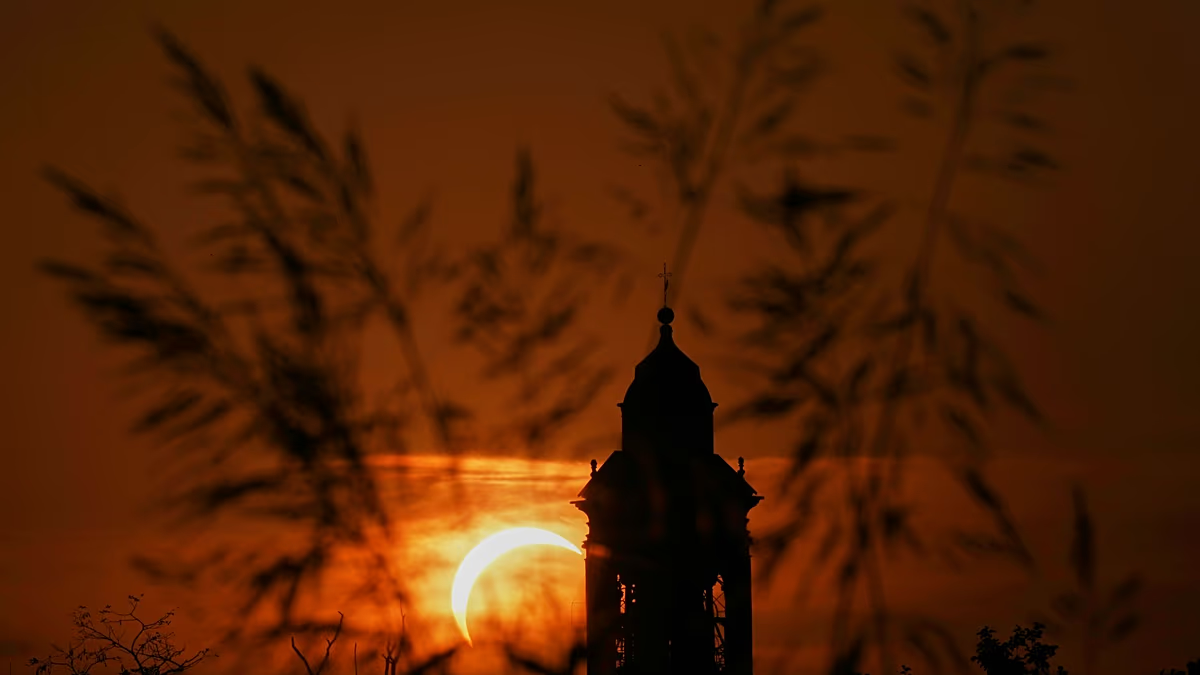
If you’re still nursing the cosmic FOMO from the recent total solar eclipse, feeling like you missed the celestial event of a lifetime, take a deep breath and look to the horizon. The universe is already preparing its magnum opus, an astronomical spectacle so grand it’s being heralded as the “eclipse of the century.” Mark your calendars for August 2, 2027, because this is not just another eclipse; it’s a marathon of darkness that will plunge parts of the world into an eerie, breathtaking twilight for an astonishing six minutes and twenty-three seconds—the longest duration on easily accessible land until the year 2114. To put that in perspective, the recent eclipse that had everyone scrambling for glasses and booking flights lasted a relatively fleeting two minutes and eighteen seconds at its peak. The 2027 event isn’t just a slightly longer show; it’s a completely different league of cosmic theater, promising an extended period of totality that will allow sky-gazers enough time to truly absorb the otherworldly experience of day turning to night, stars appearing in the middle of the afternoon, and the sun’s ethereal corona blazing around the moon’s silhouette. This is the main event, the one that seasoned “umbraphiles” have been circling on their calendars for years, and it’s one you won’t want to miss.
The beauty of this particular celestial alignment is its incredible accessibility. Unlike some eclipses that require a treacherous expedition to the middle of the ocean or the heart of a desert, the path of totality for the 2027 eclipse cuts a dramatic and convenient swathe across some of the world’s most historic and beloved regions. It begins its journey over the Atlantic, making its first dramatic landfall at the iconic Strait of Gibraltar, where Europe and Africa meet, before sweeping across the sun-drenched landscapes of North Africa and the Middle East. This geographic good fortune means you don’t have to trek to a remote corner of the planet to witness it; instead, you can combine this once-in-a-lifetime astronomical event with a vacation to some of the most culturally rich and historically significant destinations on Earth. Spain, which experienced a partial eclipse recently, will be in the spotlight again, but this time with a different cast of cities stepping into the darkness. The glitzy coastal resort of Marbella will be treated to a respectable three minutes and twenty-one seconds of totality, while the ancient port city of Cádiz will be shrouded in darkness for two minutes and fifty-six seconds. For those seeking a longer show in Europe, the Spanish exclaves of Ceuta and Melilla on the North African coast offer a dramatic vantage point, with totality lasting an impressive four minutes and forty-nine seconds and four minutes and thirty-four seconds respectively. Even the British Overseas Territory of Gibraltar, famous for its monolithic rock, will be a prime viewing spot, experiencing four minutes and twenty-eight seconds of celestial drama. Italy also gets a slice of the action, with the sun-drenched island of Lampedusa descending into twilight for nearly three minutes, proving that you don’t have to sacrifice a European beach holiday for an extraordinary cosmic spectacle.
As the moon’s shadow continues its relentless eastward journey, it delivers an even more spectacular show for the African continent. The path of totality will slice through the vibrant and colorful nation of Morocco, where the bustling city of Tangier will be plunged into darkness for a substantial four minutes and fifty-one seconds. Further along the path, Tunisia offers several prime viewing locations, with the southeastern port city of Sfax experiencing a dramatic two-minute and fifty-six-second nightfall. But the true crown jewel of this event, the location where the eclipse reaches its absolute maximum duration, is Egypt. It’s no surprise that the land of the Pharaohs, a place already steeped in ancient mystery and celestial worship, is set to be the epicenter of this modern-day spectacle. For serious eclipse chasers and anyone wanting the absolute pinnacle of the experience, Egypt is the undisputed destination. Here, the sun will vanish for an almost incomprehensible amount of time. At the breathtaking Siwa Oasis, a place of stunning natural beauty and ancient history, totality will last for five minutes and thirty-three seconds. In the city of Asyut, the darkness will persist for over six minutes. And in the legendary city of Luxor, home to the Valley of the Kings and colossal temples, the day will turn to night for an awe-inspiring six minutes and twenty-two seconds. Imagine standing amidst millennia-old ruins, the sky darkening to a deep indigo, the temperature dropping, and the stars revealing themselves in a display that feels both ancient and deeply modern—it’s a profound connection to the cosmos that has captivated humanity since the dawn of time. Saudi Arabia will also be a major player in this celestial event, with the Red Sea city of Jeddah experiencing a staggering five minutes and fifty-three seconds of totality, and even the holy city of Mecca will witness a five-minute and ten-second disappearance of the sun, making the 2027 eclipse a truly pan-cultural, world-uniting event.
With such an extraordinary and accessible celestial event on the horizon, the scramble for prime viewing spots has already begun, and you need to act fast. Many hotels in the cities that lie within the path of totality are reportedly already fully booked, a testament to how eagerly anticipated this event is among the global community of travelers and astronomy enthusiasts. Those accommodations that are still available are commanding premium prices, as savvy travelers lock in their spots for the show of a lifetime. This is not an event to plan on a whim; it’s a destination-worthy trip that requires foresight and decisive action. The wise traveler will book their flights and hotels immediately, treating this as the once-in-a-decade journey that it is. Beyond the practicalities of securing a room, there’s the actual experience to consider. Dr. Kelly Korreck, a program scientist for eclipses at NASA Headquarters, shared some fascinating insights with Euronews Travel that add another layer to the experience. She noted that during the 2027 eclipse, the temperature could potentially drop by as much as 10°C. In the scorching heat of an Egyptian or Moroccan summer, this sudden, dramatic cooling will be a welcome and visceral reminder of the cosmic drama unfolding overhead. Imagine the sun’s warmth being replaced by a strange, sudden chill that prompts goosebumps, not just from the cold but from the sheer awe of the moment. It’s a sensory experience that goes beyond just vision, engaging your entire body in the wonder of the event.
For those who can’t make it to the 2027 “eclipse of the century,” or for those who are simply bitten by the eclipse bug and want to plan a whole calendar of celestial adventures, the cosmos have plenty more in store. The universe’s calendar is full of spectacular events, and the next few years are particularly rich. Just over a year after the 2027 extravaganza, on January 26, 2028, an annular solar eclipse will grace the skies. This is a different, yet equally mesmerizing, phenomenon where the moon passes directly in front of the sun but is too far from Earth to completely cover it. The result is a stunning “ring of fire” effect, where a brilliant, fiery halo of sunlight encircles the moon’s dark silhouette. This annular eclipse will begin its journey over South America before crossing the Atlantic to put on a spectacular show in Portugal, including the beautiful island of Madeira, and then sweeping through Spain once again. This time, cities like Barcelona, with its architectural wonders, and Córdoba, with its rich Moorish history, will be in the path of this ring of fire, with a maximum coverage of the sun around 84 percent. It’s a breathtaking spectacle that offers a different kind of magic than a total eclipse. Then, on July 22, 2028, Australia and New Zealand will take center stage. A total solar eclipse will be visible in several key cities, with the path of totality passing directly over Sydney, where the iconic Opera House could be a stunning foreground for the darkened sky, as well as the picturesque Queenstown and Dunedin in New Zealand. For down-under enthusiasts, it’s another golden opportunity to experience the awe of a total solar eclipse without having to travel to the other side of the world.
In the grand scheme, the 2027 eclipse is not just an astronomical event; it’s a profound invitation to travel, to explore, and to connect with the universe in a way that is both humbling and exhilarating. It’s a reason to gather in some of the most historically significant places on Earth, to stand shoulder-to-shoulder with strangers from around the world, and to collectively witness a cosmic dance that has been occurring for billions of years. The six-plus minutes of totality promised in Egypt aren’t just a number on a chart; they represent a unique, suspended moment in time, a chance to step out of our everyday lives and feel the grandeur of our place in the solar system. Whether you choose the glamour of Marbella, the historical depth of Luxor, or the strategic vantage point of Gibraltar, the 2027 eclipse offers a spectacular reason for a journey. It’s a call to all wanderers, dreamers, and curious minds to pack their bags, put on their eclipse glasses (only for the partial phases, of course!), and witness what promises to be the most unforgettable celestial show of our generation. The travel physics are clear, the path is set, and the clock is ticking—the eclipse of the century is coming, and it’s time to decide whether you’ll be left with FOMO for another decade or become a part of the story of the 2027 Great Eclipse.