



The crown of “World’s Best Airline” is not a permanent throne—it is a precarious perch. Singapore Airlines currently holds that coveted title, yet the competitive pressure is palpable, with heavyweights like Qatar Airways and Cathay Pacific nipping at its heels. To remain a titan atop the aviation Olympus, resting on past glory is not merely risky; it is a fatal mistake. Recognizing this, the Singaporean flag carrier has recently unveiled a colossal S$2 billion (€1.4 billion) investment dedicated to transforming its long-haul first, business, premium economy, and economy class cabins. This is not a superficial facelift involving fresh upholstery or minor tweaks; it is a total reinvention of the physical environment where weary travelers spend countless hours at high altitude. The fruits of this ambitious project will be revealed starting in the second half of 2027, first appearing on retrofitted Airbus A350-900 long-haul and ultra-long-range aircraft, as well as the eagerly anticipated new Boeing 777-9s when they join the fleet. This timeline allows for meticulous engineering, exhaustive testing, and absolute perfection—a luxury that ordinary product launches can never afford. In the world of premium air travel, where every millimeter of legroom and every inch of seat width is fiercely contested, this strategic allocation of capital signals a resolute commitment to setting the standard that rivals will be forced to chase, rather than merely keeping pace with the pack.
However, what sets this project apart from other ambitious airline makeovers is its obsessive focus on human insight rather than pure engineering bravado. This is not a case of designers sketching futuristic concepts in ivory towers, disconnected from the realities of spending seventeen hours above the Pacific Ocean. Instead, Singapore Airlines engaged in an extraordinarily inclusive research process, inviting more than 5,000 individuals—frequent flyers who know the annoying view of a hotel ceiling far too intimately, frontline cabin crew who witness the subtle sagas of passenger frustration and fatigue, and technical experts who understand the structural nuances of aircraft interiors—into their design laboratories. Through an exhaustive cycle of focus groups, surveys, and concept testing, they ensured that every new feature did not exist in a vacuum but actively harmonized with the real-world travel experience. The fundamental philosophy driving this massive endeavor is one of passenger agency and freedom. As Lee Lik Hsin, the airline’s Chief Commercial Officer, poetically articulated, while each cabin has been designed individually, they are united by a singular ambition: to make the experience more comfortable, flexible, and rewarding for their customers. This translates into a tangible promise that travelers will have far greater control over their in-flight journey, whether they are locking in for a focused work session, enjoying a leisurely gourmet dinner with a companion, sinking into deep relaxation, or simply surrendering to a well-deserved rest.
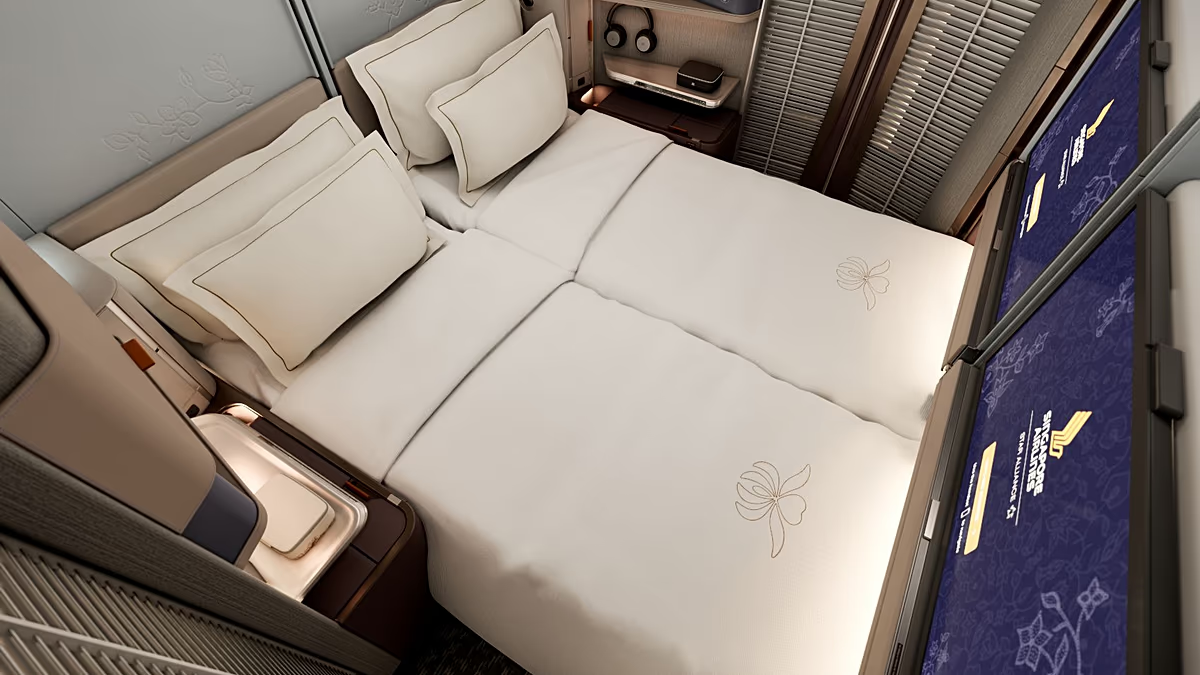
Ascending to the pinnacle of air travel, the reimagined First Class cabin is redefining the very concept of private aeronautic space. For travelers sharing the journey with a partner or loved one, the two center seats now possess a magical dual-purpose capability. During the daylight hours, they effortlessly transform into an expansive two-seater sofa, creating an intimate lounge-like environment perfect for sharing a bottle of vintage champagne, engaging in meaningful conversation, or simply enjoying the panoramic views of the clouds passing by below. However, when the cabin lights dim and the world outside turns an inky black, a subtle transformation occurs. These paired seats morph into what the airline confidently proclaims as the largest double bed in commercial aviation history, measuring a staggering 203 centimeters in length and 152 centimeters in width. This is not two cramped single beds awkwardly pushed together; it is a genuinely shared sleeping surface that invites true intimacy—a rare commodity in the skies where privacy often comes at the cost of companionship. But the true genius of this design lies in the micro-details that address the real frustrations of luxury travel. Passengers gain access to dedicated storage spaces that go far beyond a simple closet: a personal wardrobe for hanging suits and dresses without wrinkles, a vanity drawer for maintaining skincare rituals at 30,000 feet, and a cabin baggage compartment neatly tucked underneath the ottoman, eliminating the awkward fumbling through overhead bins. The dining table is a masterstroke, vast enough to accommodate a proper restaurant-style meal for two or to function as a sophisticated workspace with spreadsheets and documents laid out neatly.
For the vast majority of premium travelers, Business Class is the true battleground where loyalty is won or lost, and Singapore Airlines has deployed its most intelligent tactical maneuvers here. The introduction of sliding doors marks a pivotal shift in perceived privacy, offering not merely physical separation from the aisle but a profound psychological sanctuary—a private cocoon where the ambient noise of the aircraft becomes a distant murmur. The seat pitch is generously stretched to 127 centimeters, providing legroom that accommodates even the longest-limbed travelers. When it is time to sleep, the leather and tufted fabric fold into a completely full-flat bed, measuring 200 centimeters in length and up to 61 centimeters in width—dimensions that finally allow side-sleeping without contorted positioning. In a first for the airline’s Business Class, passengers will receive complimentary pajamas, a perk that was previously reserved exclusively for First Class clientele. This is a profound psychological gesture—an acknowledgment that the airline recognizes your need for true rest and is providing the literal uniform of sleep. The sensory experience has been meticulously curated with the introduction of BYREDO amenities, transforming even the simple act of washing hands into an aromatic ritual. This focus on small, tactile pleasures—the feel of soft cotton against tired skin, the subtle spritz of a luxury fragrance—humanizes the sterile metal cylinder that is an airplane fuselage, turning it into a sanctuary of personal restoration.
Yet, the airline has not forgotten that true excellence extends far beyond the front of the aircraft. The Premium Economy cabin, often the smartest purchase choice for savvy travelers, has been redesigned with a thoughtful 101cm seat pitch, eliminating the dreaded sensation of knees pressing into the seat back. The four-way adjustable headrest is an unassuming hero, as any seasoned flyer will attest to the eternal battle against the crick in the neck that comes from falling asleep at awkward angles. This headrest cradles the head with “wings” that prevent it from lolling forward, while the addition of a leg rest with a fully adjustable footrest elevates the experience to quasi-cot levels of comfort. Even the Economy cabin—traditionally the afterthought in such luxury-focused redesigns—has received respectful attention. Passengers will enjoy a seat pitch ranging between 78 and 81 centimeters, alongside that crucial four-way adjustable headrest. Across every cabin, a digital evolution is underway: universal USB-C charging ports are now standard, while select aircraft and classes will feature USB-A ports, universal AC power, and even wireless charging. This recognizes the modern traveler’s reality of carrying multifold devices. The most anticipated technological leap, however, is the Bluetooth connectivity integration, allowing passengers to wirelessly pair their personal AirPods or Bose headphones directly to the KrisWorld in-flight entertainment system, freeing them from the tyranny of substandard wired earphones. Of course, the gastronomic front cannot be ignored, and the airline has curated over 100 refreshed appetisers, main courses, and desserts, designed specifically to combat the taste-numbing effects of high cabin pressure.
Looking ahead, waiting until 2027 may feel like a lifetime, but in the slow dance of aviation dry-dock reconfigurations, it is merely the blink of an eye. The retrofitting of the long-haul Airbus A350-900s and the introduction of the Boeing 777-9s will bring this ambitious vision seamlessly to life. When these aircraft finally take to the skies, they will not simply ferry passengers from point A to point B; they will carry with them the weight of immense expectations. The intense focus on charging capabilities, Bluetooth pairing, and the fluid transformation of cabin space speaks to a modern traveler who juggles multiple identities throughout a single journey—corporate executive, parent, tourist, and dreamer. This S$2 billion investment is far more than just hardware procurement; it is the maintenance of a sacred, unspoken emotional contract between airline and passenger. The passenger entrusts Singapore Airlines with their most precious commodities: their time, their comfort, and their physical well-being over long distances. In return, the airline promises to make that time evaporate, to suspend reality in a calm, luxurious bubble. The competitors watch with apprehension, eager to shadow these strides, but this holistic commitment to refinement—from the oversized double bed for couples in First Class to the ergonomic headrest for the budget-conscious traveler in Economy—cements the carrier’s legacy as the gold standard for decades to come. The wait is considerable, but for a journey designed with this much thoughtfulness, the boarding call will be worth every patient moment.