






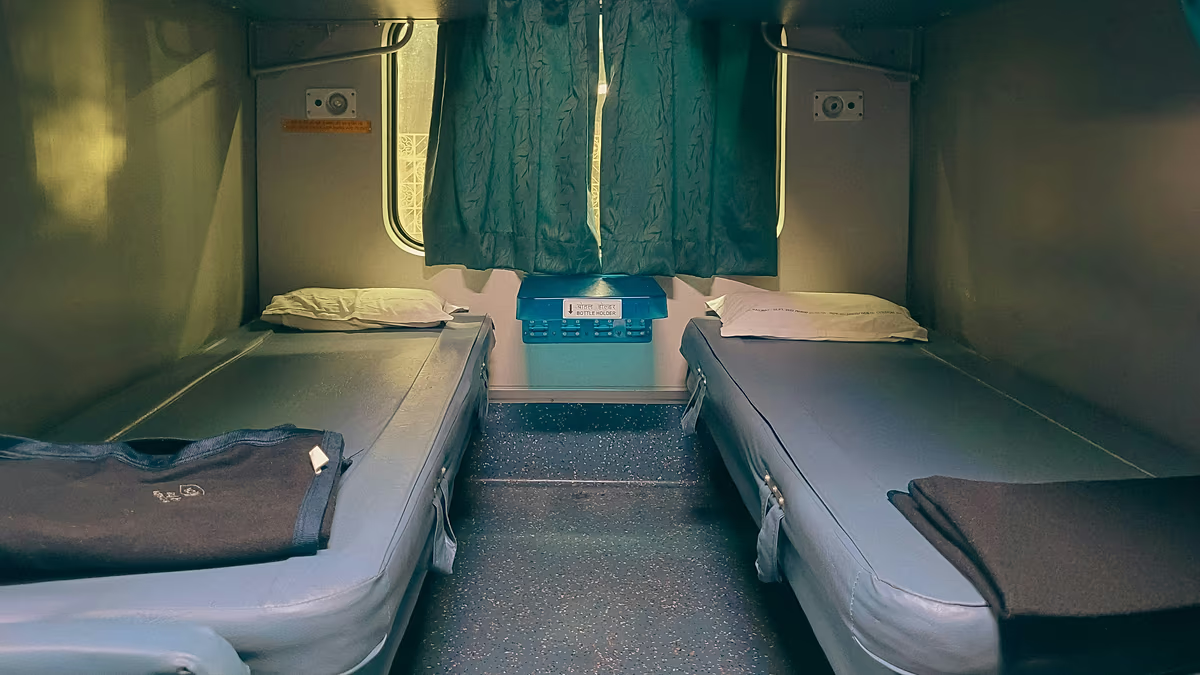
The romantic allure of train travel is experiencing a profound renaissance across Europe, capturing the hearts of modern travelers who are increasingly weary of the friction-filled reality of aviation. There was a time when the rhythmic, hypnotic click-clack of steel wheels on iron rails was considered a relic of a bygone era, replaced by the sterile efficiency of high-altitude jet travel. Today, however, that perspective has fundamentally shifted. A landmark 2025 survey commissioned by rail manufacturer Hitachi Rail, which gathered perspectives from 11,000 people across the globe, revealed that almost half of the respondents intend to travel more by train and less by plane over the next five years. This statistic is more than a mere data point; it is a testament to a growing cultural migration toward slow travel, where the transit itself is reclaimed as a meaningful part of the vacation rather than a stressful, carbon-intensive hurdle to be quickly endured. Travelers are increasingly prioritizing their mental well-being and seeking out the spaciousness, quiet comfort, and contemplative atmosphere of the passenger carriage, where they can watch the diverse topography of the European landscape unfold outside their windows in real-time.
Yet, despite this groundswell of enthusiasm, a frustrating disconnect persists between the desires of conscious travelers and the structural realities of modern rail infrastructure. The very same Hitachi Rail survey highlighted a painful, systemic bottleneck: seven out of ten respondents globally stated that they would gladly utilize public transport much more frequently if only it were better integrated and connected. Currently, the actual availability, pricing, and infrastructure of European rail are struggling to keep pace with the public’s soaring demand. This friction is particularly glaring when looking at night trains, which represent the ultimate fusion of sustainable transport and practical accommodation, yet face an uphill battle against systemic neglect. Despite the widely recognized global climate emergency, cheap and heavily subsidized short-haul flights continue to expand their frequencies across European skies. At the exact same time, vital overnight sleeper services are being quietly rolled back or suspended, a baffling contradiction highlighted by Back-on-Track.eu, a dedicated pan-European network of advocates and experts striving to promote and expand cross-border night trains.
To shine a bright, analytical spotlight on the current state of European sleeper services and to provide an invaluable resource for frustrated travelers trying to navigate this fragmented landscape, Back-on-Track.eu has released its comprehensive 2026 interactive night train map. This meticulously curated map displays every regular night train connection operating across the European continent in a single, beautifully integrated, transport-network style visualization. Beyond serving as a striking visual summary of Europe’s nocturnal rail options, the group’s website hosts a robust, open-access database complete with granular route directories, booking advice, and travel tips designed to demystify the booking process. The organization released this update at an incredibly vital juncture, emphasizing that night trains represent an elegant, ready-to-use solution for linking European cities as passengers look for viable alternatives in the face of ongoing fuel volatility, rising living costs, and a deeply felt desire to dramatically shrink their individual carbon footprints without sacrificing their freedom of movement.
Comparing the new 2026 map to previous editions reveals a complex, bittersweet picture of progress and loss across the continent. On one hand, the map celebrates some highly anticipated victories for sustainable travel, showcasing five brand-new connections that represent step-by-step triumphs of cross-border cooperation. Among these are European Sleeper’s highly praised route connecting the cultural hubs of Paris and Berlin, new Polish State Railways (PKP) services weaving links from Poland through to Prague and Munich, and an ambitious, scheduled overnight run connecting Brussels with Milan. On the other hand, the map also documents the quiet erasure of ten previously beloved lines. Most notably, several popular ÖBB Nightjet routes have vanished from the schedule, alongside the devastating cancellation of the legendary 1,456-kilometer Stockholm-to-Narvik link. This historic sub-Arctic route previously allowed travelers to sleep in comfort while crossing deep into the remote wilderness of northern Sweden and Norway. Furthermore, other overnight services have been frustratingly truncated; for instance, a popular route that formerly ran all the way from Bratislava to the sun-soaked Croatian coast of Split now begins far further west in Vienna, leaving travelers in parts of Central and Eastern Europe increasingly isolated.
To understand why these vital overnight services are struggling to survive despite record-high passenger demand, one must look deep into the structural and financial crises plaguing the rail sector. Juri Maier, the chair of Back-on-Track and the lead designer behind the interactive map, points out that the single greatest hurdle facing overnight rail travel is a severe, chronic lack of investment in modern “rolling stock”—the actual sleeping carriages and specialized locomotives needed to run these overnight services safely and comfortably. While the public’s eagerness to ride these rails has effectively weakened the competitive advantage once held by budget airlines, railway operators simply do not have enough physical train carriages to meet the demand. Maier emphasizes that viable, modern design concepts exist to seamlessly carry up to 750 sleeping passengers on a single train, a scale that would instantly make these sleeper runs highly profitable for operators. However, unlocking this green future requires immediate, large-scale financial commitments from European governments to build new fleets of carriages, rather than the small, piecemeal investments currently on offer. This issue is compounded by unavoidable, wide-scale track maintenance works across the continent which frequently disrupt schedules, though experts hope that by 2032, major infrastructural milestones will finally make far more stable, high-capacity cross-border connections a reality.
Despite these immense operational hurdles—such as the complex Alpine routing required to successfully run the new Brussels-to-Milan line through Switzerland—the release of the 2026 Night Train Map represents an empowering call to action. Coordinated by spatial data scientist Giovanni Antoniazzi, the group’s Open Night Train Database offers a glimmer of hope, proving that grassroots data-sharing can help travelers reclaim control over their journeys. The beautifully rendered map is freely accessible online at back-on-track.eu/night-train-map, where enthusiasts can even order a physical, high-quality printed poster to hang on their walls at home. Having this network visualized on a bedroom wall transforms the map from a simple travel guide into a daily source of dreaming, a vivid blueprint of a more connected, slow-paced, and ecologically responsible Europe. Ultimately, supporting overnight rail is about far more than just getting from point A to point B; it is an active choice to invest in a lifestyle that respects our planet, showing that the journey itself can be just as magical as the destination.