



1.
Let’s be honest: these days, the conversation around living longer can feel a little intimidating. Between expensive peptide injections, red-light therapy masks, and endless supplement stacks, the quest for longevity sometimes looks more like a billionaire’s hobby than something the rest of us can realistically embrace. But if you step away from the wellness industry and look at the places where people actually live to a ripe old age, a very different picture emerges. In the so-called “Blue Zones”—regions with unusually high numbers of centenarians—the secret isn’t a fancy gadget or a costly anti-aging protocol. It’s much simpler. It’s about walking everywhere, eating fresh and uncomplicated food, taking time to enjoy life, and knowing your neighbours. Europe is home to two officially designated Blue Zones: the Greek island of Ikaria and the Italian island of Sardinia. But according to a new ranking by CV Villas, a villa holiday company, plenty of other European destinations quietly live by the same principles. They may not have the official Blue Zone label, but they offer the same unhurried rhythm, strong community spirit, and daily movement that scientists believe keep people healthy and happy for longer. The ranking set out to identify the best European destinations where you can actually experience a longevity lifestyle—without needing a single supplement, serum, or session in a hyperbaric chamber.
2.
The ranking was built around the “Power 9” lifestyle principles identified by Dan Buettner in his famous Blue Zone research. These are the common habits shared by the world’s longest-lived communities, from eating largely plant-based foods to staying active naturally and prioritising family and social connection. CV Villas looked at almost 100 European destinations and scored them against several of these principles, creating a “longevity score” out of 100. The criteria were deliberately practical. Walkability was measured by elevation range—because a place with gentle hills and pleasant streets encourages you to move without thinking about it. Pace of life was assessed through average annual working hours, which gives a sense of whether the local culture values rest and leisure as much as productivity. The food scene was judged by the number of vegan-friendly restaurants and wineries per capita, capturing both healthy eating and the social, moderate wine-drinking culture that features in Blue Zone communities. And community itself was measured by the number of cafés and churches per capita, because those are the places where people naturally gather, chat, and build the kind of social bonds that protect against loneliness and stress. As Hannah Marshall, marketing manager at CV Villas, put it: “From their walkability to their good food, sense of community and general downshift from the pace of life so many of us are used to, these destinations offer everything that a good, restful holiday should be.” She added that while Europe has only two officially designated Blue Zones, years of destination expertise show many other places share a similar way of life.
3.
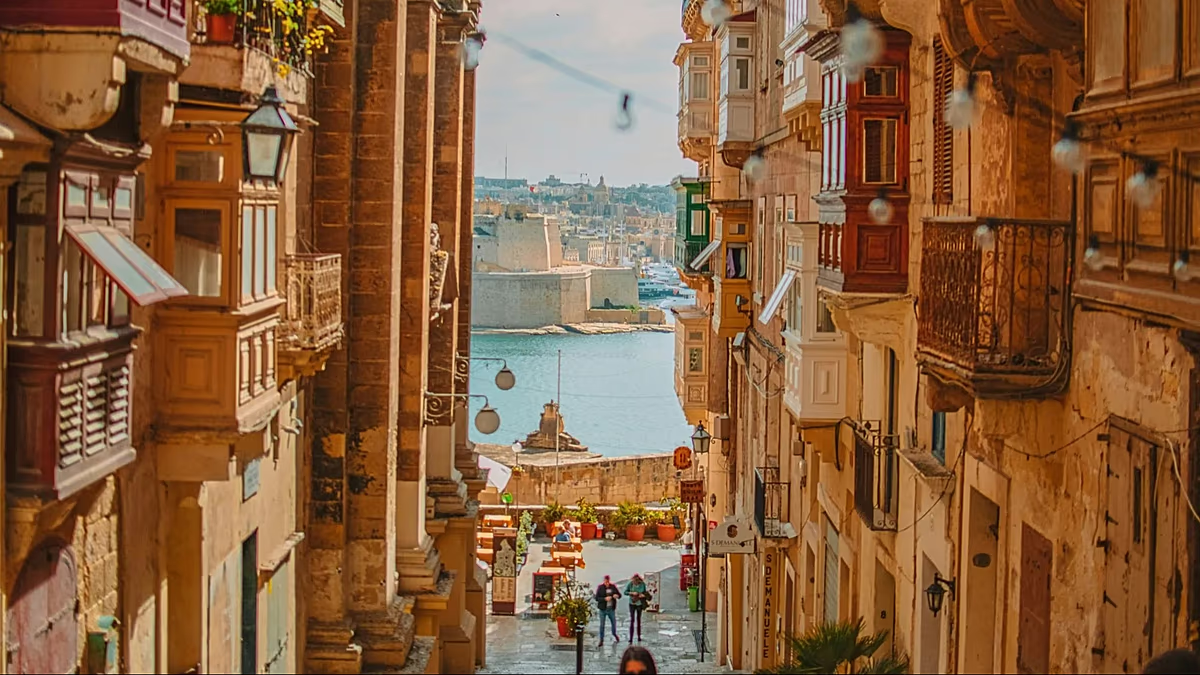
So, which European spots came out on top? The number one destination is Valletta, the compact and gorgeous capital of Malta. It may be small, but it packs an enormous amount of everyday charm. Valletta scored highest thanks to its walkability—its narrow, historic streets and dramatic elevation make wandering an adventure in itself—and its sociable dining culture, with plenty of spaces where people gather over long, leisurely meals. The ranking described it as offering “exactly the kind of everyday movement and balanced rhythm that supports a longevity lifestyle.” Coming in second is Paxos, a tiny Greek island in the Ionian Sea. Paxos was praised for its close-knit, unhurried community life and for being wonderfully walkable, with untouched nature all around. It’s the kind of place where you can genuinely slow down, switch off, and feel part of the local rhythm rather than just a tourist passing through. Third place goes to St. Tropez in France—though the glamorous resort town might seem more about luxury yachts than long life, its walkable seafront and relaxed Mediterranean lifestyle clearly help. And in fourth place is a slightly unexpected contender: Eger, a historic town in Hungary. Eger is not only walkable, but it has a moderate, sociable wine-drinking culture. Locals gather over dinner to share the region’s famous “Bull’s Blood” red wine blend, a tradition that is believed to contribute to a long life—not because of any magic in the wine, but because it is shared with good food, good company, and a sense of ritual.
4.
The rest of the top 20 is a wonderfully diverse mix of coastal hideaways, mountain towns, and Mediterranean islands. Fifth place goes to Mdina, Malta’s ancient walled city, while sixth is Ibiza—not just for its nightlife, but for its quieter villages and slow, sun-soaked days. Seventh is Taormina in Sicily, with its dramatic hillside streets and stunning views. Eighth is Lefkada, another Greek island, followed by Budva in Montenegro and Dingle on Ireland’s rugged Atlantic coast. Then comes Nesebar in Bulgaria, Bad Ischl in Austria, Piran in Slovenia, Ålesund in Norway, and two more Maltese spots—St. Julian’s and Gozo. The list also includes Ksamil in Albania, Levoča in Slovakia, Bordeaux in France, and Novi Sad in Serbia. What’s striking about this top 20 is how many of these places are not obvious wellness retreats or spa destinations. They are simply real towns and islands where daily life is carried out on foot, where meals are unhurried, where wine is drunk in moderation and with company, and where people still know their neighbours. Even Ålesund, a Norwegian town known for its rainy climate and Art Nouveau architecture, made the cut—proof that longevity isn’t only about sunshine and Mediterranean diets. It’s about a way of living that prioritises connection, calm, and natural movement, no matter the latitude.
5.
If you look closely at the destinations on this list, a clear pattern emerges. Walkability is not about gyms or fitness trackers; it’s about living in a place where walking is the default. In Valletta, Paxos, or Piran, you don’t have to force yourself to exercise—you simply walk to the bakery, to the market, to meet a friend, and up and down beautiful old streets. The pace of life is slower, with shorter working hours and longer breaks, so there is room for a coffee at a café, a glass of wine in the evening, or a long dinner that stretches into conversation. Community is everywhere—cafés and churches, town squares and seaside promenades, all of which give people natural excuses to come together. And food is treated with respect: simple, fresh, often plant-based, and always shared. None of this requires expensive technology or complicated routines. It’s all about environment and habit. This is exactly the message of the Blue Zone research: environments shape behaviour. Put people in a place where they accidentally walk, eat well, relax, and socialise, and they tend to live longer and better. So if you’re looking to experience a longevity lifestyle for yourself, you don’t need to move to a Blue Zone or buy the latest biohacking equipment. You can simply book a holiday to one of these destinations and absorb the habits while you’re there. Walk everywhere. Sit at a café for no particular reason. Eat local food. Share a bottle of wine with friends. Sleep well. Let your body move naturally. Let your mind slow down. That’s the real secret, and it’s available to all of us.
6.
There’s something deeply reassuring about this ranking. It reminds us that the good life doesn’t have to be complicated or expensive. The places that produce the most centenarians are not the ones with the most advanced medical technology or the most famous wellness gurus. They are the ones that have kept the old ways alive: walking, eating together, taking a midday rest, respecting the seasons, and leaning on a strong web of family and friends. CV Villas’ list of the best European destinations for longevity is a lovely invitation to step out of our over-scheduled, screen-filled lives and into somewhere slower and saner. Whether it’s the sun-baked stone streets of Valletta, the olive groves of Paxos, the vineyard terraces of Eger, or the windswept shores of Dingle, each destination offers a chance to recalibrate. You can come home from a week or two in any of these places feeling not just rested, but somehow lighter, more connected, and more aligned with the habits that matter. And maybe that’s the whole point. Longevity isn’t a 30-step morning routine. It isn’t something you can inject, buy, or optimise. It’s a way of living that has been around for thousands of years, and it’s still waiting for us in the world’s most beautiful and unpretentious corners. So pack your walking shoes, leave your supplements at home, and head to one of these places. Your future self—and your present self—will thank you.