


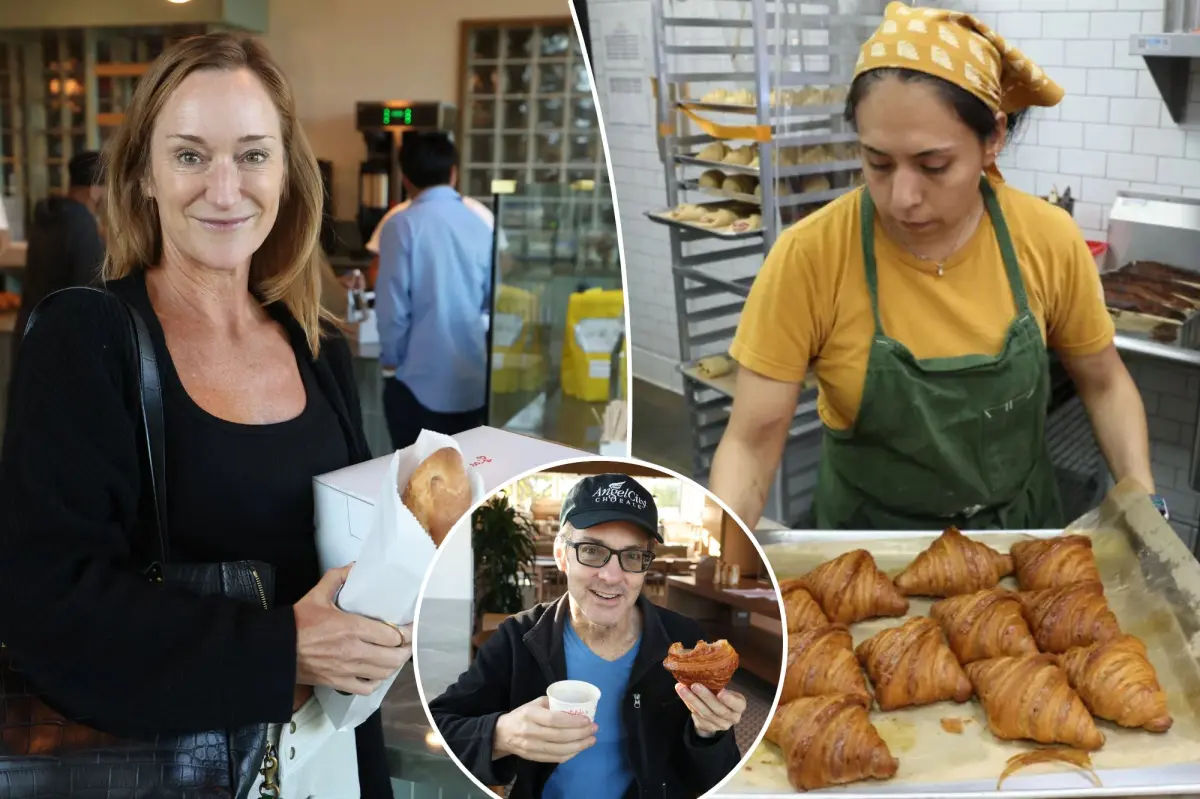
On a cool Santa Monica morning, before the city has fully rubbed the sleep from its eyes, a different kind of ritual is unfolding. Outside a small bakery near the Santa Monica Airport, a line of people is already forming, some of them having arrived before sunrise, all of them hoping to get their hands on a single, perfect croissant. The bakery is called Matilda, and in just a few weeks since it opened, it has become the center of a full-blown pastry panic. It is a scene playing out across the city, at a moment when Santa Monica’s broader business community is struggling to keep its doors open. Empty storefronts are becoming as common as palm trees. Restaurants are closing. Retail vacancies are climbing. And yet, in the middle of all that uncertainty, a handful of bakeries are not just surviving—they are thriving, selling out their buttery creations by mid-morning and drawing customers out of bed at absurd hours just for a taste. Two names keep coming up in this new pastry boom. One is Matilda, the newcomer near the airport that has taken the city by storm. The other is Petitpain et Chocolate, a tiny window on Pico Boulevard from the team behind the cult-favorite Petitgrain Boulangerie. Together, they have turned the humble croissant into something like a status symbol, a test of devotion, a reason to set an alarm for a time most people only see when they are coming home from a party. The early bird gets the croissant, the saying might go now, but the early bird also gets the line, the 45-minute wait, and, occasionally, the quiet heartbreak of reaching the counter just as the last pastry disappears. This is the strange, delicious new reality of Santa Monica’s bakery boom, and it says something hopeful about the city’s appetite for things made slowly, carefully, and with real butter. For a city that has spent years chasing convenience, there is something almost rebellious about waiting in the dark for a pastry that took four days to make.
Matilda opened quietly, or at least it tried to. Head baker Francois Pied told the California Post that the team expected a low-key debut, a soft opening with a manageable trickle of customers. Instead, they got a flood. From the very first week, people were showing up before the 8 a.m. opening, waiting on the sidewalk, watching the door like it might disappear if they blinked. The bakery is now producing roughly 500 baked goods on a weekday and as many as 1,000 on weekends, and it still isn’t enough. The shelves have been known to empty out by 10:30 a.m., leaving the team scrambling to figure out how to make more, faster, without losing the quality that made people line up in the first place. The prices are not cheap: a classic croissant costs $6, a sandwich $17, a baguette $6.50. But even hefty price tags, long waits, and copious quantities haven’t been enough to satisfy Santa Monica’s growing appetite. Customers wait in line for up to 45 minutes, sometimes only to reach the counter and discover that the croissants, cookies, or baguettes they came for are already gone. The situation got so out of hand that Matilda issued a public apology on Instagram, addressing the people who had driven across town, stood on the sidewalk in the morning cold, and then reached the counter to find almost nothing left. “We see you,” the bakery wrote, “and we see your face when you reach the counter and the shelves are almost bare.” It is an almost absurd position for a business to be in: apologizing for being too popular. But that is exactly the predicament Matilda finds itself in. Pied, who arrives for work at 2:30 a.m., said the shop has recently acquired another piece of baking equipment that should help the team produce more pastries throughout the morning. It can’t come soon enough.
The secret to Matilda’s success isn’t just hype; it’s process. The bakery uses high-quality organic grains and flour from smaller mills rather than the mass-produced stuff that most commercial bakeries rely on. It also practices slow fermentation, with some pastries taking up to four days to prepare. That kind of patience is rare in an industry built on speed, and it shows in the final product. Andrew Cheeseman has spent the past decade on a mission to find the best croissant in Los Angeles. He has tried nearly every bakery worth trying, and on a recent Wednesday morning, he was in line at Matilda by 7:50 a.m. “This place wins,” he said simply. “It’s the butter. Other places are able to get the crunchy outside. They’re able to get the fluffy, even-textured inside. It’s great, but this place has the butter thing mastered, and that finishes the whole thing.” He admitted that part of the appeal of visiting newly opened bakeries is getting in before they become “inundated,” before the secret gets out and the lines become even longer. But for now, Matilda is still in that sweet, chaotic window where the quality is undeniable and the crowds are growing by the day. Another early bird, Kristin Dossetti, the owner of the French-inspired restaurant Zinque, arrived at 7 a.m. and walked out with a haul that read like a love letter to French baking: four croissants, a ham and cheese sandwich, a baguette, a chocolate chip cookie, two chocolate croissants, and a guava danish. She had heard about Matilda through word of mouth, through the buzz that had already started circulating through the local food community. She wanted to see for herself whether the hype was real. It was. Stories like hers are becoming common: people who meant to buy one pastry leaving with an armful, people who planned to just peek at the line and ending up in it, people who showed up at 7 a.m. and still worried they might be too late.
Matilda isn’t the only bakery in Santa Monica riding this wave. A few blocks away, on Pico Boulevard, a tiny new bakery window called Petitpain et Chocolate has been making its own kind of noise. Petitpain comes from the team behind Petitgrain Boulangerie, a cult favorite on Wilshire Boulevard. It opens at an almost cruel 6:45 a.m., but that hasn’t stopped hungry locals from lining up outside the small window for $7 chocolate croissants and other pricey but undeniably worth-it baked goods. On weekends, the line can stretch to 40 people, a small crowd for a tiny window that probably wasn’t designed for a crowd at all. Owner Clémence de Lutz, however, doesn’t see Petitpain as an expansion or a power move. “Petitpain is not so much an expansion as that’s where the bread is baked,” she said. The location opened in September and houses a separate production kitchen, which allows her team to make breads, jams, and other items they couldn’t produce at Petitgrain. It also gave them room for something they had been dreaming about: a coffee program. “We were really excited to be able to offer our breads that are baked there, and put in a coffee program at this cute little window,” de Lutz said. “What we want to do is to be a neighborhood spot, not necessarily like a big destination.” That neighborhood feeling is part of the appeal. Petitpain is just a short walk from Santa Monica High School, and students stop by before class for morning pastries and matcha drinks, adding an easy, youthful energy to the early-morning line. De Lutz insists that the bakery’s success isn’t just about the food. “We’re really not in the product business, we’re in the hospitality business,” she said. She and her bakers start shaping pastries at the ungodly hour of 1 a.m., staggering production until 6 a.m. to ensure that everything that reaches the counter is fresh out of the oven. “Every time you come in, you’re never going to get a pastry that’s more than 45 minutes old,” she said. “We want to greet you and give the freshest product we can offer, rather than just pushing it all out.” It is a philosophy that treats every customer like a guest, every pastry like a small occasion.
All of this comes at a precarious time for Santa Monica. The beachside city has been grappling with increasing retail vacancies, rising operating costs, and a wave of restaurant closures that have left once-bustling corridors dotted with empty storefronts. A recent RAND Corporation analysis found that 11.2 percent of retail space in Santa Monica is vacant—higher than neighboring cities like Beverly Hills, Culver City, and West Hollywood. For anyone paying attention, it feels like a slow-motion unraveling of the city’s commercial identity. And yet, here are these bakeries, pulling people out of bed at dawn, creating lines on sidewalks, selling out of $6 croissants before lunch. It would be easy to dismiss the bakery boom as a niche trend, a blip of enthusiasm for overpriced pastries. But the bakeries are tapping into something deeper. In a city where so many storefronts have gone dark, these small businesses are offering a reason to show up, to wait, to connect. They are not just selling food; they are selling ritual. The morning pilgrimage to the bakery, the anticipation of the first bite, the shared experience of standing in line with strangers who all want the same thing—this is the kind of human connection that online shopping and delivery apps cannot replicate. It is a reminder that commerce, at its best, is also community. And in a moment when Santa Monica’s business community is searching for answers, the bakeries offer a simple but powerful lesson: people will come, even at 6:45 in the morning, if you give them something worth coming for. They will pay $6 for a croissant, $17 for a sandwich, $7 for a chocolate pastry, and they will thank you for it. They will wait in the cold, watch the shelves empty out, and come back the next day to try again. That kind of loyalty cannot be bought with advertising or discounts. It has to be earned, one batch of dough at a time.
The irony is not lost on the owners. Matilda is apologizing for having too many customers. Petitpain is trying to remain a neighborhood spot even as the lines grow. These are good problems to have, especially in a city where so many businesses would kill for a customer willing to wait nearly an hour and spend real money on a sandwich. But the bakery frenzy also carries a message about what Santa Monica needs right now. It needs places that feel alive, that smell like butter and bread, that greet you by name and hand you something made by hand. It needs the early birds, the regulars, the students, the visitors who drove across town and got there too late. The croissants sell out, the shelves go bare, and still people come back the next morning, hoping to get lucky. That devotion is not really about a pastry, no matter how perfect. It is about the feeling of being part of something small and real in a city that is changing fast. The early bird gets the croissant, yes. But the croissant—and the bakery, and the neighborhood around it—gets something even better. It gets a community that refuses to stay home, that lines up in the dark, that keeps showing up. In a place struggling to keep its doors open, that might be the most hopeful thing of all. Santa Monica may not know exactly what it wants to become in the years ahead, but on any given morning, it knows what it wants for breakfast. And for now, that is enough. The butter is worth it. The wait is worth it. The empty shelves are proof that the city is hungry for something more than convenience—something that tastes like care. The bakeries are giving them that, one croissant at a time, and the city is showing up to receive it.