





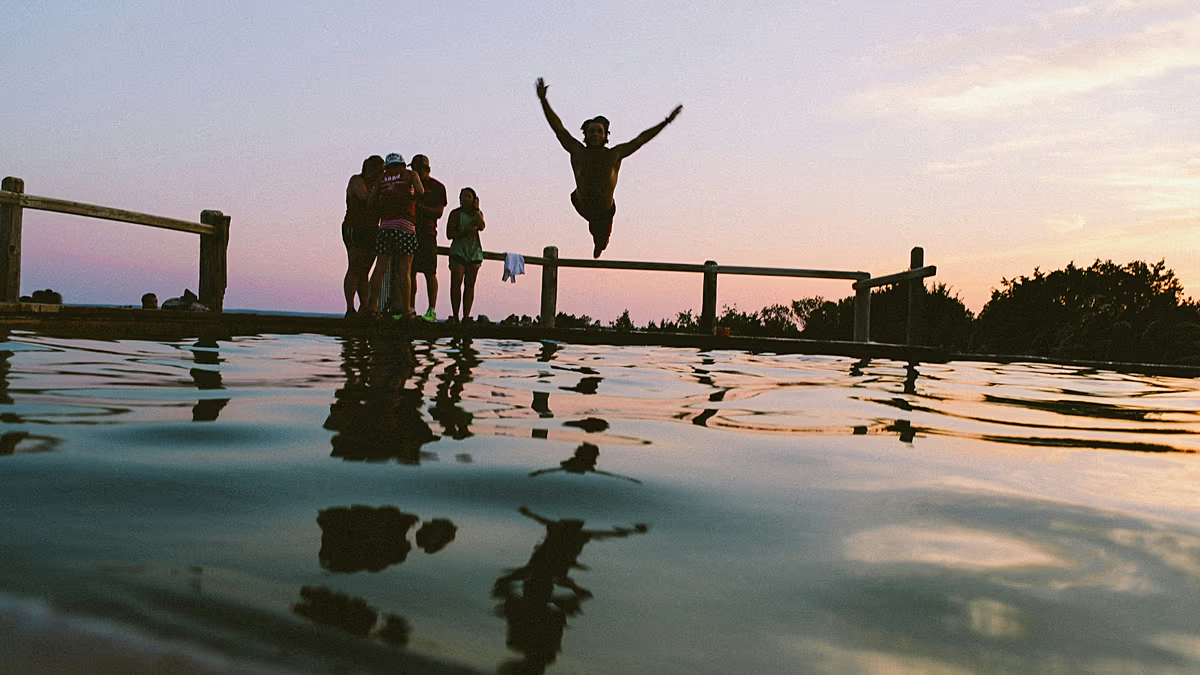
As a relentless heatwave continues to grip the European continent, pushing urban temperatures to record-breaking extremes, the stifling combination of hot asphalt and stagnant city air makes the sight of a glittering lake or a rushing river feel like an irresistible oasis. For millions of residents and holidaymakers, plunging into these cool, natural basins seems like the only sensible, therapeutic physical response to a climate that feels increasingly hostile. Yet, beneath the sparkling, picture-perfect surfaces of these natural plunge pools lies a sobering, tragic reality that demands our utmost attention. Just recently, as mercury levels shattered historical records across several French cities, a severe wake-up call emerged when the country reported that forty people had drowned in unsupervised swimming areas in a matter of weeks. French Prime Minister Sébastien Lecornu publicly lamented this “tragic scourge,” emphasizing that the majority of these young, vibrant victims lost their lives simply seeking temporary relief from the oppressive summer elements in waters that lacked professional lifeguards. This heartbreaking news serves as an urgent reminder that while wild swimming is a magnificent, soul-restoring way to connect with the planet, our desire to cool down must always coexist with a deep respect for water safety. The line between a peaceful retreat and a life-threatening emergency is incredibly thin, but it can be managed by choosing officially designated, monitored swimming spots, obeying local hazard flags, and remaining vigilant against hidden undercurrents, sudden drops, or submerged debris like branches. By pairing our natural wanderlust with a commitment to designated bathing lakes—monitored under safety and environmental frameworks like the EU Bathing Water Directive—we can transform our hot summer days into safe, memorable adventures across Europe’s most pristine environments, guided by ecological metrics that help us distinguish between beautiful waters and safe ones.
When it comes to safeguarding both human health and ecological purity, the alpine crown jewels of Austria, Germany, and Switzerland stand unmatched in their commitment to spectacular, highly regulated wild swimming. Austria leads this continental charge with a staggering 96.5% of its inland bathing waters rated as “excellent” by the European Environment Agency, a direct gift of its geography, where the soaring, snow-capped Alps serve as giant natural filters feeding pristine reservoirs. Imagine swimming in the emerald depths of Austria’s Lake Attersee, where the water is so astonishingly pure that you can see seven to nine meters beneath you, or floating in Lake Klopein, which warms to an inviting 26°C in the height of summer, before visiting the historic town of Hallstatt to sunbathe on its dedicated artificial bathing island. Just across the border, Germany boasts a 91.5% excellence rate, translating to a deeply rooted culture of the Strandbad, or open-air lakeside lido, where families spend entire days enjoying manicured lawns, playgrounds, changing facilities, and local restaurants alongside exceptionally clean waters. From the shallow, quickly warming waters of Lake Griessee to the breathtaking expanse of Lake Constance—which bridges three nations under the shadow of the mountains—German lakes offer safe, communal sanctuaries, including the magical Lake Walchensee in Bavaria, which glows with a Caribbean-style turquoise hue due to dissolved calcium carbonate, often called “rock flour.” Switzerland, not to be outdone, claims an 84.4% excellence rating, where centuries-old urban swimming habits are woven directly into the fabric of daily life in Zurich and Geneva through historic wooden lakeside baths known as Badi. Here, lifeguards watch over swimmers diving into deep lakes like Lake Lugano, the country’s warmest alpine marvel, which frequently hits 26°C in late summer, proving that pristine natural quality and robust public safety can easily go hand-in-hand.
Venturing south and west toward the sun-drenched landscapes of Italy and France reveals a completely different, yet equally enchanting, flavor of lakeside living where Mediterranean warmth meets dramatic mountain backdrops. Italy, with 87.7% of its inland waters designated as excellent, offers lakes that act as warm, deep-blue mirrors reflecting the dramatic cliffs of the Southern Alps, with Lake Kaltern in South Tyrol standing out as an alpine anomaly that heats up to a blissful 28°C under the Italian sun. Beyond the sheer thermal luxury, famous destinations like the glamorous Lake Como, Lake Garda, and Lake Maggiore are legendary hubs for active tourists, where open-water swimming is seamlessly integrated with windsurfing, sailing, kayaking, and hiking along historic lakeside trails protected by organized public lidos. France, despite its recent, tragic reminder of the dangers of unmonitored swimming, features 71% excellent inland bathing waters, offering extraordinary options for travelers who prioritize safety at supervised city beaches and state-run recreational parks. Tucked into the Savoie region of the French Alps, the extraordinarily warm Lake Aiguebelette reaches temperatures of up to 28°C due to its shallow depths and natural thermal springs, offering a highly protected environment where motorized boats are banned to preserve both peace and safety. Nearby, the famous Lake Annecy captivates visitors with its striking turquoise coloration and towering peaks, while the dramatically sheer cliffs enclosing the Lake de Sainte-Croix and the lively, sailing-studded shores of Lake Bourget, France’s largest natural water body, offer proof that even in countries grappling with public safety awareness, pristine and highly secure swimming sanctuaries are always within reach if one knows where to look. These locations feature experienced rescue teams and clear signage, showcasing the state’s ongoing efforts to balance breathtaking geographic beauty with the necessary vigilance required to prevent water-related accidents during the intensely hot summer months.
For those who hear the call of the wild in its most untouched and expansive form, the dense forests, rocky archipelagos, and ancient philosophies of Finland and Sweden offer an open invitation to experience water in its purest, most untamed state. Finland, crowned the “land of a thousand lakes” with over 187,000 bodies of water, boasts a remarkable 94.7% excellence rating, providing a playground where water is not just a holiday destination, but a fundamental part of the national identity. You can swim in the legendary Lake Tuusula, once the intellectual and social home of Finland’s greatest turn-of-the-century artists and composers, or lose yourself in the labyrinthine expanse of Lake Saimaa, Europe’s fourth-largest lake, where lucky swimmers might catch a rare glimpse of the endangered Saimaa ringed seal swimming alongside them through thousands of green islands. Sweden matches this watery wilderness with an 82.1% excellence rating, powered by the cherished democratic principle of Allemansrätten, or the Right of Public Access, which legally grants anyone the freedom to roam, camp, and swim in nature, provided they leave no trace and show deep respect for the environment and private property. In Sweden, do not be deterred if the water in forest-locked lakes has a dark, tea-like color, as this is merely a harmless, organic byproduct of the surrounding pine forests rather than a sign of pollution. From swimming across the immense, sea-like horizons of Lake Vänern with its sandy coves, to the surreal, life-affirming experience of diving into glacial, crystal-clear pools in Swedish Lapland under the golden glow of the midnight sun, the Scandinavian landscape proves that absolute natural freedom and environmental safety can live in perfect, sustainable harmony. This unique cultural framework allows for a profound connection to the wilderness, urging swimmers to behave responsibly and thoughtfully while exploring these secluded, cool aquatic sanctuaries away from crowds.
If your traveling desires lean toward unique, therapeutic wellness and ingenious engineering, the inland waters of landlocked Hungary and the low-lying Netherlands present brilliant alternatives to the standard mountain lakes of Western Europe. Hungary, lacking an ocean coastline, has transformed its inland resources into a globally renowned culture of thermal bathing, with 64% of its monitored waters classified as excellent, many of them enriched with healing minerals beloved by wellness seekers for centuries. For a truly unique experience, one must visit Lake Hévíz, the world’s largest swimmable thermal lake, which sits atop a subterranean cave that continuously pumps mineral-rich, warm water, keeping the lake at a comfortable 22°C even in the dead of winter and a steaming 36°C in the summer. For a more traditional lakeside holiday, Hungarians flock to the massive expanse of Lake Balaton, Central Europe’s largest freshwater body, which hosts the famous “Balaton Átúszás” cross-lake swimming race and offers warm, shallow shores perfect for young families. Meanwhile, the Netherlands, with 70.4% excellent waters, showcases how human ingenuity can carve beautiful, safe recreational spaces out of a landscape dominated by sea walls and reclaimed land. While it lacks alpine springs, the Dutch landscape is dotted with picturesque, crystal-clear, man-made lakes, such as Lake Henschotermeer, and vast stretches of open water like Lake IJssel, a massive freshwater body that was once a salty bay of the North Sea but is now a windsurfing capital that warms to 24°C in July. Even within urban Amsterdam, the artificial Sloterplas lake offers clean, sandy city beaches, showing that a country built on water knows exactly how to make its aquatic spaces safe, accessible, and deeply enjoyable for everyone. These locations are strictly monitored and offer excellent parking, dining, and restroom facilities, ensuring that families can relax under the sun with absolute peace of mind.
Our journey across Europe’s premier wild swimming destinations culminates in Poland, a country whose hidden gems and expansive lake districts deserve a prominent spot on every nature lover’s summer itinerary. Boasting a 56.7% excellence rating among its monitored bathing waters, Poland offers an incredibly wild and untouched landscape, particularly in the northeastern Masuria region, where over two thousand interconnected lakes form a breathtaking ecological matrix. Here, the gargantuan Lake Śniardwy, often referred to as the Masurian Sea, stretches as far as the eye can see, providing an inland sea experience that plays host to a vibrant community of sailors, windsurfers, and open-water swimmers. For a slower, more immersive connection to nature, the Krutynia River Trail winds gracefully through a sequence of incredibly clear lakes surrounded by thick, ancient forests, while those looking for the ultimate warm dip can head to Lake Licheńskie, which reaches summer temperatures of 24°C, far warmer than the country’s typical cooler natural basins. As we reflect on these diverse European waters—from the soaring, glacial peaks of Austria to the therapeutic, steaming springs of Hungary and the peaceful forest sanctuaries of Poland—the ultimate takeaway is clear: wild swimming is one of the most liberating ways to experience our planet, but it requires mindful humility. By choosing to swim only in designated, monitored locations, staying aware of our physical limits, and preserving the delicate ecosystems we visit, we can keep the tragic statistic of drownings in the past where they belong. This summer, let us seek out the cooling comfort of these pristine, monitored treasures, diving deep into their refreshing waters with a sense of wonder, gratitude, and above all, absolute safety. By doing so, we respect both our deep physical limits and the wonderful aquatic ecosystems that offer us life, cooling reprieve, and unforgettable memories during these challenging seasons of unprecedented environmental warming.