


The glitz and glamour of the aviation world descended upon London as the 2026 World Airline Awards, often dubbed “the Oscars of the skies,” were unveiled. This year’s ceremony, orchestrated by the esteemed air transport rating organization Skytrax, painted a clear picture of global aviation power, with Asian and Middle Eastern carriers soaring to the top of the rankings and asserting their dominance. The event, a staple of the industry since 1999, serves as a comprehensive benchmark for excellence, meticulously evaluating over 300 airlines on everything from product quality to service standards. While the results highlight the exceptional work of carriers worldwide, they also reveal a shifting landscape, prompting a closer look at how European airlines fared in this fiercely competitive environment.
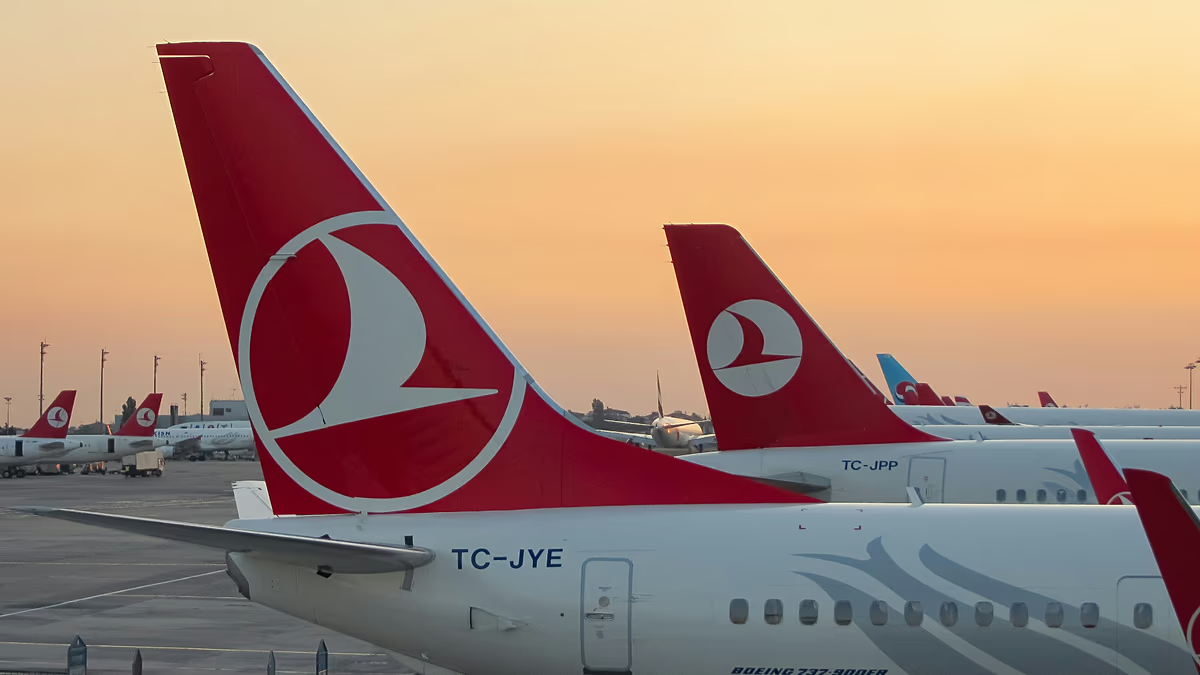
The 2026 results sent a clear message about the current hierarchy of global air travel. Singapore Airlines clinched the coveted title of the world’s best airline, unseating the previous champion and setting a new standard for excellence. Following closely behind were the formidable Qatar Airways and Hong Kong’s Cathay Pacific, cementing the Asia-Pacific region’s stranglehold on the top spots. This left European carriers trailing, with Turkish Airlines emerging as the highest-ranked European representative in a respectable fifth place. This placement underscores a broader trend, with just six European airlines managing to secure a place within the top 20. Alongside Turkish Airlines, the list featured a mix of legacy and modern carriers including Air France, Lufthansa, Iberia, Virgin Atlantic, and Swiss International Air Lines. While this representation is noteworthy, the sheer dominance of airlines from the Middle East, Asia, and the Pacific in the upper echelons of the ranking suggests a competitive edge that European carriers are working diligently to match.
While the overall title may have eluded them, European airlines found numerous reasons to celebrate, demonstrating their strength in specialized areas of the passenger experience. Air France, in particular, had a standout year, sweeping the board in luxury travel categories. The French flag carrier took home awards for the world’s best first class, the world’s best first class lounge dining, and the world’s best first class comfort amenities. These accolades reaffirm Air France’s commitment to providing a premium, refined, and quintessentially French experience for its most discerning passengers. Beyond these cabin-specific triumphs, the airline was also honored as the best airline in Western Europe, a testament to its consistent service quality and extensive network. This success highlights a key differentiator for European carriers: an ability to excel in the high-end market through meticulous attention to detail, culinary excellence, and elegant design, even when they may not dominate the overall standings.
Further down the European landscape, other airlines carved out their own niches of excellence. Spanish carrier Vueling took home the award for the best low-cost airline in Europe, a competitive segment that also recognized Germany’s Eurowings, Spain’s Iberia Express and Volotea, and the Dutch Transavia. This win is significant, showcasing that value and quality are not mutually exclusive and that low-cost carriers can provide a stellar customer experience. Turkish Airlines, meanwhile, proved its mettle beyond its fifth-place overall finish, scooping a trio of awards. The airline was celebrated as the best airline in Europe for the eleventh time and also received honors for the world’s best business class catering and the best airline in Southern Europe. Murat Şeker, Turkish Airlines chairman of the board, expressed his pride in the recognition, stating it was a great source of pride for the entire Turkish Airlines family. These regional and service-specific victories demonstrate the depth of talent across the continent, moving beyond the traditional powerhouses to acknowledge excellence in various market sectors.
However, a closer look at the awards also reveals areas where European carriers are falling short. Notably, all European airlines were absent from the world’s best cabin crew category, an award won by Hong Kong’s Cathay Pacific Airways. This particular award is often seen as a core measure of hospitality and passenger service, a realm where Asian carriers are consistently lauded for their intuitive, warm, and highly professional service culture. Similarly, the world’s best regional airlines category saw only Greece’s Aegean Airlines cracking the top 10, securing a commendable fourth place. This absence suggests a potential gap in the training and consistent delivery of inflight service that defines the passenger experience on a more personal level. While European airlines may excel in hard products, such as lounges, seating, and catering, the softer skills—the anticipatory service and genuine warmth that often characterize Asian hospitality—appear to be a more significant competitive advantage for their international rivals.
The story of this year’s awards is also one of a changing of the guard at the very top. Qatar Airways, a nine-time winner of the world’s best airline title and a consistent powerhouse in the industry, was knocked down to second place, losing its coveted top spot to Singapore Airlines. Despite this setback, the Doha-based carrier had a remarkable evening, securing four major awards. Most notably, it was named the world’s best business class airline for an unprecedented thirteenth time, a testament to its near-legendary Qsuite product. It also retained its title as the best airline in the Middle East. Furthermore, Qatar Airways made history by receiving the first-ever award for the World’s Best Onboard Wi-Fi. This new category was introduced to acknowledge the increasing importance of fast and reliable connectivity for modern travelers, highlighting how the definition of a premium travel experience is evolving to include technology and seamless digital integration. This focus on innovation signals where the industry’s future focus lies, even for established leaders.
In conclusion, the 2026 World Airline Awards presented a fascinating snapshot of the global aviation industry, celebrating excellence while also highlighting shifting priorities and competitive pressures. While Asian and Middle Eastern carriers clearly dominate the global top 20, European airlines remain formidable players, demonstrating their strengths in specific premium products, regional service, and support for low-cost travel. The success of airlines like Air France and Turkish Airlines in their respective niches proves that European aviation still holds significant sway. Yet, the absence of European names in the cabin crew category serves as a critical reminder of the “people power” that remains at the heart of the great airline experience. The top 20 list—featuring Singapore Airlines, Qatar Airways, Cathay Pacific, ANA All Nippon Airways, Turkish Airlines, Emirates, Air France, Hainan Airlines, Japan Airlines, Korean Air, EVA Air, Qantas, STARLUX, Lufthansa, Saudia, Iberia, Air Canada, Virgin Atlantic, Swiss, and Thai Airways—reflects a world where the pursuit of perfection is relentless. As the industry continues to evolve, driven by both technology and timeless hospitality, these awards not only honor the current leaders but also set the benchmark for every airline striving to provide the best possible journey for its passengers.