


In the shadow of Arizona’s Dripping Spring Mountains, the small town of Kearny is living through a slow emergency. Home to about 2,000 people, Kearny has long drawn its water from the Gila River, a green ribbon of life that curves along the town’s southern edge. This year, however, that ribbon has nearly disappeared. By March, the snowpack feeding the river had fallen to just 1 percent of its historic average for that time of year, and the Gila River water commissioner slashed Kearny’s allotment of river water by roughly 85 percent. In April, town officials began warning residents that “Zero Day” was approaching—the moment when household taps would run dry. For the people who live here, that warning was not abstract. Norm Warren, who has spent his entire life in Kearny, owns the only large grocery store within a 45-minute drive of town. If the store loses tap water, its refrigerator cooling systems fail, and he cannot keep meat, dairy or fresh produce on the shelves. “We need rain,” he says. Warren has already let his lawn die, stopped washing his car, cut back on laundry and showers, and started watering his remaining plants with dishwater. These small, personal sacrifices may seem modest against the vast forces reshaping the region, but they reflect something deeper: a community that never expected to face this is now trying to stretch every single drop. “The town is really trying,” Warren says, and in Kearny, that effort is not a slogan. It is a daily arithmetic of survival.
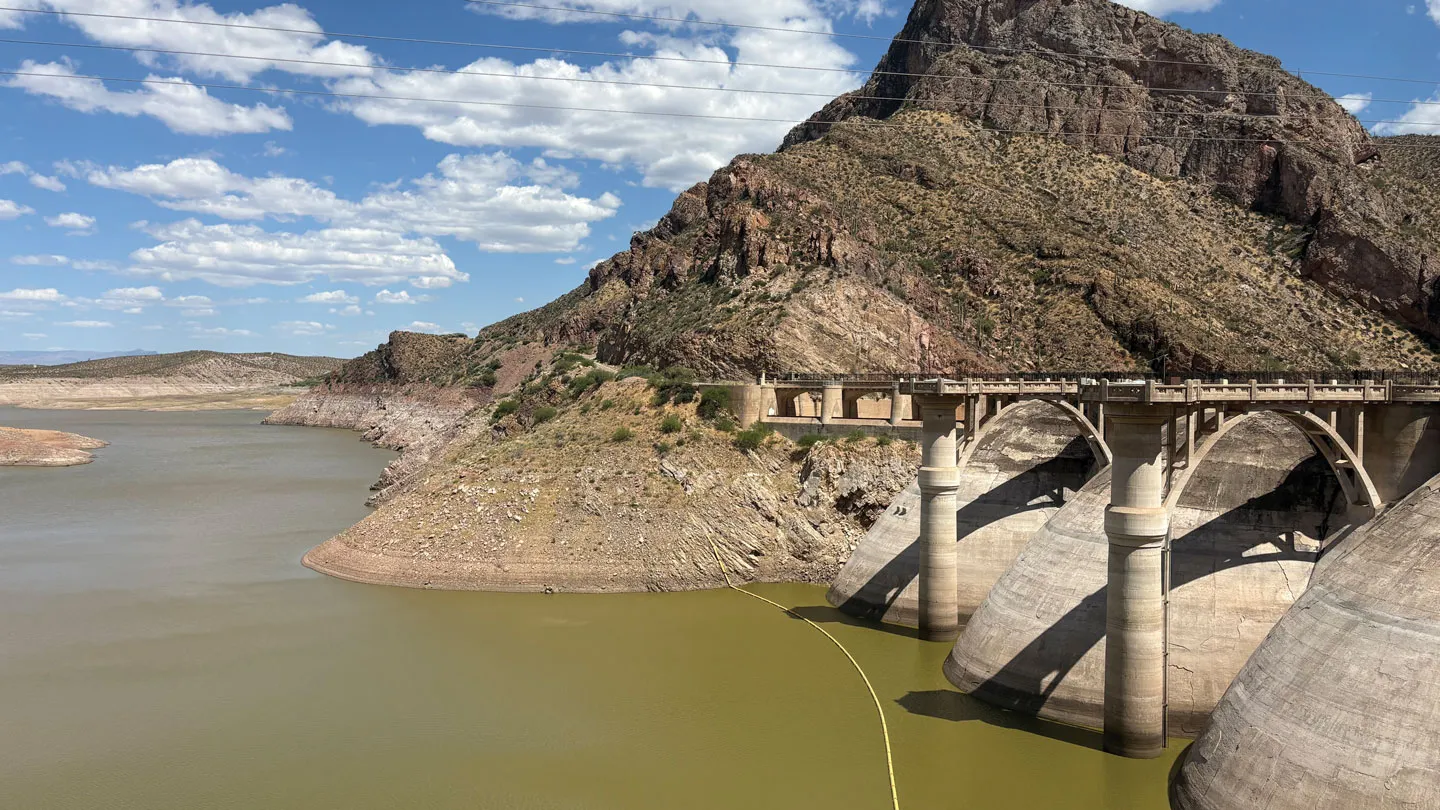
Kearny’s predicament is not an isolated misfortune; it is a front-row view of a catastrophe building across the American Southwest. Since 2000, Arizona, New Mexico, California, Utah, Colorado, Nevada and parts of northern Mexico have been locked in what scientists call a megadrought—a severe, decades-long period of dryness. Tree-ring records indicate that the past 27 years have been the driest such stretch in the region in 1,200 years, a finding confirmed by analyses of soil moisture and ancient tree growth. “We’re 27 years into it, and it shows no signs of letting up,” says Brad Udall, a water and climate researcher at Colorado State University. The region’s most vital waterway, the Colorado River, has lost roughly one-fifth of its flow since 2000. Its great reservoirs, Lake Powell and Lake Mead, fell in August to about a quarter of their combined capacity—a staggering blow for the roughly 40 million people who depend on the river for daily water. The federal government responded by cutting the amount of river water allocated to Arizona, California and Nevada by about 20 percent over the next two years, and officials have warned that future reductions could reach 40 percent if conditions do not improve. Agriculture will likely bear the heaviest burden, but municipal leaders in Phoenix and Tucson say residential water bills may rise sharply as cities scramble to find new supplies. What was once a distant warning is now a lived reality, and Kearny is simply one of the first communities to feel the full weight of it.
What makes this megadrought different from the dry spells of the past is not simply the absence of rain; it is the heat. Climate change has pushed temperatures higher across the Southwest, and a warmer atmosphere acts like a thirsty sponge, pulling moisture out of soil, plants and snowpack far more effectively than before. Kevin Anchukaitis, a dendrochronologist who runs the University of Arizona’s Laboratory for Tree-Ring Research, explains that for every degree Celsius of warming, a parcel of air can hold about 7 percent more water—an old thermodynamic relationship known as the Clausius-Clapeyron equation. “A thirsty atmosphere will take that water that does fall from the sky away from the surface,” he says. The rainfall has indeed declined: from 2000 to 2021, annual precipitation in the Southwest was 8.3 percent lower than the average of the previous 50 years. Combined with higher temperatures, that has produced soil moisture deficits unseen since around the year 800. Researchers at the tree-ring lab and elsewhere study the growth rings of ancient trees to reconstruct past climates, and those rings tell a sobering story. Thicker rings mark wet years; thin, tightly packed rings record prolonged dryness. The evidence shows at least two earlier megadroughts, one in the 12th century and another spanning much of the second century, when Colorado River flows fell to roughly 80 percent and 68 percent of their modern averages. Margaret Evans, an ecologist at the tree-ring lab, notes that the current drought thus falls within the realm of natural variability. But she stresses that this one is different because it is a “warm drought.” The heat changes everything: it makes the landscape drier even when storms do arrive, and it points toward a condition researchers increasingly call “aridification”—a progressive, long-term drying rather than a temporary dry spell that wet years will fix.
The heat alone, however, may not explain why the Southwest has remained so stubbornly dry for nearly three decades. A growing body of research points to a vast and slow-moving pattern in the Pacific Ocean known as the Pacific Decadal Oscillation, or PDO. The PDO alternates between warm and cool phases every couple of decades, shifting the position of warmer and cooler surface waters across the Pacific. This pattern has an outsized influence on the climate of North America. During the PDO’s warm phase, from about 1977 to 1998, the Pacific jet stream was pushed south, steering wet winter storms into the Southwest and producing one of the wettest periods the region had seen in a millennium. Around 1999, the PDO flipped into its cool phase, the jet stream moved north, and the Southwest entered the dry era it still occupies today. For years, scientists assumed the PDO would eventually flip back on its own because they believed it followed a natural rhythm. But in 2025, a controversial study in Nature argued that human emissions have effectively hijacked the PDO. Jeremy Klavans, a climate scientist at the University of Miami, and colleagues found that greenhouse gases and industrial aerosols have altered atmospheric temperatures in ways that nudge the oscillation toward its cool, dry phase. Clean air legislation in the 1980s reduced cooling aerosols even as greenhouse gases continued to warm the planet, and that combination drove the PDO toward conditions that make drought “commonplace,” Klavans says. Additional research examining the mid-Holocene, roughly 6,000 years ago, found that a warming climate pushed the PDO into a prolonged cool phase that lasted thousands of years, with widespread drought across the Southwest. Victoria Todd, a climate scientist at the National Center for Atmospheric Research, says current models may actually underestimate how long the modern megadrought could persist. For Udall, the implications are blunt: if the emerging science is right, the Southwest will keep getting drier. “No question about it,” he says.
Could an El Niño rescue the region? Forecasters are predicting a historically strong El Niño this year, and El Niños have occasionally been known to force the PDO into a different phase. In 1976–1977, a powerful El Niño helped push the PDO into a warm phase that lasted nearly a quarter-century. But a strong El Niño in 2015 was unable to force a long-lasting switch, producing only a few wetter years before the cool/dry pattern reasserted itself. Klavans sees that failure as a sign that “something’s different here.” Even if this year’s El Niño is strong enough to nudge the PDO into a warm phase, Richard Seager of Columbia University cautions that one wet winter will not erase decades of accumulated deficits. “We’re talking about something that’s been going on for a few decades now,” Seager says. “Even one very wet winter is not going to be enough to restore Colorado River reservoirs to where they would preferably be.” Seager and colleagues ran simulations of what would happen if the PDO switched warm in the near future, and the results are sobering: even in the best-case scenarios, the Southwest never returns to the wet years of the 1980s and ’90s, when Lake Powell and Lake Mead repeatedly filled to capacity. The region is headed for a far drier baseline than its recent past, no matter what the PDO does next. That means the work of adaptation cannot wait. Anchukaitis argues that communities need to invest in water conservation and infrastructure now, and those efforts will become only more urgent as the Southwest continues to grow: Utah, Texas, Nevada, Colorado and Arizona are among the ten fastest-growing states in the country. More rain may come eventually, he says, but it should not lull anyone into complacency. The best it can offer is time—time to ease a society built around abundant water into a new way of thinking.
In Kearny, the future has already arrived. After officials first warned that Zero Day could come as early as July, residents and businesses changed course. They cut water use dramatically, stopped unnecessary outdoor watering, and found small workarounds for daily routines. Town officials now estimate that conservation, along with canceled water requests by other communities, has stretched Kearny’s water supply at least until the end of the year. But the margin for error is nearly invisible. The upstream flow of the Gila River is controlled by the Coolidge Dam, and the reservoir behind that dam is currently less than 1 percent full. If the snowpack fails again next year, Kearny’s annual allotment of river water could fall to zero. Standing in his grocery store, looking over the stocked shelves, Norm Warren cannot hide the weight of the moment. “This is going to hurt us if we have to shut off our livelihood,” he says. “We can’t walk away from it.” Neither, it seems, can much of the American Southwest. The story unfolding in Kearny is not merely a local emergency; it is a glimpse of a hotter, drier future that scientists have been warning about for decades. The town’s residents are doing what they can—saving dishwater, letting lawns die, praying for rain—but their collective efforts cannot refill a reservoir or summon snow to the mountains. Kearny’s taps may keep flowing a little longer, yet the deeper question remains: how many other communities will be forced to live this way, and how long can anyone hold back the slow, relentless tide of aridification?