


When most people picture Dubai, the images that come to mind are almost inevitably larger than life: a skyline sliced by the Burj Khalifa, the theatrical silhouette of the Burj Al Arab, shopping malls the size of small cities, and artificial islands shaped like palm trees, all wrapped in a haze of luxury, gold, and futuristic ambition. It is a city that has become synonymous with record-breaking architecture, five-star hospitality, and the kind of extravagant ambition that makes headlines around the world. And yet, for all that glittering modernity, there is another Dubai, quieter and slower, that often escapes the attention of first-time visitors. Tucked away on the southern bank of Dubai Creek, in the heart of the old city, lies the Al Fahidi neighbourhood, a place where the relentless pace of the metropolis seems to soften, where narrow alleyways and wind-tower houses whisper of a time before skyscrapers, before air conditioning, before the global frenzy of development. Here, in this historic district, you can still feel the texture of an older world, a world of pearl divers, merchants, and traders who gathered along the waterway long before the oil boom transformed everything. And at the centre of this neighbourhood stands Al Fahidi Fort, the oldest surviving building in Dubai, a modest but deeply significant structure that has witnessed more than two centuries of extraordinary change, and which, after years of painstaking restoration, is preparing to welcome visitors once again.
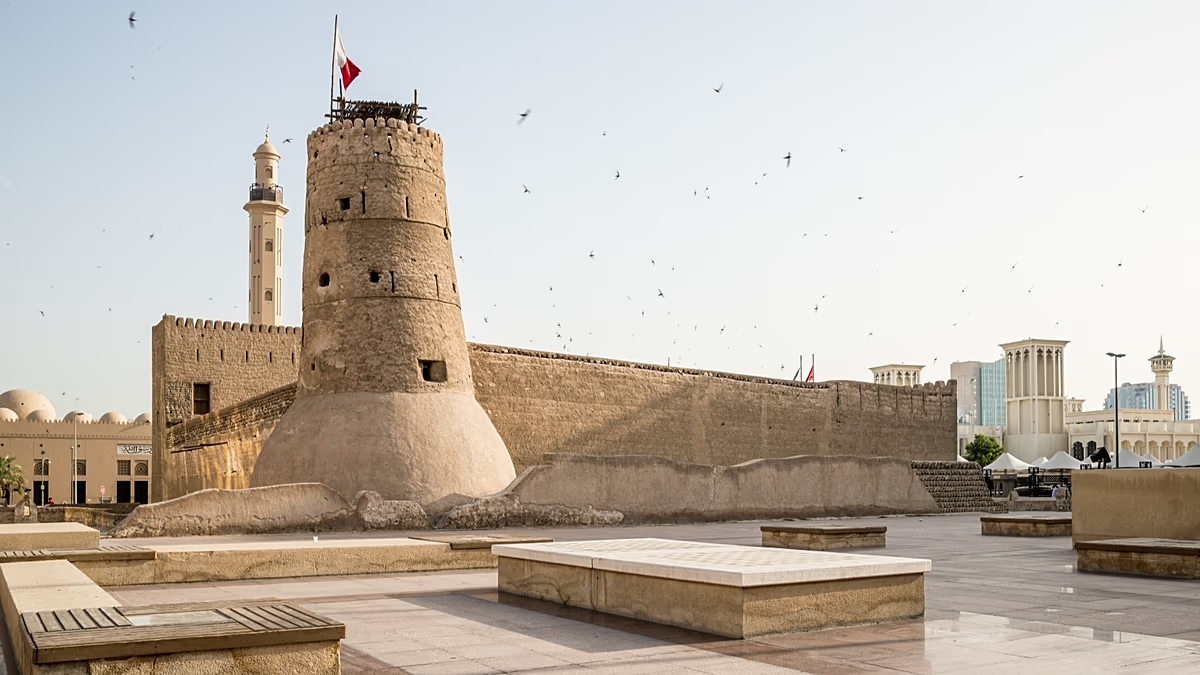
Al Fahidi Fort was built around 1787 as a defensive stronghold, a sturdy refuge of coral stone and gypsum mortar designed to protect the fledgling settlement from external threats. Over the centuries, its role shifted repeatedly: it served as the ruler’s residence, a seat of governance and administration, and even a prison, before eventually becoming Dubai’s first museum in 1971, the very same year the United Arab Emirates was formed. To walk through its gates is to step into a living timeline of the emirate’s story, from its humble beginnings as a fishing and trading village to its emergence as a global hub. But the fort has not been open to the public since 2021, when an extensive restoration project began, a project intended not simply to repair the ancient walls but to reimagine the entire visitor experience. Now, five years later, that project is nearing completion. Ayisha Khansaheb, Director of Al Fahidi Fort and Specialised Museums at the Dubai Culture & Arts Authority, recently shared the news at the Arabian Travel Market: the fort will reopen “in the coming weeks or months.” For Khansaheb, the new museum is far more than a collection of artifacts behind glass; it is, in her words, a “gateway into the story of Dubai itself,” a starting point where visitors can begin to understand the deeper currents beneath the city’s dazzling surface. The restoration, she suggests, is not just about preserving old stones, but about opening a door to the past for a global audience that has often only seen Dubai’s future.
There is a certain irony in the fact that a city so defined by forward motion should also hold within it such a carefully preserved piece of history. For years, Dubai’s cultural heritage has been overshadowed by its reputation as a playground of the future, a place where tradition can sometimes feel like an afterthought. International visitors, drawn by beaches, shopping festivals, and spectacular hotels, have not always paused to explore the older quarters, the bustling souks, the quiet mosques, and the courtyard houses that tell a different story. But that is beginning to change. As Khansaheb explains, cultural heritage is not merely a tourist attraction; it is an ecosystem, one that nourishes cultural tourism, strengthens the identity of residents, and educates younger generations about where they come from. “I think we need to have offerings for everyone,” she says, “and I think this is something that you’ve been seeing more of in Dubai and in the wider region as well. It addresses a growing need to emphasise that there is a soul, there is a culture, and there is history here.” Her words reflect a broader shift across the Gulf, where countries that have long been celebrated for their rapid modernization are now rediscovering and proudly showcasing their heritage. The reopening of Al Fahidi Fort is therefore not just a nostalgic gesture; it is a statement that Dubai’s identity is richer and more layered than its glittering facade might suggest.
The revitalised museum inside the fort promises to be a deeply immersive experience, one that blends the authenticity of historic architecture with the possibilities of modern technology. Visitors begin their journey in a newly built underground extension, where contemporary galleries set the stage for the story of Dubai’s evolution. The themes explored here are fundamental: defence, leadership, craftsmanship, the values and skills that shaped the emirate’s character. One of the standout exhibits is “The Vault,” a spectacular light-and-sound experience that traces the evolution of Dubai’s defence capabilities, from the early days of watchtowers and weaponry to the sophisticated systems of the present. It is the kind of experience that uses emotion as much as information, allowing visitors to feel the weight of history rather than simply observe it. Another gallery, titled “A Landmark Across the Ages,” focuses on the fort itself, examining how its role changed over more than 230 years, from fortress to palace to prison to museum. There is also a major collection of Islamic arms and armour, a reminder of the region’s long martial traditions and artistic craftsmanship. Yet perhaps the most powerful exhibit is the fort itself. To walk through its historic walls, to climb its watchtowers, to stand in its courtyard, is to experience history not through displays but through the very texture of stone and shadow. As Khansaheb puts it, “You experience history through architecture.”
The museum has been designed with a wide audience in mind, and the inclusion of interactive learning experiences for children is particularly telling. In a city where so much attention is paid to monumental attractions, the creation of a space where younger visitors can engage with heritage through play, discovery, and hands-on activities suggests a commitment to nurturing a sense of cultural continuity. For school groups in Dubai, the fort will become a living classroom, a place where the abstract dates and names of textbooks are transformed into tangible reality. For international tourists, it offers something perhaps even more valuable: a chance to see beyond the stereotypes and understand the deep roots of a society that is often reduced to clichés of excess and spectacle. The restored fort is not a static relic; it is a dynamic cultural centre, a meeting point between past and present, between tradition and innovation. It invites visitors to slow down, to look closely, to appreciate the beauty of simplicity. In a world where travel is increasingly defined by speed and spectacle, the fort offers an antidote, a reminder that the most memorable journeys are often the ones that connect us to something authentic, something human.
In the end, the reopening of Al Fahidi Fort is about more than the restoration of a building, however historic it may be. It is about the rediscovery of a city’s soul. For residents, it is a source of pride, a tangible link to the generations who came before and built the foundations of modern Dubai. For visitors, it is an invitation to see the emirate with fresh eyes, to understand that the gleaming towers and artificial islands are only part of the story. Beneath the surface, beneath the glass and steel, there is a city of winding lanes and ancient walls, of coffee pots and calligraphy, of watchtowers and wind towers, a city that has always known how to adapt and thrive. The fort has stood for more than two centuries, through times of hardship and prosperity, through conflict and peace, through transformation and continuity. Now, as it prepares to open its doors once again, it stands as a testament to the enduring power of heritage, a place where the past is not preserved in amber but brought to life for new generations. Whether you come for the history, the architecture, or simply to escape the overwhelming modernity of the city, Al Fahidi Fort offers something rare: a chance to stand in a place where time seems to slow down, where the story of Dubai is written not in glass and steel, but in stone, in memory, and in the quiet resilience of a people who have never forgotten where they came from. And in that sense, the old fort is not just a museum. It is a mirror, reflecting the heart of a city that is finally ready to share its whole story with the world.