

Spain is about to cross a threshold it has never reached before: the country is on track to welcome 100 million international visitors in a single year. That is an extraordinary number, and on the surface it sounds like an unqualified success story. But the people who live, work, and plan for Spain’s future know that success can sometimes feel like a burden. Streets in beloved cities overflow, housing becomes harder to find, and local life can start to feel like a backdrop for someone else’s holiday. Speaking at the Arabian Travel Market in Dubai, Carlos Ruiz González, director of the Spanish Tourist Office for the Gulf region at Turespaña, captured this tension beautifully when he said that some destinations are “dying of success.” It’s a striking phrase, and it gets to the heart of what Spain is now wrestling with: not how to attract more tourists, but how to manage the immense popularity it has already earned. This is not a simple problem, and there is no simple fix. But Spain has decided to face it head-on, not as a single tourism department issue, but as a national conversation about what kind of country it wants to be.
The response is a long-term strategy called Spain Tourism 2030, and it is rooted in a very human idea: that tourism should work for everyone, not just visitors. The plan was not written in a closed office by bureaucrats. It was developed in consultation with more than 200 tourism experts, businesses, government bodies, and other organisations from across the country. That in itself tells you something important — Spain is not trying to impose a one-size-fits-all solution on a country that is incredibly diverse. The challenges facing a crowded Barcelona are completely different from those facing a quiet rural village hoping to see more visitors. Some regions are dealing with overcrowding, while others are dealing with depopulation and economic stagnation. The plan recognises this and tries to address it with something that sounds almost like common sense: treat tourism as a country-wide policy, not just an industry issue. Ruiz González stressed that all ministries and all sectors in Spain are now aligned around this vision. That means tourism is being considered alongside housing, transport, environmental protection, labour rights, and local community life. The plan is structured in three phases, delivered through two-year action plans, and it defines sustainability in broad terms — economic, social, and environmental. It is not just about protecting beaches and monuments, though those matter. It is about making sure that tourism enriches Spanish life rather than eroding it.
At the centre of this new strategy are people, and not just the tourists. Residents are described as a “core audience” of the plan, not a “side effect” of it. That is a meaningful shift in thinking. Too often, tourism policy talks about visitor numbers, hotel occupancy, and spending data, while the people who actually live in a destination are treated as an afterthought. Spain wants to change that. Ruiz González made the point simply and powerfully: tourists go where people live, so people need to keep living there. That means being able to afford an apartment, go about daily routines without being squeezed out, and feel like a real community still exists. This is not an abstract concern. In places with heavy tourism pressure, housing costs have risen sharply, short-term rentals have changed neighbourhoods, and everyday life can feel like a constant performance. The strategy acknowledges that if residents are forced out, the very thing that made the place special disappears too. So the plan places residents alongside destinations, businesses, tourism workers, and visitors as one of the five core groups the strategy is designed to serve. This is a deliberate attempt to balance the needs of all the people who make tourism possible, including the often overlooked workers who clean hotels, drive buses, and serve meals. They are not just cogs in a machine; they are part of the community, and their well-being matters.
The sheer scale of Spain’s tourism economy makes these questions even more urgent. Spain is already the world’s second-most visited country, and it welcomed 96.8 million international tourists in 2025. Tourism accounts for 12.6% of the country’s GDP and supports around three million jobs. Those numbers are staggering, and they show exactly why tourism cannot simply be turned off or discouraged. Too many livelihoods depend on it. But the government is increasingly looking beyond the arrival count. In 2026, visitor numbers are continuing to rise, and the focus is shifting from simply attracting more people to managing growth wisely. This is not about setting an arbitrary cap or telling people not to come to Spain. Ruiz González was clear that some destinations are already very well known and do not need much promotion. The goal is not to discourage tourists from those places, but to encourage them to think more broadly about what Spain has to offer. There is an entire country beyond the coastlines and the famous city centres, and much of it is struggling to get noticed. The strategy wants to spread visitors more widely across the map, while also encouraging slower travel and longer stays. The idea is not to tick off as many cities as possible in a week, but to settle in somewhere, experience the rhythm of daily life, and leave a lighter footprint. That benefits the traveller, who gets a richer experience, and also the communities, who get visitors who are more likely to support local businesses and respect local ways of life.
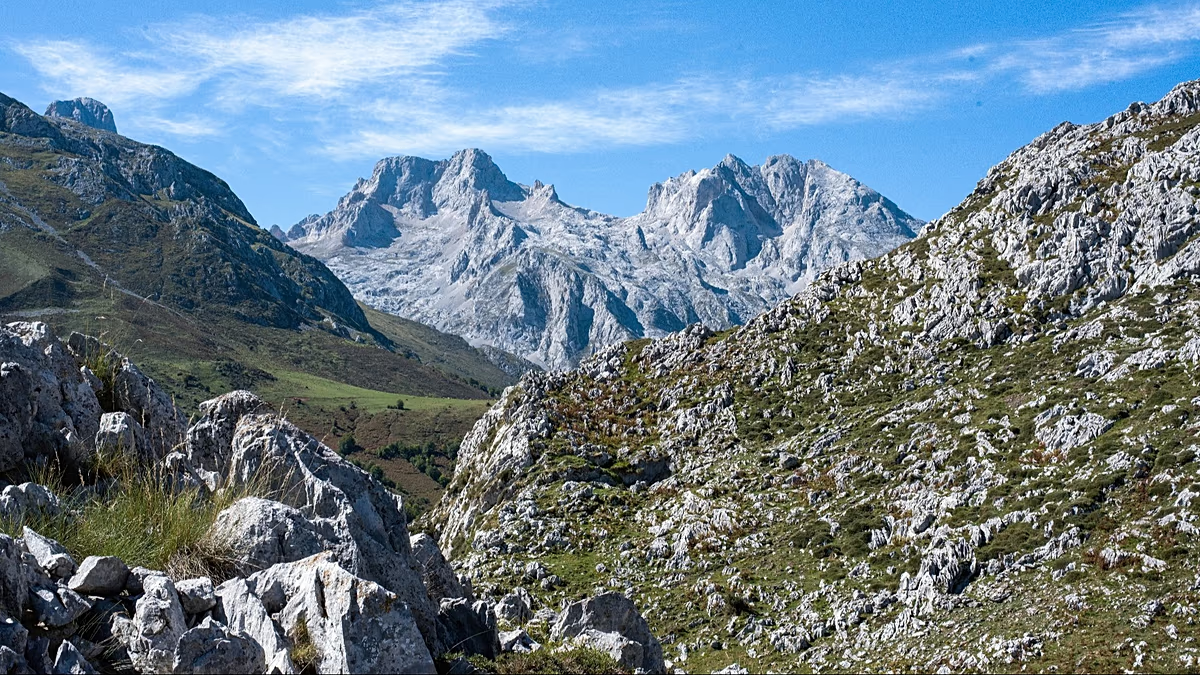
So where exactly should travellers go? The answer is refreshingly specific, and it offers a very different image of Spain than the crowded resort beaches many people picture. Ruiz González highlighted the Pyrenees and the Picos de Europa, two spectacular mountain areas that offer some of the best hiking and nature experiences in Europe. He also mentioned the Sierra de Guadarrama, a national park that sits right on the doorstep of Madrid, making it easy for visitors to escape the city and find themselves in wild, beautiful landscape within a short journey. For travellers interested in history and architecture, he pointed to the historic cities and smaller towns of Castilla, a region that is often overlooked in favour of the coasts and the big cultural capitals. These are places with incredible heritage, beautiful plazas, and a slower rhythm of life, and they have the space to welcome visitors without strain. One of the key enablers of this shift is Spain’s extensive high-speed rail network. It is making it easier than ever to reach destinations beyond the established tourism hotspots, and that is exactly the point. The vision is not to force people away from the places they love, but to offer alternatives that are genuinely appealing. Rural and inland Spain have immense untapped potential, and the goal is to make sure that the benefits of tourism are shared across the whole country. As Ruiz González put it, “We want all our destinations to be part of the solution.”
This is a deeply human approach to a problem that is all too often discussed in cold statistics. Spain is not saying tourism is bad, and it is not blaming tourists for the pressures that have built up. It is simply saying that the country needs to be more thoughtful about how it grows. The next phase of Spanish tourism is not going to be measured solely by the number of arrivals at airports and border crossings. It will be measured by whether residents feel at home in their own cities, whether housing remains affordable, whether small towns can find new life, and whether the natural landscapes that make travellers fall in love with Spain are still intact for the next generation. It is a bold vision, and it will not be easy to pull off. There will be contradictions, setbacks, and difficult trade-offs. But the fact that Spain is even trying is significant. The country is using its position as one of the world’s most loved destinations to ask a bigger question: what does responsible tourism actually look like? The answer, according to the Tourism 2030 plan, is that it looks like a place where residents and visitors can coexist, where growth is managed, and where the human scale of life is not lost. That is the kind of success worth reaching for. As Spain prepares to welcome 100 million visitors, it is also preparing to make sure those visitors are part of a larger story — one where people, communities, and places are never just the backdrop.