

There is a particular kind of traveler who measures a weekend not by how many hours were spent indoors, but by the feeling of fresh air in the lungs and the quiet thrill of discovering something old and meaningful. For those people, the eastern slopes of the Alps are a kind of secret playground. This is a region where the proud mountain peaks gradually soften as they cross from Austria into Hungary, where the forests do not recognize borders and the trails have been walked for centuries. The lower summits are still very much Austrian in character, but the foothills reach deep into Hungarian soil, and together they form a landscape that is both wild and welcoming. What makes this area especially remarkable is the way nature and history are braided together. The same mountain bike routes that challenge modern riders pass through sites where Celts once built terraces, Romans constructed watchtowers, and medieval soldiers defended their homes against invading armies. The past is not locked away in museums here; it lives in the mossy stones, the old forest paths, and the quiet villages that cling to the hillsides. For anyone who wants a weekend full of hiking, learning, and a little bit of adventure, this cross-border corner of Central Europe offers an experience that is both active and deeply humane.
The best place to begin is the small Hungarian village of Velem, a place that looks unassuming at first but carries a remarkable history under its leafy hills. As you drive toward the village, your eyes are drawn to the white chapel of Saint Vid, or Saint Vitus, shining from a distance of tens of kilometers. The chapel sits at an altitude of 589 meters, tucked deep in the forest of the Kőszeg Mountains, at the end of a gentle hiking trail that feels more like a walk through memory than a climb. It was built in the early eighteenth century on the ruins of a far older settlement, and the ground around it has stories to tell if you know how to listen. About two thousand years ago, Celtic people lived in this area, and their hand-built terraces are still visible in the forest, shaped into the slopes like faint lines of an ancient map. Later, the Romans arrived and constructed a watchtower to protect the aqueduct system that supplied water to the great city of Savaria, the predecessor of today’s Szombathely. Standing near the chapel, you can almost feel the layers of time beneath your boots. The forest is not just trees and birdsong; it is a living archive. Another popular trail from Velem leads to Geschriebenstein, the highest peak in the region, which sits right on the Hungarian-Austrian border. From the Hungarian side, the hike feels a bit more adventurous, while from Austria it is an easy stroll, a pleasant reminder that borders are often just lines on a map. Perhaps the most charming of all is the Springs Trail, or Források útja, a fourteen-kilometer route that connects eleven springs, both famous and hidden, through the Kőszeg Mountains. It is a route that rewards the curious traveler with cold, clear water, dappled sunlight, and the satisfying feeling of having earned every sip.
A few kilometers from the Austrian border lies Kőszeg, one of the most charming small towns in Hungary, and a place that knows how to hold onto its dignity. Kőszeg is most famous for Jurisics Castle, a medieval Gothic fortress that became the heart of one of the most extraordinary stands in European history. In 1532, the Ottoman army was advancing toward Vienna, and the town found itself directly in the way. The captain of the castle had only about fifty soldiers, joined by roughly seven hundred local villagers, men and women who refused to give up their home. Facing a vastly larger and better equipped Ottoman force, the defenders held out in a way that seems almost impossible. How did they do it? The true story remains a mystery, and perhaps that is exactly how it should stay. Some say that heavy August rains turned the roads into mud and slowed the enemy’s heavy artillery. Others speak of clever tactics and stubborn courage. Whatever the real explanation, the siege became a legend, and Kőszeg survived. Today, you can stand in the shadow of the castle and feel the weight of that history all around you. But Kőszeg is not just a place for looking backward. It is also the perfect destination for a full day of hiking, especially if you walk across the mountain from Velem. The route takes you past cold water springs, up to the chapel of Saint Vid, and through encounters with Styrian houses that foresters used in the 1800s. These old wooden structures, with their simple charm and sturdy craftsmanship, feel like they are still waiting for their inhabitants to return. By the time you reach Kőszeg in the evening, your legs are tired, your mind is full, and you understand why the people of this region love their mountains so deeply.
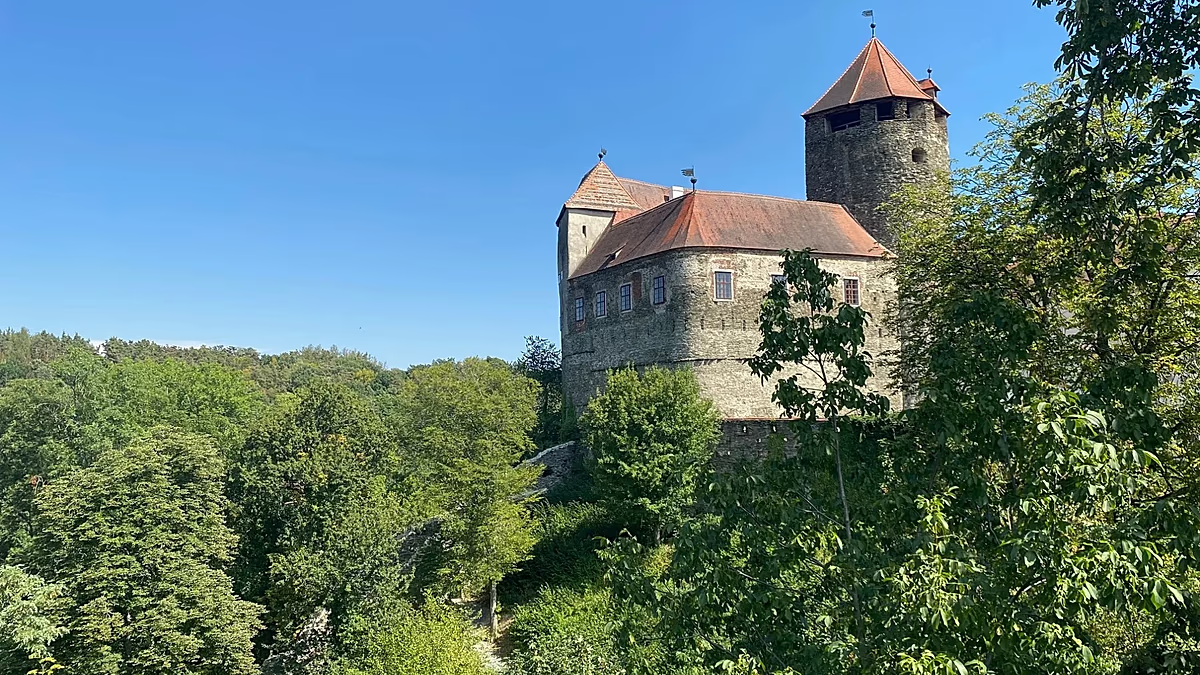
Crossing into Austria, the landscape opens up into the beautiful world of Geschriebenstein Nature Park, where the old Lockenhaus castle rises from the forest like something out of a dream. This knight’s castle, once home to the mysterious Templars, has an atmosphere that is equal parts romance and mystery. The stone walls have seen centuries of secrets, and the surrounding woods are now crisscrossed by mountain bike trails that range from gentle rides for beginners to extremely difficult routes for seasoned riders. The balance between hikers and bikers is handled with remarkable care: the bicycle trails are separated from the walking routes, so neither group has to worry about collisions or frightening the wildlife. For cyclists, the Burgenland Trails shuttle bus is a wonderful invention. From the nearby town of Rechnitz, minibuses equipped to carry bikes operate on a regular schedule during weekends and public holidays, taking cyclists and their bicycles up to designated trailheads. From Geschriebenstein, the region’s highest peak, bikers can ride in any direction they choose, toward Lockenhaus, toward the Rechnitz Badesee, or even into Hungary. The castle itself is not just a monument for human history. It also hosts a remarkable colony of Geoffroy’s bats, and visitors can observe these small, fluttering creatures from April to July. The bat colony shares the castle with feathered residents such as majestic kestrels and lightning-fast swifts, which dart across the sky in aerial displays that seem to defy the laws of physics. If you are lucky, you might also spot a beaver family by the lake near the castle, going about their quiet business in the twilight. There is something deeply reassuring about a castle that is not only preserved for visitors but also alive with wildlife, as if history and nature have finally found a way to share the same roof.
Just twenty-two kilometers from Lockenhaus, along the R1 Jubiläumsradweg bicycle road, stands the medieval town of Stadtschlaining, another jewel of the Austrian-Hungarian border region. Its thirteenth-century castle, Burg Schlaining, sits on the outskirts of town and has been beautifully preserved, giving visitors the sense that they have stepped back into a time when knights and merchants and travelers all followed the same winding roads. The medieval center of Stadtschlaining is compact but full of character, with old facades, narrow streets, and an atmosphere that encourages slow wandering. The town is surrounded by gentle hills and green countryside, making it an excellent base for walking and bike rides. At the end of a day of exploration, visitors can simply sit in the castle gardens and enjoy the peaceful view, and the best part is that this quiet pleasure does not cost anything. Stadtschlaining also serves as the starting point for excursions into the idyllic wine route of Südburgenland, a region that knows how to treat both its grapes and its guests. Here you can discover charming vineyards that seem to have been painted onto the hillsides, along with traditional heuriger wine taverns where the hospitality is as warm as the local wine. These taverns are more than just places to drink; they are community gathering spots where farmers and travelers share stories, toast the harvest, and celebrate the simple joy of being alive. The same farms also produce cider, a crisp and refreshing alternative to wine, made from apples that grow abundantly in the surrounding orchards. To wander through this landscape is to understand that the people here know the value of patience, of watching the seasons turn, and of savoring the fruits of their labor.
What makes this corner of Europe so special is not any single castle or peak, but the way everything seems to fit together naturally. The mountains are old, the forests are deep, and the history is so present that it feels like a living companion rather than a distant memory. You can start your morning in Hungary, walking through Celtic terraces and Roman ruins, cross an invisible line into Austria, and end your evening in a medieval castle listening to the quiet wings of bats. The border is not a barrier; it is a reminder that human lives and stories do not always follow the lines drawn on maps. This is a place where active weekends become learning experiences without ever feeling like school. The hiking trails challenge your body, the springs cool your feet, the old houses whisper their secrets, and the vineyards offer their sweetness. Whether you prefer to walk, to ride a bicycle, or simply to sit in a garden and look out over the hills, you will find a welcome here. The region seems to say that history is not a distant thing to be read about in books; it is a path under your feet, a chapel in the trees, a castle where bats and kestrels share the sky. So if you are dreaming of a weekend that will leave you tired, inspired, and a little bit wiser, follow the eastern slopes of the Alps to Velem, Kőszeg, Lockenhaus, and Stadtschlaining. These places will reward your curiosity with beauty, your effort with wonder, and your spirit with the timeless feeling of being connected to something much larger than yourself.