





Here is a humanized and comprehensive summary of the trends and highlights surrounding the search for quiet European escapes, focusing on the recent ranking that placed a Greek island at the top.
The New “Quiet” Rush
There is a special kind of magic that happens when you find a place untouched by the cacophony of modern life—a place where the loudest sound is the gentle lapping of the sea against ancient rocks or the distant bleating of a goat somewhere up a hillside. For the modern traveler, these moments have become the ultimate luxury, shifting the focus from ticking off crowded landmarks to actually listening to the silence. This shift is not just a passing preference; it’s a behavioral revolution. As the post-pandemic travel boom has exploded, bringing with it congested city centers and overcrowded beaches, a fascinating counter-movement has been gaining rapid momentum. The search for “quiet destinations” has soared by a massive margin, with travelers actively hunting for places that offer a more contemplative, serene, and authentic experience. It’s a shift away from the tour operators’ checklists toward a more soulful pursuit of space, history, and nature, perfectly aligned with the growing understanding that the best vacations are not just about seeing somewhere new, but about feeling profoundly different while doing so.
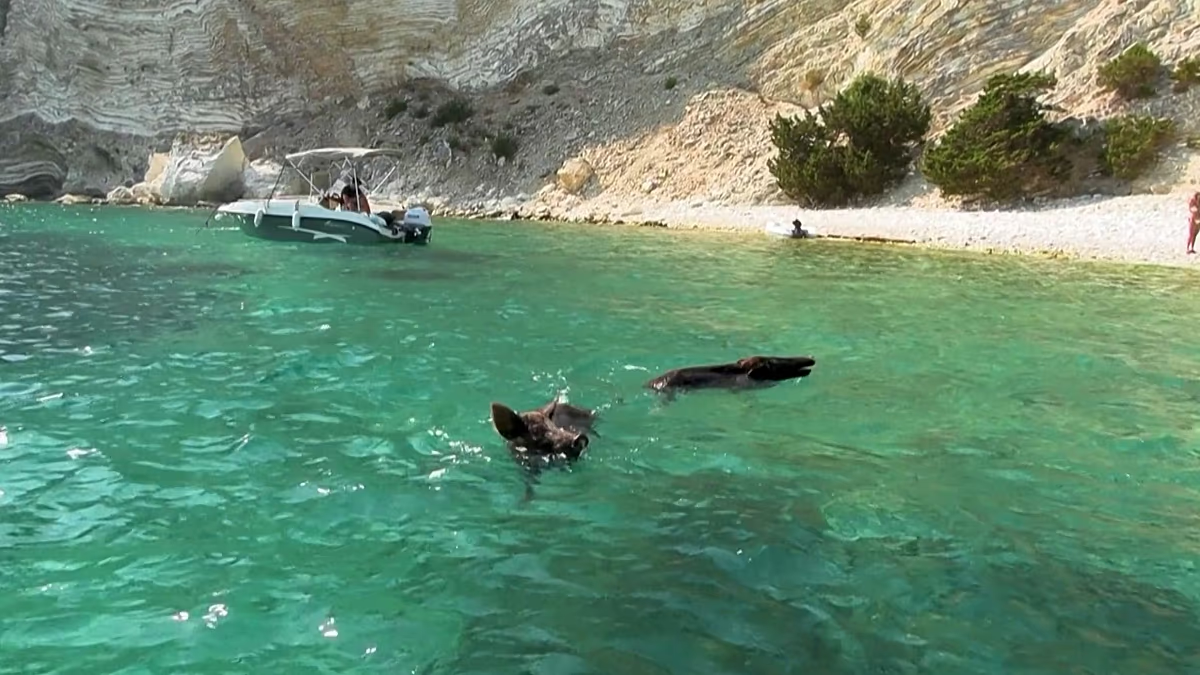
At the heart of this movement lies a brand new ranking that has just been released, and it has thrown the spotlight onto a place that perfectly encapsulates this desire for seclusion and beauty. A minuscule Greek island has come out on top, dethroning more established but far busier rivals in the race for tranquility. While the Greek islands as a whole have long been a favorite for many, this particular spot has managed to retain its unhurried rhythm and local authenticity. This is the clear winner for intrepid travelers who are determined to experience the true spirit of the Mediterranean, complete with whitewashed villages that tumble down to turquoise coves, all without the jostling crowds that frequently plague its more famous neighbors. It proves that a quiet revolution is taking place in the way we travel.
The Allure of the Unspoiled
For most of us, the desire for a “quiet destination” is about far more than just avoiding a queue for a sunbed—it’s about reclaiming a sense of ownership over our time and experiences. There is a fundamental shift in how we perceive time away from our daily lives. We have moved on from the concept of a holiday as a series of photo opportunities at major monuments, and instead crave the feeling of being a temporary local, even if just for a few days. When you step onto the island that topped this list, you immediately understand why it’s so special. The decisions are made deliberately, from the support of the local tavernas that rely on family recipes passed down for centuries, to the small, family-run guesthouses that dot the hillsides. The pace of life is dictated by the elements, not the clock. This, in turn, creates a more profound travel experience. Without the constant hum of souvenir shops and fast-food restaurants, you’re left with the essentials: good food, great company, and stunning vistas that you can actually hear yourself think above.
The appeal is deeply psychological, tapping into a primal need for safety and restoration. Quietude is the new luxury in a world that is almost always turned up to eleven. When we are constantly bombarded with visual and auditory stimuli, our brains are in a state of constant low-level alert, even when we don’t realize it. However, the moment you arrive in a place where the only sounds are the rustle of the olive trees and the gentle ebb and flow of the tide, your body starts to decompress. This is what travel used to be like—a true break from the everyday. The ranking wisely takes this into account, looking beyond the simple infrastructure of a destination to assess its “quiet” atmosphere and the authenticity of the experience on offer. For the island that clinched the top spot, this means a triumphant win for a different way of being—one that prioritizes genuine human connection and appreciation for our natural surroundings over the performative aspect of travel.
A New Standard of Luxury
What constitutes a “quiet escape” has changed just as much as the travelers who seek them. It’s no longer enough to simply have a list of archaeological sites or beaches; the journey to and from the location becomes a key part of the experience. The top-ranked destinations have this in common: they are not easy to reach, but they are certainly not inconvenient. Instead, the journey itself becomes a form of decompression. The ferry ride that slowly approaches the island is a ritual of sorts, allowing you to leave the mainland—and your mental baggage—far behind. The anticipation builds with each passing wave, and when you step off the boat, you’re not just arriving at a new location; you’re arriving at a new state of mind. The digital detox is organic, not forced. The absence of constant connectivity is not a hindrance but a gift, allowing you to be more present for the platform of life happening around you—the old fisherman mending his nets, the family enjoying a long, lazy lunch under a vine-covered terrace.
This brings a level of intimacy to the travel that is simply impossible to manufacture in more popular destinations. It allows for exploration that is not a check-list, but a discovery. You might stumble upon a small, secluded cove that isn’t listed in any guidebook, or find a local bakery that serves the most incredible spanakopita you’ve ever tasted. These islands are also part of a larger network of similar destinations that are enjoying a well-deserved moment in the spotlight and collectively represent a better way forward for the tourism industry. They demonstrate that sustainable tourism is not just about protecting the environment; it’s about protecting the culture, supporting the local economy, and leaving a place better than you found it. By promoting these smaller, out-of-the-way places, local communities are able to control the narrative of their own tourism and maintain the very essence that makes them so special.
The Journey to True Seclusion
Yet, even with the top pick so clearly defined, the secret to unlocking the best of these “quiet destinations” lies in understanding that the journey to them is often just as important as the destination itself. For instance, while the winner might be a tiny dot on the map, getting there often involves a stopover in the country’s larger city, which can be a shock to the system if you’ve been in rural solitude for a while. This transition, however, is part of the magic. It’s a gentle introduction to the culture and the pace of life that awaits you. Travel influencers and experts are quick to point out that the key to truly enjoying these places is to allow them to reveal themselves to you, rather than trying to force your way through a rigid itinerary. It’s about enjoying a long, lingering breakfast that stretches well into the afternoon, taking a siesta when the sun is high, and staying out late to watch the stars after a simple, delicious dinner. You aren’t just visiting a place; you are stepping into a story in which you are the supporting character, not the main attraction.
This behavior has major implications for the kind of traveler who is drawn to these hidden gems. You tend to find a community of like-minded souls—curious, open-minded, and respectful of the places they visit, who appreciate the slower pace and the opportunity to connect with others on a deeper level. There is a shared understanding that you are a guest in someone’s home, and this graciousness is repaid with incredible hospitality. The locals, unjaded by over-tourism, are often eager to share their stories, their food, and their love for their island with you. This sense of genuine connection is what separates a trip from a truly transformative travel experience. It is also a critical component of building a sustainable future for these islands—one where the locals are not driven out by high costs of living or overwhelmed by the daily influx of visitors, but rather remain proud stewards of a way of life they are keen to preserve.
The Future of Travel is Quiet
As we look toward the future of travel, it is clear which direction the winds of change are blowing. The days of the frantic, whistle-stop tours are numbered. Today’s traveler is more conscious, more intentional, and more willing to step off the beaten path, even if it means giving up a few modern conveniences. The rise of the “quiet destination” is not a fad; it is a fundamental realignment of our values. We are searching for depth in a shallow world, authenticity in a sea of the artificial, and above all, the profound peace that comes from silence. The Greek island that won the top spot is not an outlier; it is the herald of a new era in travel. It is a testament to the power of a slower, more thoughtful approach to exploring the world.
In conclusion, the “quiet destinations” trend is more than just a vacation style; it is a testament to our innate human desire to connect—with nature, with local culture, and with ourselves. The tiny Greek island that came out on top in this ranking isn’t just a place to go; it’s a feeling that you carry with you long after you’ve dusted the sand off your shoes, a feeling that is fast becoming the most precious souvenir we can possibly bring home. The search for quiet destinations is, ultimately, a search for the quiet parts of ourselves that we too often leave behind. As we move forward, may we all be a little more open to the whisper of the waves, the scent of wild herbs in the air, and the simple, profound luxury of being genuinely, gloriously unplugged.