





For decades, Greece has held a special place in the hearts of travelers, a sun-drenched land where ancient history meets postcard-perfect coastlines. This year, however, the data suggests that this beloved relationship has reached a new and unprecedented intensity. The country’s stunning island regions have not just been popular; they have become the undisputed epicenter of European tourism, drawing in visitors at a rate that dwarfs nearly every other destination in the European Union. According to freshly analyzed figures from Eurostat, the sheer volume of tourists flocking to the Greek Isles has created a phenomenon where the line between inviting guests and being overwhelmed by them is becoming increasingly blurred. The numbers paint a stark picture: in certain corners of this Mediterranean paradise, for every single permanent resident, there are more than a hundred nights of tourist stays, a ratio that signals a profound shift in the very fabric of these communities. It’s a situation that celebrates Greece’s immense global appeal while simultaneously raising pressing questions about sustainability, local life, and the future of travel itself.
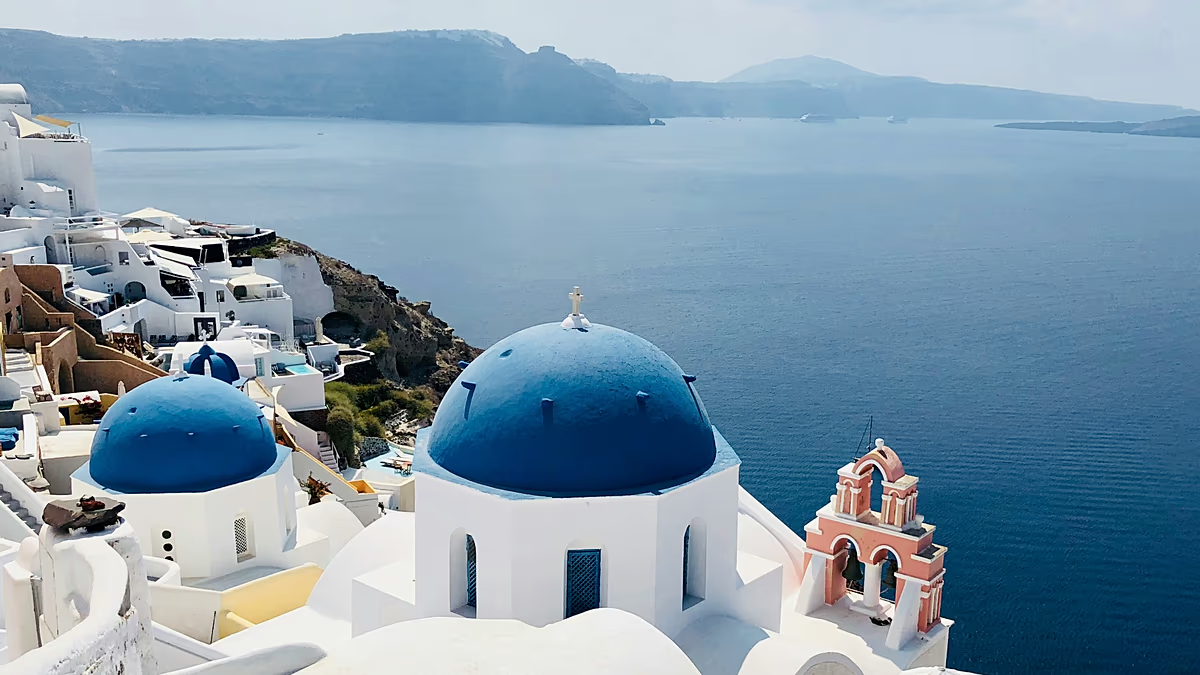
Leading this charge is the South Aegean region, a dazzling constellation of islands that includes the world-famous caldera of Santorini, the historic medieval town of Rhodes, and the sun-drenched beaches of Kos and Mykonos. In 2024, this region didn’t just top the charts; it obliterated the competition. The statistics reveal that tourists logged an astonishing 127.2 nights in the area for every single resident. To put that into perspective, the islands welcomed over 41.5 million overnight stays against a local population of roughly 326,000 people. This numerical chasm between the transient guest and the permanent local is the widest found anywhere in the entire European Union, marking the South Aegean as the continent’s ultimate hotspot of tourist saturation. Walking through the narrow, whitewashed streets of Oia in Santorini, you don’t just see tourists; you are immersed in a global crowd, where the chorus of different languages often drowns out the sound of the waves. The infrastructure has been stretched to its absolute limit to accommodate this influx, a testament to the region’s magnetic pull but also a cautionary tale about the double-edged sword of extreme popularity, where the very beauty that attracts the crowds is threatened by their sheer numbers.
Just a short distance away, the Ionian islands, located off the western coast of mainland Greece, offer a slightly different but equally intense story. Home to the emerald-green landscapes of Corfu, the party-centric shores of Zakynthos, and the charming, Venetian-influenced town of Kefalonia, this region secured the second-highest saturation level in the EU. The numbers here are just as formidable, with 102.6 nights recorded per resident. This translates to a massive 20.5 million overnight stays, a staggering figure when weighed against the local population of just around 200,000 people. The Ionian islands have long been celebrated for their lush, verdant scenery and a more relaxed atmosphere compared to their Aegean cousins, but the recent data suggests that the secret is well and truly out. The rise in popularity has brought undeniable economic benefits, but it has also transformed the rhythm of daily life. In Corfu’s old town, a UNESCO World Heritage site, the season is relentless, and the local tavernas that once served families now operate in a constant state of high rotation, catering to a never-ending stream of visitors seeking a taste of the Mediterranean dream.
While the Greek islands dominate the top of the ranking, they are not alone in experiencing this pressure. The analysis reveals that several other European regions are also feeling the strain of overtourism, though none so acutely as Greece. The Italian province of Bolzano, the gateway to the breathtaking Dolomites mountain range, recorded 68.9 nights per resident. This is a unique case, as the saturation is driven by both summer hiking and the world-renowned winter ski season, creating a year-round tourist economy in the Alps. Similarly, Croatia’s Adriatic coast, home to the cinematic city of Dubrovnik and the vibrant port of Split, followed closely with 67.5 nights per resident. The allure of the Game of Thrones filming locations and the crystal-clear Adriatic sea has solidified this region as a European power player in tourism. Even the Spanish Balearic islands, famous for the party atmosphere of Ibiza and the family-friendly beaches of Mallorca, recorded a significant 60 nights per resident. And back in Greece, the largest island of Crete, a destination known for its Minoan ruins and rugged beauty, earned the sixth spot with 55.6 nights per resident, proving that the saturation issue is not confined to the smaller, more famous islands alone.
To truly grasp the magnitude of the phenomenon in Greece, one must look at the broader European landscape, where the contrast is stark and illuminating. Across the EU as a whole, the vast majority of regions recorded fewer than 15 nights per resident compared to tourist stays. This means that the 127-night figure for the South Aegean isn’t just a little high; it is roughly eight times the rate of what could be considered a normal or manageable level of tourism. Even within Greece itself, the disparity is huge. The North Aegean region, which includes islands like Lesbos and Chios, recorded just 14.9 nights per resident. While this figure seems modest in comparison, it was still high enough to earn it the 24th position out of all European regions, indicating that even Greece’s less-hyped destinations are busier than much of the continent. This stark unevenness highlights a significant challenge: the immense popularity of a few iconic destinations draws resources and attention away from other beautiful but quieter regions, creating a cycle where the most popular spots become increasingly overwhelmed while others struggle to attract visitors.
At the opposite end of the spectrum, the data reveals the extremes of the European travel landscape. The Mazowieckie region, which surrounds Warsaw in Poland, recorded a mere 0.7 nights per resident, a figure that is almost negligible given Poland’s emerging status as a tourist destination. Yet, this was not the lowest ranking. The final spot was taken by Mayotte, a French island located in the Indian Ocean between Madagascar and Mozambique. This territory, which is an integral part of the EU despite its geographic distance, reported just 0.5 nights per resident. These figures serve as a powerful reminder of the profound concentration of global tourism. While millions flock to a handful of island beaches and alpine peaks, vast swathes of the continent remain untrodden by international visitors. This imbalance underscores the fact that travel is not evenly distributed but rather flows along well-established, heavily marketed routes. For a traveller, this contrast offers a choice between joining the crowds at world-famous landmarks or exploring the quieter, equally rewarding corners of Europe, where the welcome might be warmer and the experience more authentic.
Ultimately, the new Eurostat figures are far more than a simple ranking of popular places; they are a profound reflection of the state of modern travel. They tell a story of an insatiable global appetite for sun, sea, culture, and new experiences, and how that appetite is reshaping remote communities. The data from Greece is a clarion call, a warning that the current model of mass tourism is straining the very places we cherish most. The charm of Santorini lies in its beautiful sunsets and white-washed architecture, but when you are packed shoulder-to-shoulder with thousands of others watching that sunset, the experience can be diminished. The data forces a critical conversation about capacity, sustainability, and quality of life for the thousands of people who call these islands home. For Greece, a country whose economy is heavily reliant on tourism, the challenge is immense. The decision-makers must now walk a tightrope, trying to manage the influx in a way that preserves the islands’ unique character and protects the environment for future generations, all while maintaining a thriving industry. The 2024 numbers are not just a badge of honor for their popularity; they are an urgent memo that the golden era of unchecked growth must give way to a more thoughtful, balanced, and responsible approach to welcoming the world.