





Europe’s summer of 2026 felt like a scene from a story of resilience, motion, and quiet determination. While the world watched news of conflict in the Middle East, the continent’s airports were humming with a life of their own. Families, students, backpackers, couples, and solo adventurers filled terminals from Lisbon to Athens, dragging suitcases, sipping overpriced coffee, scanning departure boards, and hoping for a text-free day from their airline. It was the busiest summer ever recorded in European skies. Between July and August, an average of nearly 36,000 flights took off and landed every single day. That is more than one flight every two seconds across the continent, day and night, in heatwaves, through thunderstorms, over mountains, and across crowded airspace. What makes this even more remarkable is that this record-breaking season unfolded against the backdrop of a war that involved the United States and Iran, a conflict that inevitably rippled through global aviation, affecting routes, fuel costs, insurance, and traveler confidence. And yet, people still flew. In fact, they flew in greater numbers than ever before, often choosing to stay closer to home, rediscovering Europe’s own coasts, islands, cities, and countryside. The summer of 2026 was not just a statistic; it was a testament to how deeply travel has become woven into modern life, and how hard airports, airlines, and air traffic controllers worked to keep the world moving even when geopolitics tried to ground it.
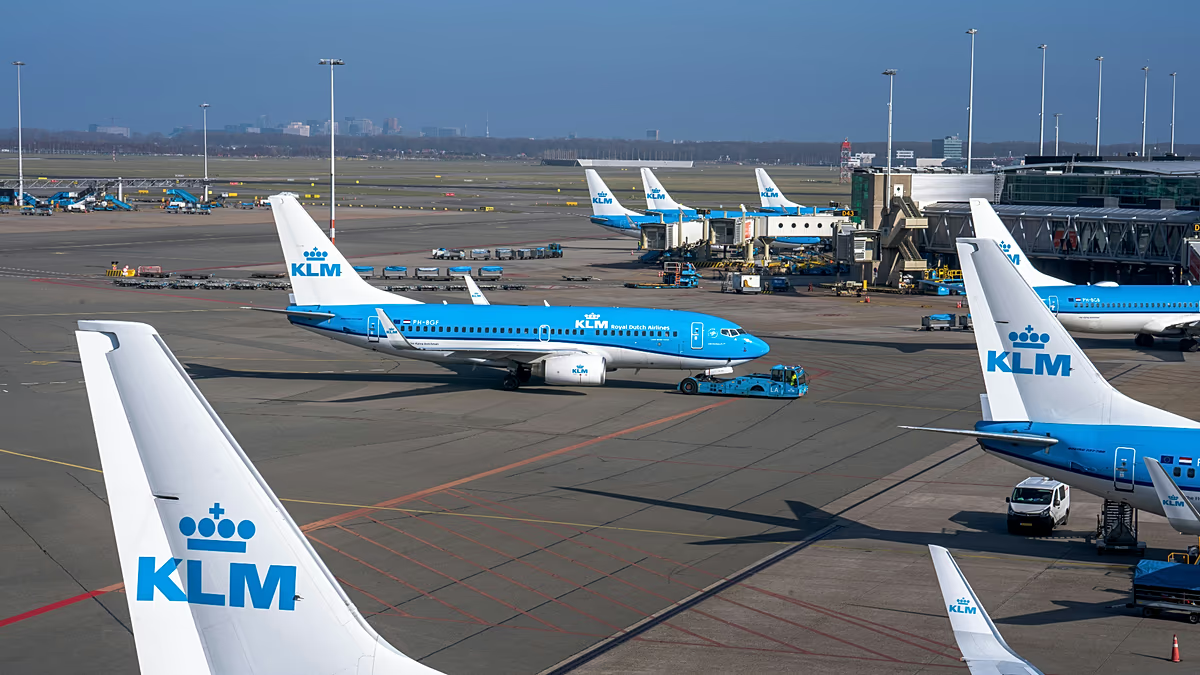
The numbers tell a story of extraordinary scale. Eurocontrol, the agency that coordinates air traffic across Europe, released its report on Friday, and the figures are striking. From July to August, Europe saw an average of 35,959 commercial flights per day, a 2.4 percent increase compared to the same period in 2025. On Friday, July 10, the continent hit an all-time daily record of 37,640 flights in a single day. To put that in perspective, imagine a city the size of Monaco being lifted into the air and moved across borders every 24 hours, with every flight needing a departure slot, a route, a climb, a descent, and a safe landing. This wasn’t just a busy summer; it was a logistical symphony performed at maximum volume. What’s even more encouraging is that, despite the chaos of record traffic and external disruptions, arrival punctuality improved. About 72.6 percent of flights arrived on time, which is 1.2 percentage points better than the previous summer. That may not sound like a huge leap, but for passengers it meant millions fewer missed connections, family dinners, business meetings, and precious vacation hours lost to tarmac waiting. It also means that the men and women behind the scenes—air traffic controllers, ground crews, airline dispatchers, and ramp agents—managed to keep things flowing smoothly even as the pressure mounted. The summer airspace felt like a crowded highway where everyone had to cooperate perfectly, and for the most part, they did.
Still, not everything was smooth. France, as often happens, emerged as the weakest link in the European air traffic control chain. The country accounted for a staggering 32 percent of all delays caused by air traffic control management issues. Anyone who has ever sat on a runway in Paris, Lyon, or Nice, watching the minutes tick by while the pilot explains “we are waiting for a departure slot,” understands the frustration. The reasons are complex: French airspace is among the busiest in Europe, its air traffic control system is centralized, and it experiences recurring staffing shortages and industrial action. This summer was no different, and thousands of flights were delayed because of constraints in French air traffic control centers, even when the weather was clear and the rest of the network was running smoothly. For passengers, these delays were more than just an inconvenience. They meant missed connections in far-flung airports, rebooked holidays, extra hotel nights, and the exhaustion of arriving home a day late with a suitcase full of dirty laundry. Yet, despite France’s persistent struggles, the overall on-time performance across Europe improved. That is a quiet miracle of coordination. It shows that when airlines, airports, and controllers work together, even a large bottleneck like France can be absorbed into a system that somehow maintains safety and dependability. But it also raises a question that has been asked for years: how much longer can Europe rely on aging air traffic infrastructure that splits the sky into national fragments, especially when demand keeps growing every summer?
The war between the United States and Iran left a deep imprint on Europe’s travel patterns. Eurocontrol acknowledged that the conflict influenced the tourist season in ways that were both visible and subtle. Some regions saw fewer flights. Bulgaria, Hungary, and Türkiye experienced lower traffic compared to previous summers, likely because of concerns about flying over or near conflict zones and uncertainty about the broader Middle East. But interestingly, the same conflict pushed many Europeans to holiday within their own continent, which they perceived as safer and more predictable. The report found a “high increase” in traffic to Albania, Croatia, Cyprus, Greece, Montenegro, North Macedonia, Serbia, and Slovenia, along with “continuous growth in southwest Europe.” There is something deeply human about this behavior. When the world feels unstable, we gravitate toward what feels familiar and protected. We swap distant, exotic destinations for a sun-drenched Greek island or a quiet Adriatic cove, not because we are afraid, but because we want to feel safe while still experiencing the joy of discovery. The war did not stop travel; it rerouted it. It redrew the mental maps of millions of Europeans, who looked at the news, considered their options, and chose a beach in Croatia over a bazaar in Istanbul, or a mountain village in Montenegro over a hotel in Cairo. In a strange way, the conflict created an unintended boost for parts of Europe that have long been overlooked, giving smaller countries a moment in the spotlight and helping local economies at a time when global uncertainty threatened the tourism industry.
Greece, in particular, felt the full force of this travel surge. Record passenger numbers streamed through Greek airports throughout the summer, pushing the country’s air traffic control system to its absolute limit, especially during the peak season. Athens, Thessaloniki, Heraklion, Rhodes, Corfu, Mykonos, Santorini—each one became a gateway to the mythic beauty of the Aegean and Ionian seas, but also a pressure point for controllers who had to manage wave after wave of arriving and departing aircraft. The human story here is one of extraordinary effort. Air traffic controllers in Greece worked long shifts in packed control towers, staring at radar screens crowded with targets, coordinating with pilots who were often flying into islands with short runways and tricky winds. Airlines, too, pushed their operations to the edge. Yet the system held. It bent, but it did not break. And the rewards were visible everywhere: in the jammed promenades of Nafplio, the overflowing tavernas of Corfu, the crowded ferries between islands, and the radiant smiles of travellers who had finally made it to the place they dreamed about all year. Greece’s success was not just a number on a chart. It was the sound of bouzouki music drifting into the night, the smell of grilled octopus in seaside restaurants, the sight of families laughing as waves lapped the shore, and the quiet satisfaction of a country that had bet everything on tourism and seen that bet pay off, despite geopolitical headwinds and the strain on its own infrastructure.
Beyond Greece, the summer of 2026 was one for the record books across a wide swath of Europe. No fewer than fourteen countries saw their highest-ever daily traffic for arrivals and departures this summer: Albania, Armenia, Georgia, Greece, Ireland, Italy, Moldova, North Macedonia, Montenegro, Portugal, Serbia, Slovakia, Spain, and Türkiye. That is a remarkable wave of growth spanning everything from tiny Moldova to massive Spain, from the Adriatic coast to the Atlantic edge. Each of these countries had its own story. In Albania and Montenegro, tourism has been growing for years, and this summer accelerated that trend. In Ireland and Portugal, travellers were drawn by culture, coastline, and friendly welcomes. In Slovakia and Moldova, the increase may have been smaller in absolute numbers, but it still represented a moment of arrival on the aviation map. The same was true for airlines. Several carriers and airline groups celebrated record traffic, including Aegean, Air Serbia, easyJet, Jet2.com, Pegasus, Royal Air Maroc, Ryanair, Sky Express, SunExpress, Turkish Airlines, and Wizz Air. These airlines are very different: some are full-service national carriers, others are low-cost giants; some fly only short hops, others stretch into Africa and Asia. But they all shared one thing in 2026: a summer of demand so strong that their planes were packed, their crews were busy, and their schedules were stretched to the limit. For a young pilot in Serbia or Greece, seeing their airline hit record numbers must have felt like a personal triumph, proof that their chosen profession was part of something vital. For a flight attendant on easyJet, it meant a blur of airmiles, early starts, and the deep satisfaction of carrying thousands of passengers to their holidays.
By the end of August, as children returned to school and the first leaves began to turn, the great summer migration drew to a close. But the season left behind more than just statistics. It left a powerful reminder that, even in a world shadowed by conflict, people need to move, to travel, to connect, to rest, and to explore. The skies over Europe were full of stories: a mother travelling with her two kids to meet grandparents in Lisbon, a couple celebrating their anniversary in Santorini, a group of friends hiking in Montenegro, a businesswoman closing a deal in Milan, a student flying home to Dublin after a summer job. Behind every flight number was a heart, a plan, a hope. The record-breaking summer of 2026 was not simply a triumph of logistics or aviation engineering. It was a reflection of human stubbornness and optimism, of our refusal to let geopolitics trap us in our own corners of the world. Yes, there were delays. Yes, France struggled. Yes, some destinations were missed and others were overrun. But 72.6 percent of flights arrived on time, and tens of millions of passengers reached their destinations safely. As Europe looks ahead to the autumn and winter, the question is how to build on this success, how to modernize air traffic control, how to support smaller countries that are suddenly on the rise, and how to keep the system resilient in the face of future shocks. The summer of 2026 will be remembered as the year Europe’s skies roared with activity, not despite the world’s troubles, but because people chose to carry on living, loving, and travelling anyway. That is a beautiful thing, and it deserves more than a number in a report. It deserves a quiet moment of appreciation the next time you fasten your seatbelt and look out the window, watching a continent unfold beneath you, busy, beautiful, and unbreakable.