






Something is changing in the way people choose to see the world. Tourism on two wheels is booming, with Google searches for “cycling holiday” up by a remarkable 292%. More and more travellers are swapping airport terminals for open roads, discovering that a bike can unlock a destination in a way no car, train or plane ever could. A cycling trip is never just about the bike—it’s about the wind in your face, the smell of the countryside, the slow unfolding of a landscape from one silent valley to the next. That’s why a new study by the adventure booking platform Explore set out to find which routes in the world are truly unforgettable. Using eye-tracking software, researchers showed 200 participants images of 52 renowned cycling routes from across the globe. The technology recorded how quickly each route captured their attention and how long it held it, combining these measurements into a weighted “eye-catching” score out of 100. The result is a ranking that speaks to something deeper than stats: it reveals which landscapes genuinely stop us in our tracks. “There’s something about seeing a country from the saddle that no other kind of travel can match,” said Luke Judd, travel expert at Explore. “You’re moving fast enough to cover real ground, but slow enough to take it all in.” For anyone who has ever crested a climb and caught their first glimpse of a distant horizon, that feeling is instantly familiar.
The study’s podium is surprisingly far from Europe. Canada’s Bow Valley Parkway, a scenic, winding route threading between Banff and Lake Louise in the heart of the Rocky Mountains, takes the top spot with a near-perfect score of 97 out of 100. It’s easy to see why: this is a road that feels like a film set, with elk grazing beside the pavement, turquoise glacial lakes flashing through pine forests, and towering peaks that seem to stretch on forever. Just behind, Australia’s Great Ocean Road earns a score of 94. Stretching along the southwest coast of Victoria, this legendary route hugs cliffs above the roaring Southern Ocean, passing the limestone stacks of the Twelve Apostles and endless beaches that turn from gold to orange at sunset. These two icons are powerful reminders that some of the world’s most spectacular cycling experiences lie far from Europe. Yet the real headline of the ranking is Europe’s depth. Eight of the top 15 routes are on the continent, a remarkable showing given that the list spans four continents. For cyclists in Europe, the message is clear: some of the planet’s most breathtaking rides are almost on your doorstep, waiting to be discovered.
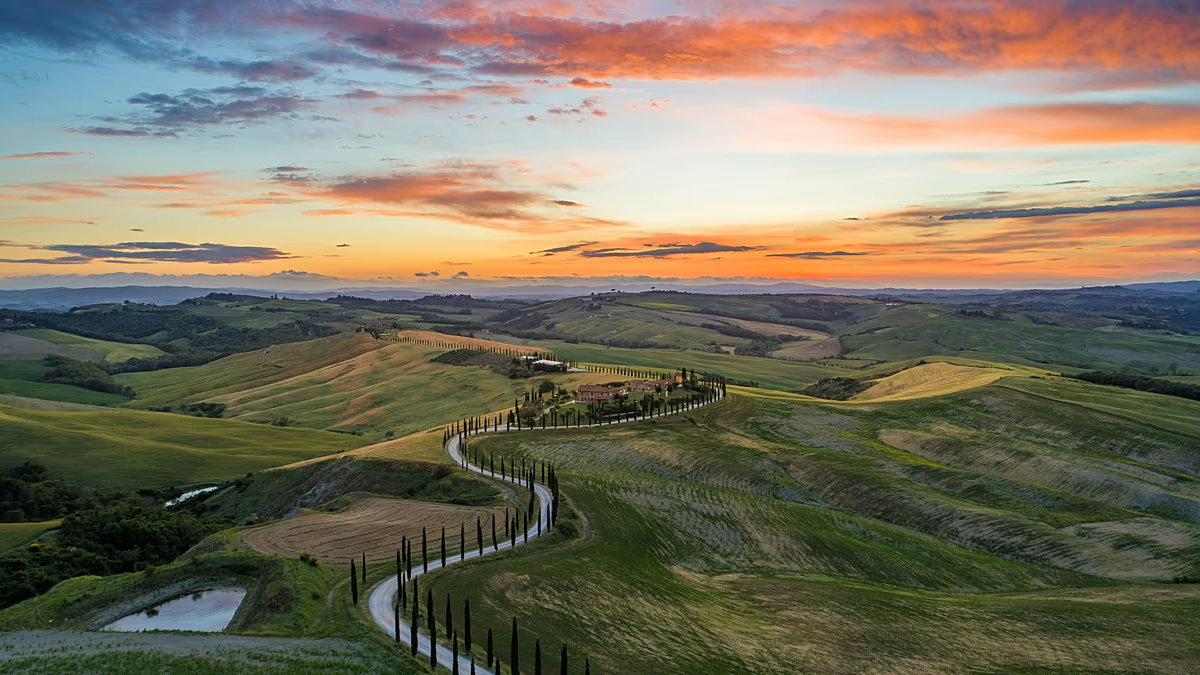
Among the European entries, Italy and Germany shine especially brightly. In third place, with a score of 91, are Tuscany’s Gravel Routes, a network of unpaved roads that weave through one of the most beloved landscapes in the world. This is the terrain made famous by springtime professional one-day races, where riders tackle cypress-lined climbs, push through working vineyards and emerge in centuries-old hilltop towns that appear to float above the mist. It is cycling at its most cinematic, a blend of physical effort and pure visual poetry. In fourth place, with a score of 90, is Germany’s Elbe Cycle Route, which follows the Elbe River for roughly 1,220 kilometres from Czechia toward the North Sea. The route passes through Saxony and Saxony-Anhalt, skirts several German states and runs right through Hamburg, offering a journey through historic cities, peaceful countryside and some of the most interesting landscapes in eastern and northern Germany. Then comes the Netherlands, a country that is almost synonymous with biking. Amsterdam Cycle Route 10 earns a score of 86, securing sixth place. This circular route is a perfect introduction to the city and its surroundings, taking riders past canals, parks and historic neighbourhoods before opening up into quieter countryside. It proves that a cycling trip doesn’t have to be epic or arduous to be unforgettable—sometimes the magic is in a slow, easy ride through familiar-looking streets that suddenly feel new.
The middle of the ranking offers a fascinating study in contrast. Italy’s Stelvio Pass, with a score of 82, is one of the toughest climbs in the world, notorious among professional cyclists and the second-highest road pass in the Alps. Its hairpin bends are a brutal test of legs and lungs, and reaching the summit feels like an achievement measured in more than just metres. France’s Provence Lavender Route, also with a score of 81, is mercifully easier. It is best experienced in summer, when the lavender plants are in full bloom and the countryside is bathed in colour and scent. The route winds through rolling hills, hilltop villages and the vast purple fields of the Luberon and Valensole Plateau, creating an almost dreamlike atmosphere. These two routes show just how broad the definition of beautiful can be: one is about triumphing over an impossible climb, the other about drifting gently through a painting. The United States also appears in this part of the ranking, with the dramatic Pacific Coast Highway claiming a score of 82 and Hawaii’s Road to Hana scoring 78, both offering stunning ocean views and jungle-draped curves that demand to be seen slowly and savoured.
For cyclists who prefer their scenery with a side of challenge, the top 15 is full of rugged northern adventures. Scotland’s North Coast 500, in 11th place with a score of 78, starts and finishes in Inverness and stretches for more than 800 kilometres. Even the fittest cyclists can expect to spend up to five days on its rugged, windswept roads, but the reward is an ever-changing panorama of dramatic cliffs, empty beaches, misty mountains and sea lochs that strike a chord deep in the imagination. France’s Route des Grandes Alpes offers a similar kind of grandeur, carrying riders from the shores of Lake Geneva all the way to the Mediterranean through some of the most spectacular scenery in the French Alps. With towering peaks, deep valleys, high mountain passes and picturesque villages, it is a ride that belongs on every serious cyclist’s bucket list—though its long, winding and sometimes steep sections mean it is best suited to experienced riders. The final European entry in the top 15 is the Lake Ohrid Circuit, in 14th place with a score of 76. Covering roughly 90 to 96 kilometres, this route crosses an international border between North Macedonia and Albania, passing the historic towns of Ohrid and Struga, the Monastery of Saint Naum and the Albanian lakeside town of Pogradec. It’s a ride with history around every bend, though riders should remember their passport to experience the whole route.
Completing the global picture are a few non-European routes that add even more variety to the list. Chile’s Carretera Austral, with a score of 86, shares fifth place with Amsterdam, offering untamed Patagonian wilderness, fjords and glacial peaks. The United States appears multiple times: the Pacific Coast Highway in California, the Road to Hana in Hawaii and the Slickrock Trail in Utah, which claims 76 points for its surreal rock formations and desert views. Canada also appears again with the Vancouver Seawall, scoring 75 and proving that city cycling can be just as beautiful as wilderness riding. Ultimately, this ranking is more than a list of pretty places. It is a celebration of how cycling changes the way we connect with the world. Whether it’s the quiet thrill of a lavender field, the raw power of a mountain pass or the simple joy of a canal-side pedal through Amsterdam, the best routes are the ones that stay with us long after the ride ends. In an era of fast travel and fleeting images, the bicycle offers something rare: presence. As the research shows, the world’s most beautiful routes aren’t just admired—they are felt. And perhaps that’s why so many of us are searching for a cycling holiday of our own.