






When Jules Verne first imagined Phileas Fogg racing around the globe in eighty days, he captured something essential about the restless human spirit. The idea was thrilling: to compress the entire planet into a tight schedule, to cross oceans and continents with barely a pause, to prove that the world could be measured and mastered by timetables. For more than a century, that fantasy has inspired travellers to follow in Fogg’s footsteps, chasing ever-faster connections, ticking off countries with the kind of urgency that would make any modern frequent flyer proud. But there is another, quieter truth hidden in Verne’s story: the world is not a checklist. It is a place to be tasted, lingered over, and understood. And if the goal is truly to see the world, rather than simply to cross it off, then speed is almost the enemy. That is exactly the philosophy behind Explorations by Norwegian, a remarkable new voyage that has just launched, offering passengers not eighty days, but more than a year to let the planet slowly unfold around them.
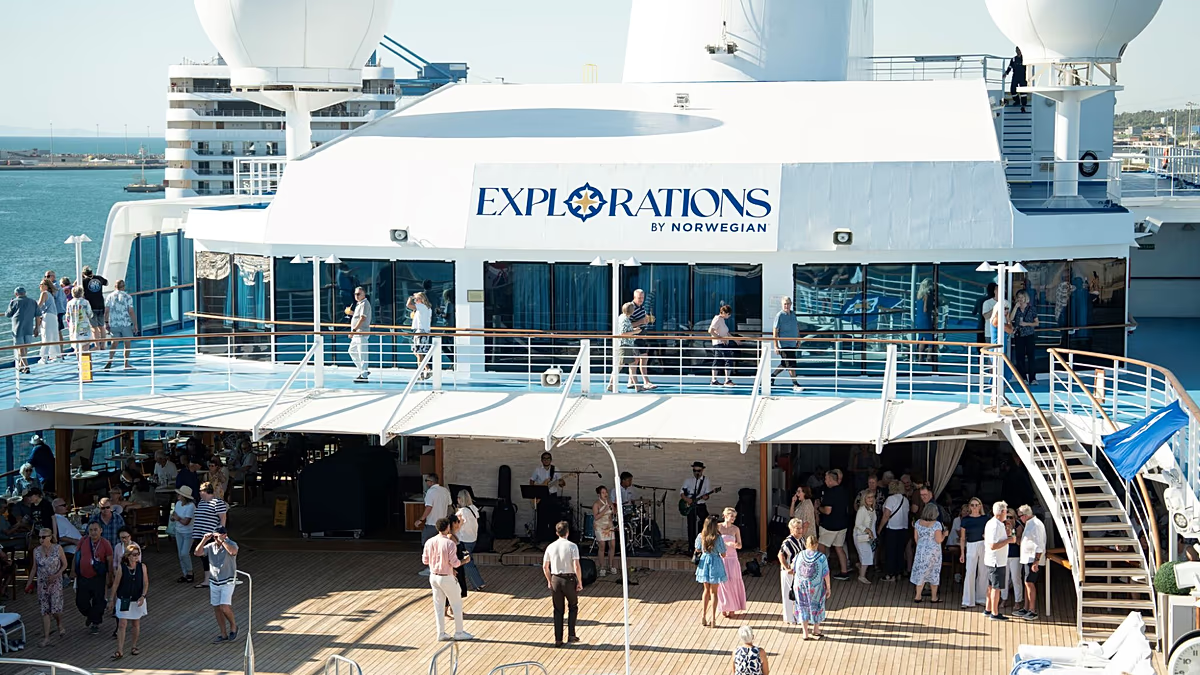
The vessel chosen for this extraordinary undertaking is the Regatta, a 348-room ship that feels more like a floating home than a floating resort. It has just slipped out of Rome on the first sailing of what is being called the world’s longest continuous scheduled cruise: a 371-day journey that will wind through 220 ports in 62 countries. If you missed that departure by a matter of days, you are not entirely out of luck. A second voyage, lasting 367 days, is already scheduled to begin in February, providing another chance to hand over worries, calendars and responsibilities for more than a year of continuous navigation. The numbers alone are staggering. More than five hundred days of travel, a route that touches every meaningful corner of the planet, and a pace that is deliberately, gloriously slow. This is not about rushing from landmark to landmark. It is about waking up to a new horizon every few mornings, coming to know the rhythms of the sea, and letting the world come to you rather than chasing it.
For those who have dreamed of seeing every shade of the earth, the itinerary reads like a love letter to travel itself. In Europe, the Regatta glides into places that have inspired writers, painters and dreamers for centuries: Santorini with its dazzling white cliffs and blue domes, Naples smoking in the shadow of Vesuvius, Copenhagen’s canals catching the soft Nordic light, and Helsinki rising clean and elegant from the Baltic. The journey then moves south and east, to Africa, where stops include the sun-scorched islands of Cape Verde, the majestic sweep of Cape Town beneath Table Mountain, and the spice-scented alleys of Zanzibar. Further on, Asia unfurls in an almost overwhelming sequence of contrasts: Hiroshima, a city of quiet memorials and stubborn hope; Jeju Island, with its volcanic landscapes and wind-bent trees; Colombo, bustling and chaotic and alive; Malé, low-lying and palm-fringed, a hinge between ocean and sky. And across the Atlantic, the Americas offer their own epic spectrum, from the icy glaciers of Alaska to the dense, breathing green of the Amazon. It is difficult to imagine a more complete portrait of the planet, a catalogue that includes snowfields, rainforests, ancient cities, coral atolls, fjords, deserts and everything in between.
All of this, of course, comes at a significant price. A place aboard the Regatta for the full journey costs NZD$129,990, which translates to roughly €65,700 per person. That is not a sum to be taken lightly. It is, for most people, the kind of money that could buy a house, a retirement fund, or a substantial nest egg. But for those who can afford it, the price buys something that money ordinarily struggles to quantify: an entire year of life, freed from the usual routines, spent in a small community of like-minded wanderers on a ship that becomes home. There is, however, a more accessible doorway into this world. Norwegian is also offering a range of shorter itineraries for travellers who cannot commit to a year at sea. A 19-night voyage around Türkiye, the Greek islands and Malta offers a taste of the same unhurried spirit, a chance to explore the ancient Aegean without having to pack and unpack every few days. For many, that shorter journey may be the perfect introduction to a style of travel that prioritises depth over distance, and presence over progress.
There is something deeply human about the impulse to slow down, to let a journey absorb you rather than simply passing through it. The Regatta is designed to facilitate exactly that kind of experience. With only 348 rooms, it is intimate enough that passengers quickly become familiar faces, crew members learn your breakfast order, and strangers become friends over a shared sunset on the deck. There are no frantic early-morning flights to catch, no hurried checkouts, no wrestling with luggage. You unpack once and spend the rest of the year in a state of rare stability. On sea days, there is time to read, to write, to stare thoughtfully at the horizon, or to do absolutely nothing at all. And when the ship reaches a port, passengers are free to step off and wander, to taste a new cuisine, to listen to a language they have never heard, to feel the particular texture of a different place. Over more than a year, these moments accumulate into a profound understanding of how vast and varied human life really is. The previous holder of the longest-cruise title, the Ultimate World Cruise by Royal Caribbean, lasted 274 nights. The Regatta extends the concept by nearly a hundred days, not merely for the sake of a record, but because the extra time allows a different rhythm to emerge, one closer to the way we actually live, rather than the way we usually travel.
Ultimately, Explorations by Norwegian is more than a cruise. It is a philosophical statement about what travel can be when it is freed from the tyranny of the clock. Verne’s Phileas Fogg was a man obsessed with precision, but the true treasure of his journey was not the fact that he returned to London in time. It was the encounters, the landscapes, the detours and the human connections he found along the way. In that sense, the Regatta is a modern correction to Fogg’s story. It says that the point of circling the globe is not to prove you can do it quickly, but to prove you can do it thoughtfully. For those who have already missed the first sailing, February is not far away. The ship will wait, the ocean will call, and another chance will come to exchange the noise of ordinary life for the quiet, endless horizon. Whether you book the full 367 days or just nineteen nights among the Greek islands, the message is the same: slow down, look around, and let the world reveal itself. Because in the end, the greatest journey is not about how many miles you cover, but how much of the world you truly allow inside.