





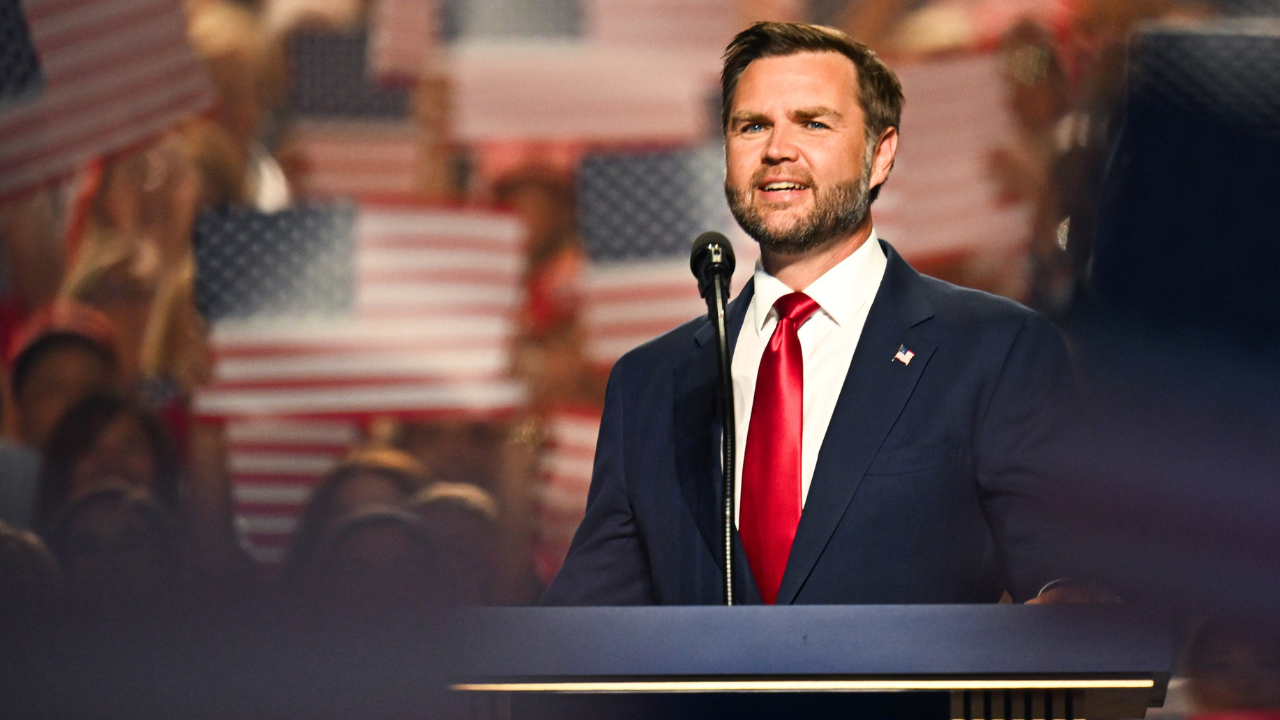
In a crowded convention hall in Dallas, Vice President JD Vance stood before a sea of Republican loyalists, but the tone he chose was less like a typical political rally and more like a father trying to explain the future he wants for his children. The GOP’s midterm convention gave Vance one of his largest and most prominent national stages since taking office, and he used the moment to lay out a deeply personal vision of what America owes its youngest citizens. With his wife and family in mind, and with a newborn son named Alec at home — a baby born just six weeks earlier — Vance spoke about the idea of inheritance. He said that every American child is born an heir, not heir to a fortune or a famous name, but heir to the country itself. “Every American child is born an heir, born with the right to inherit the blessings of the greatest country on Earth,” he told the audience. He made clear that this birthright does not depend on the identity of a child’s parents, the color of their skin, or the place they call home. Simply by being American, he argued, a child is entitled to a share of the nation’s promise. It was a majestic and powerful way to frame an election. Vance said this birthright is exactly what the November midterms are all about, and he urged the crowd to see the upcoming vote as something far greater than ordinary partisan combat.
From that sweeping opening, Vance moved to the practical realities that make his idea of inheritance meaningful. He was careful not to speak only in lofty abstractions; instead, he talked about the daily things parents worry about. Clean water. Healthy food. A quality education. Safe neighborhoods. The ability to afford a home and start a family. These are not extraordinary demands, Vance argued. They are the basic foundations of an American life, the quiet accommodations that allow children to grow up with dignity and hope. He connected those needs to the birth of his own son, Alec, whose arrival only weeks earlier had turned every abstract policy discussion into something intensely immediate. He also remembered his late friend Charlie Kirk, who was killed a year ago. Kirk, Vance said, spent his time encouraging young men to fall in love, to marry, to become fathers. It was an unusual and tender memory to include in a political keynote, but it made perfect sense. Vance was using his friend’s legacy to push back against a culture that often treats family formation as old-fashioned or even suspect. He placed fatherhood at the center of his political philosophy, describing the simple act of raising children as a quiet act of defiance and patriotism. In that version of America, a wealthy inheritance is not measured in dollars, but in the security of the world a child inherits.
Those who had followed Vance’s rise during the 2024 campaign might have noticed a remarkable evolution in his voice. Earlier in his public life, he was best known for telling the story of his Appalachian childhood, a story of poverty and struggle and hard-won escape. That story remains a powerful part of his biography, but in Dallas he shifted his focus from the past to the future. He no longer stood before the audience as the boy from the hills who made good; he stood there as a father, with a newborn waiting at home, looking forward into a fragile and uncertain tomorrow. This change matters because Vance is now one of the most closely watched figures in the Republican Party’s post-Trump future. There is constant speculation about a possible presidential run in 2028, and this speech offered a glimpse into the themes he may carry with him into that race. He did not spend his time re-litigating old battles or dwelling on grievances from the past. Instead, he tried to claim the high ground of family and legacy. He wanted people to see him not as an angry warrior, but as a protector — a man who worries about what his children will breathe, drink, learn, and own. It was a sophisticated political approach, but it did not feel artificial. The presence of Alec, still a tiny and vulnerable human, made the message feel grounded. Vance was asking his party to think beyond the next election cycle and to consider the country his children will inherit.
Of course, no speech by a modern political leader would be complete without confronting the opposition, and Vance did so with striking intensity. After laying out his warm and deeply human vision of family and inheritance, he pivoted hard toward attack. He accused Democrats of abandoning working-class Americans, turning away from the very people who built the country’s wealth and strength. He argued that the Democratic Party had become consumed by hatred and hostility toward traditional values. “The Democrats are the party of hatred,” Vance said plainly. “They’re the party that despises America and the people who built it.” The words were stark, and they drew an enthusiastic reaction from the crowd. But they were not merely a political jab. For Vance, they reflected a worldview shaped by his own childhood. He grew up in communities that often felt ignored by the elites on both coasts, places where good jobs disappeared and family life fractured under the weight of economic pressure. He clearly believes that the party he now attacks turned its back on those communities, telling them their concerns were outdated and their culture was flawed. That conviction gives his criticism a personal urgency. He was not simply name-calling; he was fighting back on behalf of people he still seems to carry in his heart. Whether one agrees with him or not, there was an emotional depth to his anger that made the moment memorable.
Vance’s broader appeal was an attempt to lift the midterm election above the usual red versus blue rivalry. He told the audience that the upcoming vote is not a sporting event, and the result is not just about which party gets to control the levers of power. “This November is so much more than red team versus blue team,” he said. “It’s about fighting for our fellow citizens, for their dreams, and for the inheritance of a great nation that all of us are going to leave behind.” With those words, he was asking Republicans to see themselves as participants in a moral campaign, not just a political one. He wanted them to believe that their efforts in the election would determine whether children growing up today can find clean water, good schools, safe streets, and affordable homes. He was also asking them to think about dreams — not the dreams of unnamed abstract citizens, but the dreams of their own neighbors, their own children, their own futures. It was a humanizing way to frame the high stakes of the midterms. Instead of talking about polling, strategy, or parliamentary majorities, Vance spoke about inheritance and memory and the kind of world that will be passed along to a newborn like Alec. He wanted the crowd to leave the hall with a sense of weight and duty, understanding that the fight in November is not merely for a temporary political advantage, but for something permanent and sacred.
Taken as a whole, Vance’s keynote speech was a declaration of what he hopes the Republican Party will become after the current political era finally recedes. He is placing family, faith, and national identity at the center of his message, and he is doing so in a way that is both soft and severe at the same time. He used the fragile image of his six-week-old son to justify a fierce attack on his political opponents, combining tenderness with toughness in a way that could serve as a template for a future presidential campaign. Whether this approach will succeed beyond the confines of a friendly convention hall remains to be seen, but there was no doubt that Vance is growing into his own voice. He is no longer simply echoing the former president; he is beginning to define himself as a statesman who sees the future in the faces of his children. By remembering his late friend Charlie Kirk, and by speaking with fresh emotion about the birth of Alec, Vance made his political philosophy feel deeply personal. He is not offering a return to a mythical past; he is offering a vision of a promised land, a country where every child, no matter their origin, can claim a birthright of opportunity. For a father who has just welcomed a new life into the world, that message is not just political theory. It is a promise whispered over a crib, a hope written in the quiet hours of the night. And as the Republican Party looks toward the uncertain future, Vance has given it a story to tell — a story about heirs, dreams, and the inheritance we all must protect.