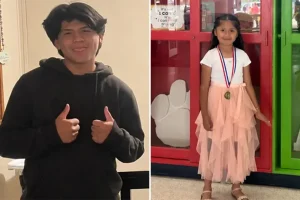






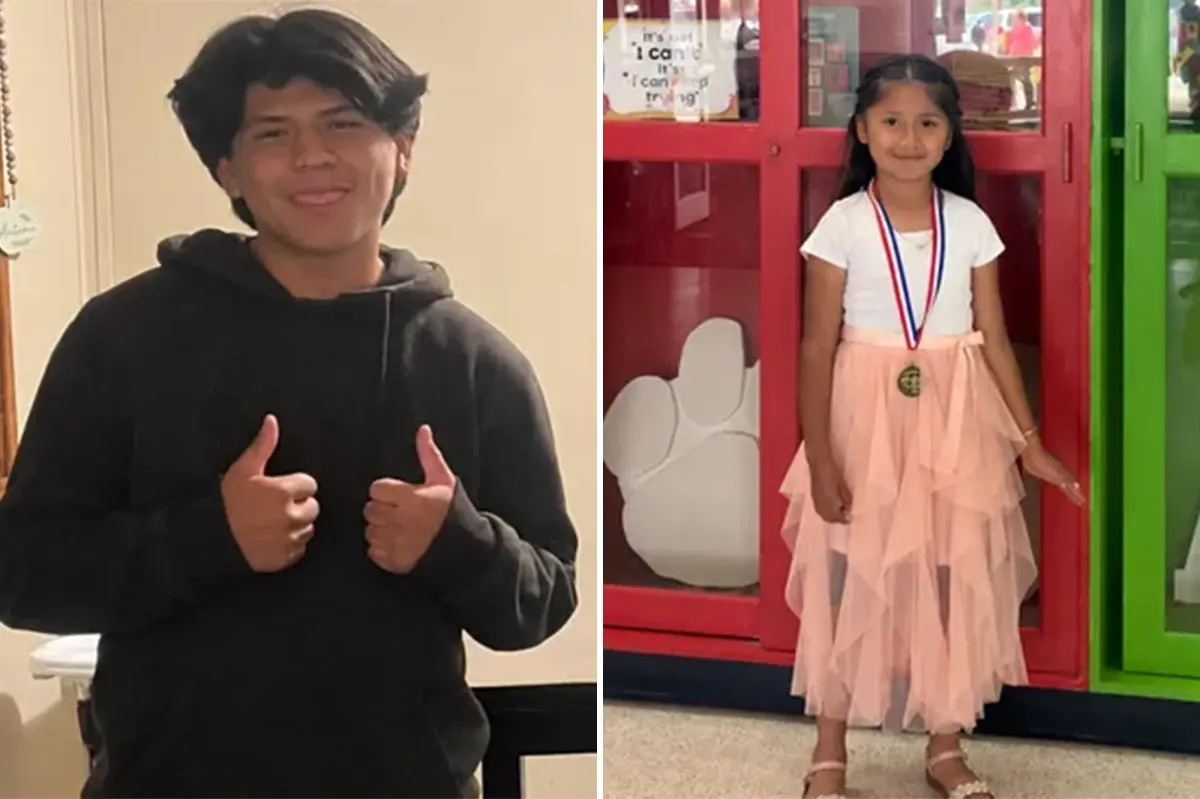
On a Friday that began like any other morning, the Alvarado family’s world fell apart in a single, violent instant. In the quiet countryside near Steele, Alabama, two young lives were cut short and a third hung in the balance after a pickup truck crashed into a tree. Alonso Alvarado, just sixteen years old, was behind the wheel of a 2010 Chevrolet Silverado. Traveling with him were his ten-year-old sister, Lia Miriam Alvarado, and his eighteen-year-old brother, Juan Alvarado. The three siblings were likely doing nothing more complicated than going somewhere together, the ordinary rhythm of family life. But somewhere along the road, the truck left the pavement, careened off the road, and collided with a tree with devastating force. When emergency responders arrived, the scene was already grim. Alonso was pronounced dead at the site, a boy who had not yet lived a full decade and a half gone before help could even reach him. Lia, who was only a child, was rushed to a nearby hospital, but despite the efforts of medical staff, she too died from her injuries. Juan, the eldest, was barely clinging to life. He was rushed into surgery, his condition described as unknown by relatives. In a matter of minutes, a family of three siblings was reduced to one young man fighting for his survival in a hospital bed.
The shock of the tragedy rippled far beyond the crash site. Maria Morales, a relative of the family, shared the heartbreaking news in a fundraiser meant to support the family in their time of unbearable need. “Our family is heartbroken and trying to process an unimaginable amount of pain all at once,” she wrote. Her words carried the weight of a family torn apart, struggling to make sense of a loss that defies comprehension. She also offered a poignant farewell to the two children who had been taken too soon: “Rest in peace, Alonso Alvarado and Lia Miriam Alvarado. You will be deeply missed, forever loved, and never forgotten.” Those words, tender and final, captured what many in the community were feeling. There is no way to prepare for the death of a child, let alone two in a single afternoon. The Alvarado family now faces the agonizing task of arranging funerals while sitting beside a hospital bed, waiting and praying for Juan to survive. The fundraiser was a small but meaningful effort to lift some of the practical burden from a family already crushed by grief. It was also a way for friends, neighbors, and strangers to say: you are not alone.
The tragedy also struck deep into the St. Clair County school district, where the younger Alvarado siblings had recently returned to class. The school year had barely started, only about a month earlier, when the summer break had ended. Children filled classrooms with new backpacks, new schedules, and the usual nervous excitement of a fresh year. For Alonso and Lia, that new beginning was stolen almost before it truly began. Superintendent Rusty St. John struggled to find words that could comfort a grieving community, acknowledging the profound difficulty of such a loss. “There is nothing I can say that makes a day like this any easier,” he said. His honesty was a reminder that some grief is too vast for speeches or platitudes. In schools, the empty seats would be a constant reminder. Teachers who had watched Alonso move through his teenage years, who had seen Lia skip into classrooms as a little girl, now had to face the impossible reality that they would not return. School counselors and staff likely braced for the difficult conversations ahead, as classmates and friends tried to process the sudden absence of two familiar faces. The school district became a place of mourning, where hallways that had echoed with laughter and chatter just days before now felt heavy with silence. There is no lesson plan for grief, and no classroom activity that can make the death of a classmate easier to understand. The community of St. Clair County would have to learn how to grieve together, one day at a time.
Yet in the middle of such overwhelming sorrow, the memory of little Lia Alvarado shone brightly. Those who knew her spoke not only of her death, but of the life she lived in just ten short years. Staff members at a head start center she had attended remembered her as a “sweet girl,” a description that felt both simple and heartbreakingly fitting. Stephanie Nelson, who had helped organize a Christmas in July event, recalled knowing Lia since the girl was in kindergarten. “She was one of the children we were blessed to support, and it has been such a gift getting to know her over the years,” Nelson wrote in a social media tribute. The fact that someone would call knowing a child a gift is a powerful testament to the kind of girl Lia was. She was clearly the kind of child who left a mark on people, who made adults smile and feel that their work mattered. Lia was more than a name in a news report, more than a number in a tragedy. She was a daughter, a sister, a student, a friend, a little girl who loved and was loved. The holiday event where Nelson knew her from was supposed to be a time of joy and generosity, and Lia was one of the children who brought that joy to life. Now, those same memories, once light and happy, become precious treasures, the only place where Lia is still alive and smiling.
As the community mourns, investigators are working to understand exactly what caused the crash that ended two lives and endangered a third. The Alabama Law Enforcement Agency has confirmed that none of the three people inside the pickup truck were wearing seat belts. That detail is both a factual finding and a quiet caution. Seat belts are designed to protect people in moments that happen in a split second, when there is no time to think, no time to brace, no time to reach for safety. In many crashes, the difference between life and death comes down to a small click, a strip of fabric stretched across a chest. The loss of Alonso and Lia is a heartbreaking reminder that driving rules are written in the blood of previous tragedies. It is impossible to know whether seat belts would have changed the outcome in this case; the crash was severe, and a tree is unforgiving. But the fact alone adds another layer of sorrow, the terrible “what if” that can haunt survivors and loved ones. For teenagers especially, seat belts can feel uncomfortable or unnecessary, particularly on familiar roads close to home. Yet it is often on those roads that the unthinkable happens. As the investigation continues, officials will examine speed, road conditions, and every other possible factor. The answers may bring some understanding, but they cannot bring back Alonso and Lia. The confirmation about seat belts, however, offers a tragic, urgent lesson to every other young driver and passenger who might read this story: buckle up, every time, no matter how short the trip.
In the end, the story of the Alvarado siblings is not just a series of details, not a collection of facts about a crash, an investigation, or a family. It is a story about love and loss, about a family forced to say goodbye far too soonchen. It is about a community gathering around a hospital bed and a funeral home, trying to find meaning in a tragedy that feels deeply meaningless. It is about a teenage boy behind the wheel, a little sister in the back, and an older brother watching over them, all three thrown into a nightmare on an ordinary road. The fundraiser organized by Maria Morales is more than a plea for money; it is a declaration that Juan still needs help, that his healing will be long and painful, and that his family will need support long after the initial wave of sympathy has passed. The tributes to Lia remind us that even the shortest lives can leave legacies of love. The quiet words of Superintendent St. John remind us that leaders cannot always fix things, but they can stand beside their people and admit that they are grieving too. The crash itself reminds us that life is fragile, and every time we get into a car, we are placing our trust in luck, in judgment, and in the simple safety measures that so many of us still forget. Alonso and Lia will grow no older, but their memories will remain with everyone who knew them. As their family wrote, they will be deeply missed, forever loved, and never forgotten. That is the only comfort, and the only promise, that can begin to help a family left behind.