





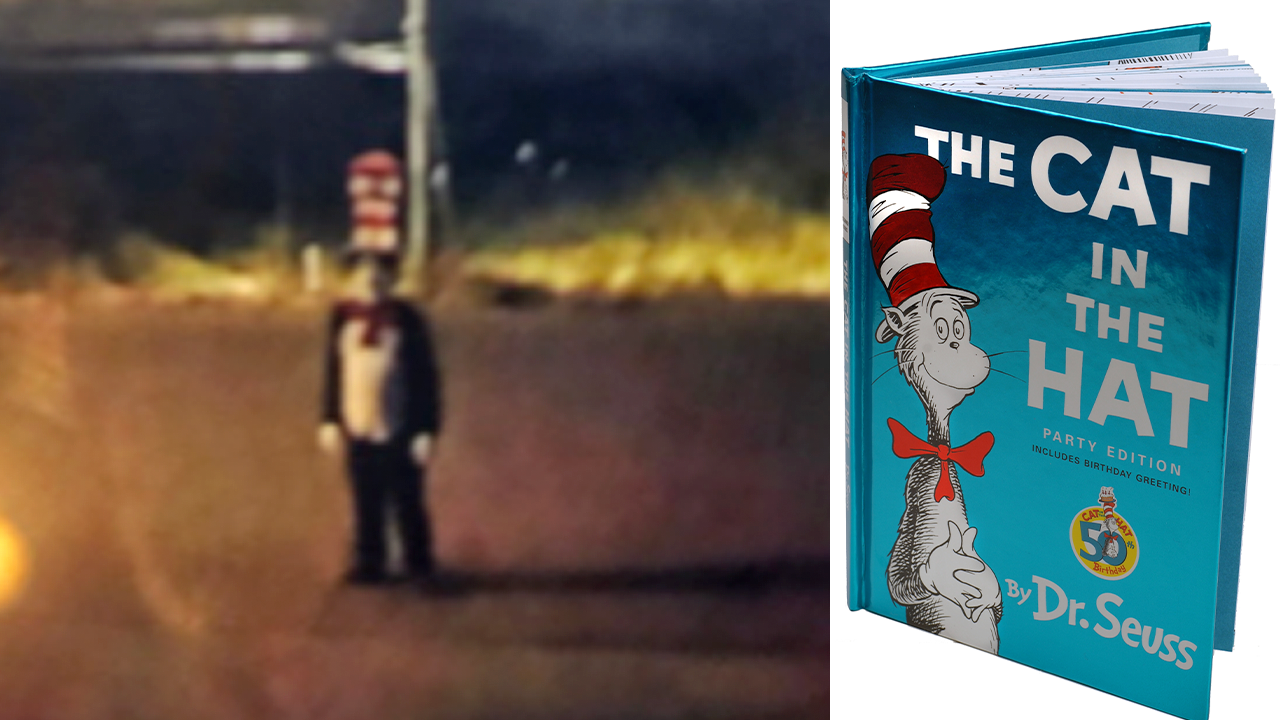
It was just after nine o’clock on a warm August evening in West Kelowna, British Columbia, and a teenage girl was doing something utterly ordinary: walking home through her own neighborhood, probably thinking about homework, friends, or just the comfort of her own bed. Then, out of the shadows, a figure emerged wearing a full Cat in the Hat costume—not the playful, whimsical Dr. Seuss character from childhood storybooks, but something darker, more sinister. The person began chasing her. Imagine that moment: the sudden thud of footsteps behind you, the surreal horror of being pursued by a familiar face turned nightmare, the frantic realization that the world you thought was safe suddenly isn’t. The girl ran. She managed to escape and reach her home safely, but the fear didn’t end there. The Royal Canadian Mounted Police are now investigating, and they’re asking the public for help identifying the costumed individual. “Regardless of whether the individual intended the behavior as a joke, following a young person and causing them to fear for their safety is extremely concerning,” said Cpl. Devon Gerrits. He added a warning that pranks can have serious consequences when they cause another person to reasonably fear for their safety. Police also offered practical advice for anyone who finds themselves in a similar situation: move toward a populated location, contact a trusted adult, and call 911 if you are in immediate danger. Investigators are reviewing doorbell, security, and dashcam footage from the 2000 block of Shamrock Drive, hoping someone captured the costumed figure on camera. The incident is unsettling on its own, but it’s also part of a much larger, stranger moment sweeping across North America—one where an innocent childhood icon has been twisted into a symbol of dread, and where online jokes are bleeding into real-world terror.
The Cat in the Hat has always been a character of mischief, but never of malice—until now. Across the United States, a creepy online trend has taken hold, featuring edited or AI-generated images and videos of a sinister version of the beloved children’s character lurking outside homes, standing near schools, or prowling through quiet communities. Some anonymous accounts have gone even further, attaching the names of students, staff members, campuses, and towns to these menacing images, sometimes accompanied by ominous messages or outright threats. What began as a disturbing digital meme has spiraled into a wave of fear that has prompted investigations, increased police patrols, and school warnings from California to Florida, Virginia, and Texas. In Baldwin Park, California, police said they were reviewing “concerning social media posts” that referenced local schools and named specific students and staff members. Their message was firm: “Any threat directed toward our schools, students, staff, or community will not be dismissed as a joke or prank.” In Hanover County, Virginia, the sheriff’s office launched an investigation after an account posted content referencing Mechanicsville High School, and deputies increased their presence on campus while working to identify the person responsible. Florida’s St. Johns County Sheriff’s Office also investigated content involving county schools, and though no credible threat was identified, deputies still increased their presence on campuses as a precaution. The effect is a strange and frightening paradox: a fictional character known for bringing chaos into a home has become a digital bogeyman, and communities are left to wonder whether these posts are empty pranks or warnings of something far more real.
One of the most important messages coming from law enforcement is that this is not a game. In West Kelowna, investigators made it clear that wearing a costume is not a crime by itself, but pursuing someone in a way that causes reasonable fear could constitute criminal harassment, and assault, threats, or intimidation charges could also be considered depending on the evidence. That legal reality is being echoed across the United States, where Texas law enforcement agencies in particular have warned that creating or spreading these threatening posts could carry consequences far beyond school discipline. The Frio County Sheriff’s Office said some anonymous accounts have attached lists of students, schools, or communities to menacing images and videos in an apparent attempt to provoke fear. While authorities there determined that posts mentioning their area did not appear to present a credible threat, they still increased patrols and law enforcement visibility around schools, and they issued a pointed warning: “Participating in, re-creating, or spreading these threatening posts is not a harmless joke.” They noted that copycat accounts and forwarded threats could lead to charges involving cyberbullying, harassment, or terroristic threats. Laredo police delivered a similar message, saying criminal charges and arrests may follow even when the person responsible claims the post was only meant as a prank. “A few seconds on social media can result in a police investigation, school disciplinary action, and potentially serious criminal consequences,” the department said. In Premont, police met with school district leaders after learning of the trend and warned that fake accounts, AI-generated content, and purported pranks involving threats could result in charges including making a terroristic threat or filing a false alarm or report under Texas law. The message is clear: the law does not laugh along with these jokes, and neither should anyone else.
The consequences are already falling on young people, and they are serious. In Berwick, Louisiana, four girls between the ages of 13 and 15 were arrested after police linked them to TikTok accounts that alarmed families and schools. Three were charged with terrorizing or menacing, while a fourth was charged with cyberbullying. In Florida, a 12-year-old student was accused of posting a written threat to kill tied to the trend, and in Colorado, a 14-year-old student was arrested after a post referenced a middle school and several homes. Authorities in Alabama, Ohio, and Kentucky have also announced juvenile arrests or pending charges connected to similar posts. It is heartbreaking to think about these young people, many of whom may have genuinely believed they were just participating in a viral challenge, now facing police records and criminal charges that could follow them for years. But it is equally heartbreaking to think about the students who received those threats, who went to school afraid, who couldn’t concentrate in class because they were wondering whether the Cat in the Hat image posted online was a joke or a promise. The parents who kept their children home, the teachers who watched every unfamiliar face, the communities that held their breath—all of that fear has a real cost. And in the middle of it all, police are trying to sort through a tangle of AI-generated images, fake accounts, and anonymous posts to figure out what is credible and what is not. Every hoax makes that job harder, because it drowns out the real warnings and exhausts the attention of those who need to be vigilant.
Amid all this chaos, law enforcement has offered practical guidance for parents, students, and community members. The most repeated advice is simple: do not share or recirculate the threatening posts, even if you think you are helping by warning others. Sharing only amplifies the message, spreads the fear, and makes it harder for investigators to trace the original source. Instead, police urge people to preserve the content—take screenshots that show the account name, the threatening material, and the date and time—and report it directly to school officials or law enforcement. This is a moment that calls for digital responsibility, and it is also a moment for parents to talk honestly with their children about the difference between a joke and a threat, about the permanence of what we post online, and about the very real consequences that can follow a few seconds of poor judgment. For those who might find themselves actually being followed or pursued in the real world, the advice from the West Kelowna RCMP is vital: move toward a populated location, contact a trusted adult, and call 911 if you are in immediate danger. And if you have doorbell, security, or dashcam video that might help identify someone behaving suspiciously, share it with police. The request for footage from the 2000 block of Shamrock Drive is a reminder that in moments like these, ordinary citizens can play a crucial role in helping investigators piece together what really happened. Fox News Digital reached out to TikTok for comment, but in the end, the responsibility does not rest with any one platform—it rests with all of us, in the choices we make about what to post, what to share, and what to ignore.
There is something deeply unsettling about seeing a character from our childhood turned into a figure of fear. The Cat in the Hat was never supposed to make anyone feel unsafe; he was the embodiment of imagination and playful trouble. But this trend has taken that innocence and twisted it into something sinister, and in doing so, it has revealed just how easily fear can spread in the digital age. A single image, a single anonymous post, can ripple across states, closing off a community’s sense of security and forcing schools to deploy extra patrols. It has also revealed how quickly our instincts to protect each other can be exploited by those who want attention, or simply want to watch the world panic. The teen in West Kelowna is home safe, but the memory of being chased through the dark by a costumed stranger will not fade quickly. For her, and for all the students whose names have appeared in threatening posts, the fear is real, even if the threat turns out to be hollow. That is why law enforcement is taking these incidents so seriously, and why they keep repeating the same warning: this is not a harmless prank. It is a disruption of our schools, our neighborhoods, and our peace of mind. As communities across North America grapple with this strange and frightening trend, the hope is that we can find a way to protect our children without letting fear consume us—and that those who think this is funny will understand, before it is too late, that terrorizing others is never a joke.