

On a bright, busy day in Brussels, the Euronews Travel & Tourism Summit 2026 brought together the people who shape the way we see the world: political leaders, policymakers, tourism chiefs, and industry experts. For one packed day, they moved from one deep conversation to another, not just celebrating the joy of travel but wrestling with the uncomfortable truths that come with it. The room was full of talk about overtourism and undertourism, about places bursting at the seams and places desperate for visitors, about heat waves and dried-up rivers and expensive tickets. There was no single headline, no easy answer. Instead, there was a shared feeling that tourism is standing at a crossroads, and the choices being made now will determine whether travel remains a source of wonder for future generations or becomes a source of friction and frustration. The discussions were often frank, sometimes funny, and always human. From an Albanian prime minister proudly comparing his country to a sparkling jewel to a European travel leader warning that climate change is the “biggest threat” the industry has ever faced, the message was clear: the old way of doing things is no longer enough. What is needed, again and again, is more collaboration, more investment, more honesty, and a willingness to imagine destinations not as isolated points on a map but as interconnected places where people actually live, work, and welcome strangers.
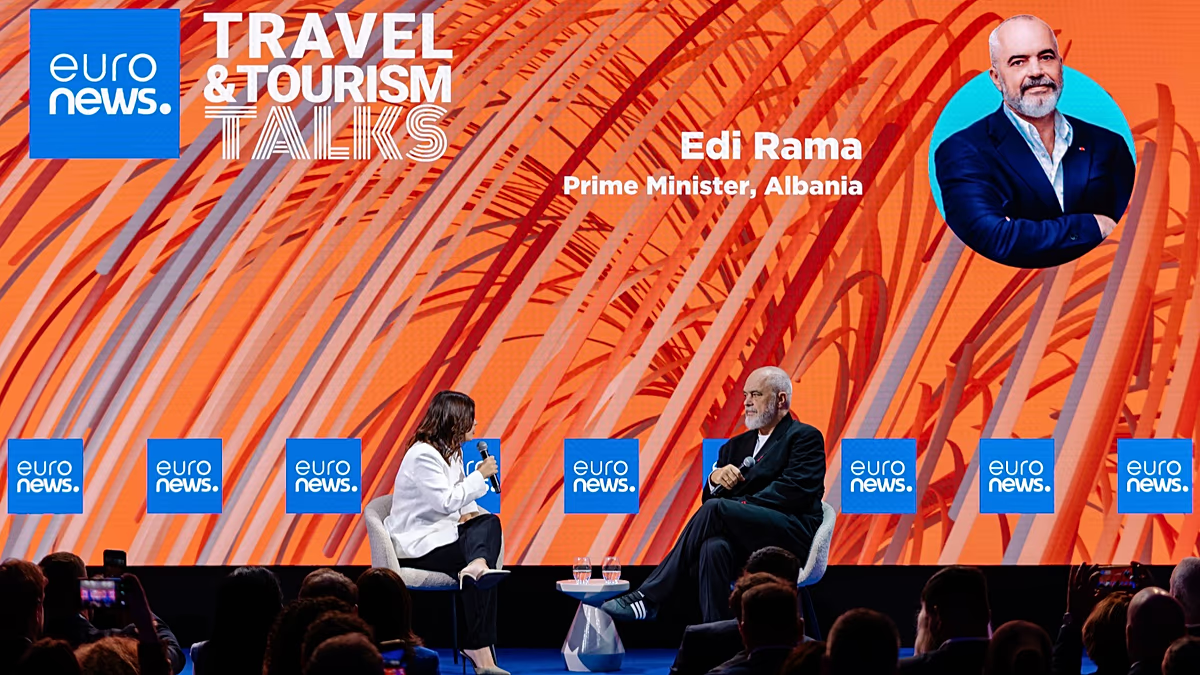
Few stories captured the imagination quite like Albania’s, and Prime Minister Edi Rama told it with the kind of energy that makes you sit up and listen. In a lively conversation with Euronews’ Maria Tadeo, Rama recalled how his country was once dubbed the “North Korea of Europe,” a phrase that stuck for years and made Albania feel closed, mysterious, and far from the usual European travel trail. Today, the same country is on everyone’s lips as a destination, and Rama was clearly relishing the change. “We are not the Black Hole of Europe – we are the shining little jewel of Europe,” he said, pushing back against old stereotypes with a smile. He acknowledged that neighbouring Croatia has had decades to build its tourism industry, refine its marketing, and welcome millions of visitors, but insisted that Albania’s moment has finally arrived: “It is our turn.” That doesn’t mean chasing just any visitor, though. Rama made it clear that Albania is now focusing on attracting a “higher quality” of tourist, a phrase that generated a lot of interest in the room. He revealed that globally recognisable hotel brands like Waldorf Astoria and Aman are planning to open properties in the country, and that Atlantis, the famous Dubai hotel name, is also set to open its first property on the European continent in Albania. Those are big statements, and they signal a deliberate shift away from the kind of low-cost, high-volume tourism that has sometimes overwhelmed other destinations. But the conversation also turned to something more complicated: the ongoing protests over the Sazan Island and Zvërnec resort project, which is backed by Jared Kushner, the son-in-law of US President Donald Trump. Rama addressed the controversy directly, saying that Albania would be releasing documents related to the project in the coming weeks. It was a reminder that tourism development is never just about beautiful beaches and luxury hotels; it is also about transparency, public trust, and the difficult question of who gets to decide how a country’s land is used.
If Albania’s story is about a country finally getting noticed, Eduardo Santander’s message was a stark warning about what could undo all that progress. As the CEO of the European Travel Commission, Santander sat down with Euronews’ Mared Gwyn-Jones to reflect on a summer that was dominated by headlines about heat waves across the continent. His words were simple and direct: “Climate change is the biggest threat to tourism right now, by far.” This was not abstract policy talk. He described trains unable to run because the rails expanded in extreme heat, cruise lines unable to sail along European rivers that had literally become too dry for navigation, and travellers finding their carefully planned holidays turned upside down by conditions no one could control. Santander argued that the tourism industry has to prepare for all of this in a much more coordinated and comprehensive way, because the old approach of reacting after the damage is done is no longer enough. He also made the point that climate change does not just cause chaos; it also makes travelling more expensive. “Travelling is becoming much more expensive, and you all have travelled this summer, I guess, and you notice it in your pockets,” he said. That line resonated because it connected the global, overwhelming topic of climate change to something incredibly personal: the feeling of opening your wallet and seeing the price of a train ticket, a meal, or a hotel room creeping upward. For many families, the decision to travel is already a difficult balancing act, and when extreme weather adds to costs, it can push the dream of a holiday even further away. Santander’s point was not that people should stop travelling, but that the entire system—governments, transport operators, tourism boards, and travellers themselves—needs to face the reality that the climate is changing the map of where we can go and how we can get there.
On a brighter note, the summit also explored the idea that destinations do not have to compete all the time; sometimes they can work together, even across borders. Hungarian Tourism Agency President Olivér Csendes joined Sandrine Buffenoir, Director for the Netherlands, Belgium, and Luxembourg at Atout France, the French tourism development agency, for a conversation about marketing Hungary and the wider Central European region. Csendes made an appeal that sounded surprisingly fresh in a world of national branding campaigns: he wants to see more international collaborations where countries position their way of life and their regions “basically as one destination.” He explained that we do not have to limit our thinking, or the creation of experience spaces, to national borders. After all, in Central Europe there are two or three capitals within a hundred kilometres of each other, a fact that makes multi-country itineraries almost natural. The conversation touched on a trendy concept called “trip-maxxing,” where travellers deliberately plan journeys that cross several countries in one go, and Csendes argued that this kind of travel fits the region perfectly. Why would you visit just one capital when you can wake up in one, have lunch in another, and end your day in a third? It is an idea that benefits everyone: travellers get richer experiences, countries get to share the load of tourism, and smaller or less famous places get the chance to be part of a larger story. The presence of a French tourism official on stage with a Hungarian tourism leader was itself a quiet symbol of this new spirit of cooperation. It suggested that the future of tourism marketing may not be about drawing hard lines on a map, but about building bridges across them, and inviting people to see a whole region, not just one country, as their destination.
The relationship between Belgium and the United States was also in the spotlight, and the conversation there was very much about making travel easier on a practical, human level. Host Jane Witherspoon sat down with Bill White, the United States Ambassador to the Kingdom of Belgium, to talk about the special ties between the two countries. White emphasised that if we want to encourage travel in both directions, we have to improve the experience at airports, the very first and last impression many travellers get. That is why the US is set to roll out Global Entry for Belgian citizens in the coming months, a system that allows pre-approved, low-risk travellers to enjoy expedited processing when they arrive in the States. Instead of waiting in long, stressful lines, vetted travellers can move through a faster lane, and anyone who has ever arrived in a foreign country after a long flight knows how valuable that can be. The ambassador explained that the US is working with the Belgian government to get all the paperwork in order, and he singled out Belgium’s Minister of Foreign Affairs, Maxime Prévot, as someone who is personally leading the effort. Depending on how quickly the details are finalised, the move could happen before the end of the year or early in the next year. It was a refreshingly practical discussion in a summit filled with big, ambitious ideas. Not every problem in tourism is about climate change or overtourism; sometimes it is simply about whether you can get through passport control without losing your patience. By making travel smoother, both countries hope to deepen the human connections that make international friendship real, and that starts with making people feel welcome the moment they step off the plane.
Finally, the summit turned to a question that touches every other conversation: how do we actually manage the flow of visitors? On a panel called “managing visitor flows and shaping tomorrow’s destinations,” MEP Daniel Attard made a passionate case for investment, and he put it in very direct terms: “We have to put the money where our mouth is at the European level.” His point was that many of the under-the-radar places that would truly benefit from tourism simply do not have the infrastructure to bring tourists in. Beautiful towns, stunning coastlines, and hidden cultural treasures remain invisible because there is no reliable rail connection, no well-connected airport, no decent road network. Meanwhile, famous destinations struggle with crowds because they have all the infrastructure and all the attention. Attard argued that the solution is to create better connections and invest in new connections, and to bolster aviation services as well. This is not just about building bigger airports for the sake of it; it is about spreading the benefits of tourism more evenly across Europe. It is a way to ease pressure on overcrowded hotspots while breathing new life into places that have been waiting for their chance. The panel’s conversation was a reminder that behind every statistic about visitor numbers, there are real communities and real lives. When a village finally gets a good train connection, it is not just a win for tourists; it is a win for the people who live there, who can connect to jobs, education, and family more easily. When a region is marketed as part of a larger story, it is not just a clever campaign; it is an invitation to be seen, valued, and visited. By the end of the summit, the message was unmistakable. Travel is not merely an industry of hotel bookings and airline tickets; it is an enormously human activity, shaped by hopes, fears, budgets, changing weather, and the simple desire to connect with something beyond our own doorstep. The leaders in Brussels may not agree on every detail, but they all seemed to understand that the future of tourism depends on being honest, collaborative, and ready to adapt to a world that is changing faster than ever.