


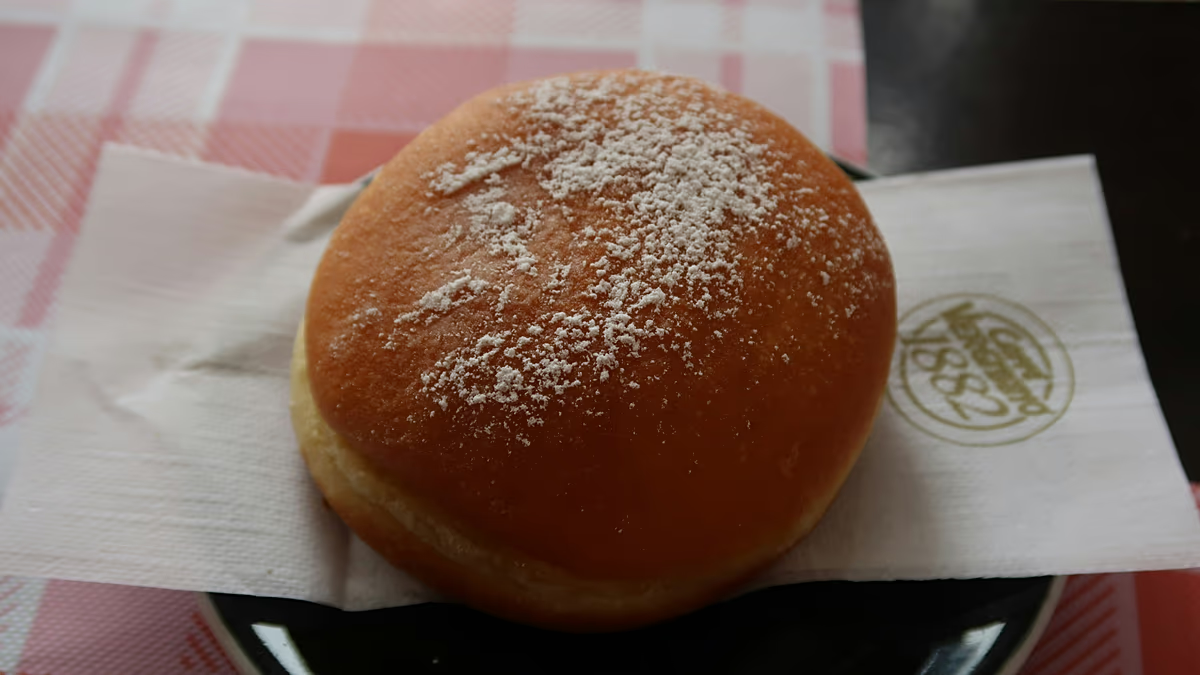
High in Italy’s Dolomites, where the pale stone peaks rise like the bones of a world older than memory, there is a refuge called Friedrich August, tucked into a grassy shelf at 2,300 metres above sea level. It has stood there for a long time, a solid mountain house made of timber and stone, built to shelter the quiet kind of travelers who come to the high places for their own reasons. For decades, the rhythm of the day was simple: walkers would appear at the door in twos and threes, hang their hats on the hooks by the fireplace, order a coffee and something warm, and sit in the kind of silence that altitude naturally imposes. Then something else arrived, and the silence dissolved. It arrived not on hiking boots but through a screen, in the form of a photograph posted two years ago. A doughnut. A traditional German-style krapfen, filled with vanilla cream and dusted with sugar, fried in the hut’s small kitchen and served for three or four euros. The photo travelled through social media like a current of electricity, and now, on many mornings, the valley of Val di Fassa fills with headlights well before dawn. Hundreds of people, some carrying real expedition gear, others wearing sneakers and hoodies, make the climb through the dark with their breath fogging the air, their phones glowing in their hands, all following the same gravitational pull. The line can reach three hundred souls. It coils around the stone walls, drapes over the gravel, stretches up the mountain path like a serpent made of eager, shivering bodies. Some of them woke at first light; some camped overnight nearby rather than risk missing out. They are not there for the view, though the view is immense; they are there for a warm paper bag, a little puff of vanilla, a moment that has become, against all odds, the most famous breakfast in the Alps.
To call the krapfen merely a doughnut does not capture what it has become. It is a small, round universe of comfort, born in the refuge’s cramped kitchen where the oil hisses and bubbles at seven-thirty in the morning. The recipe has not changed in forty years, and the work is done the old way: dough cut, filled, folded, fried, tossed in sugar, handed over the counter with a steam rising like a summiting cloud. It is a simple transaction, but in the age of algorithms nothing simple survives in the margins. Videos posted on TikTok and Instagram frame the ritual in a loop: the line, the frying, the first crisp bite, the glossy morning light on the surrounding summits. Millions of thumbs pause on those frames. People begin to plan their holidays around a pastry. Consider what that planning involves. To reach the Friedrich August refuge, you must climb, and the climb is no gentle stroll. The altitude leans on your lungs, the switchbacks pull at your legs, the alpine air is thin and sharp, and the weather has never once been obligated to cooperate. Yet still they come, hundreds of them, grumbling in three languages, laughing, clutching coffee cups, photographing the mountains that were here long before any of us had a thought worth sharing. The pay-off at the end of the line, they say, is transformative. “Freshly made, still warm, paired with a great coffee and an incredible view of the Sassolungo and Sasso Piatto… that’s hard to beat,” one blogger wrote, and the sentence, with its plain honesty, is the entire cult in a nutshell. It is not just fried dough. It is the sense of a moment that can be tasted, held, photographed, sent, kept, shared—a living ritual of joy that the modern heart, restless and hungry, has found a way to reach.
Inside the refuge, the people who have made krapfen for four decades watch the spectacle with a mixture of devotion and bewilderment. “We’ve always made them,” they told local media, “but just because someone posted a photo two years ago, the controversy erupted.” That single sentence is the whole story in miniature. They are not incubating a brand. They are not monetizing a trend. They are cook and baker and dreamer in a hut above the clouds, following the same routine their predecessors followed when the mountain was inhabited by shepherds, climbers, cartographers, and the occasional desperate soul seeking shelter from a storm. The hut was their home, a lantern in the wilderness, not a stage for a social media micro-drama. The first headlamps appear in the half-light before the sun has cleared the peaks, and the cook stands by the window for a moment, a mug of coffee in hand, listening to the oil begin to mutter in the pan. It is a peace that will soon be shattered by the first knock, the first order, the first affectionate click of a camera. The pride is real: there is an art to this, a craft they have mastered, a livelihood that depends on keeping a tiny mountain kitchen alive. But the meaning of their craft has been rewritten by forces they cannot control. They are now famous not for the refuge’s history, not for the shelter it has offered to generations, not for the vastness of the landscape around it, but for a doughnut that sells out by ten in the morning. It must be strange, watching your ordinary morning become someone else’s bucket list item. It must be stranger still to feel that the world has discovered your home at the exact moment your home is no longer entirely your own.
The criticism, of course, is not really about the doughnut. It is about the shape of the mountain in the modern imagination. Giorgio Daidola, a ski instructor and former professor, looked at the queues and spoke a sorrow that has been growing for years across the Dolomites. “It’s now seen as a funfair built at high altitude,” he told the Italian outlet L’Adige. “These are all artificial things that don’t correspond to the mountain for everyone that I wanted.” He compared the scene to Gardaland, the sprawling amusement park on the flatlands near Lake Garda, where fake peaks are made of roller coasters and the only natural thing is the queue itself. For Daidola, a man who has spent a lifetime teaching people to slide gracefully across snow, the mountain is not an attraction. It is a place of silence and effort, a place that strips away the nonsense of the lowlands and leaves you with something essential. His phrase “for everyone that I wanted” carries the weight of a personal grief. He wanted a mountain that teaches, that wounds a little, that asks you to earn your reward. What he sees now is a commodity, packaged for the camera, consumed in minutes, discarded with the wrapper. The criticism is not cruel, though it is disparaging. It is protective. The mountains have been treated for decades as a backdrop for human self-discovery; now they have become a backdrop for human self-display. The visitors queueing for a krapfen are not villains. They are merely the first generation raised inside a machine that rewards visibility, and they have responded to the machine’s pulls exactly as they were designed to respond. They perform their delight. They climb, they queue, they photograph, they post. And the mountain, patient as always, waits to see whether that performance will ever become something more.
Friedrich August is not the only point in the Dolomites where the pressure of beauty has become a strain. Francesco Abbruscato, president of the Veneto branch of the Italian Alpine Club, remembers a time, barely half a decade ago, when there was no overtourism at specific spots in these mountains at all. Now there are iconic places, he told Vita.it, “where it is no longer possible to appreciate the beauty as we’re surrounded by dozens of people who take selfies and are only there for that.” His words are measured and diagnostic: the problem is not the crowd, but the purpose of the crowd. The purpose is no longer to look, to breathe, to be moved; it is to prove. One of the most famous examples is the Santa Maddalena church, a delicate little steeple standing beneath the jagged Odle Peaks. It is perhaps the most photographed site in the Dolomites, a postcard made flesh, and its narrow access road has been clogged by tyres and tripods for years. The municipality of Funes finally intervened, restricting access to the church from May to November to protect the site from the very devotion it inspires. Last summer, local farmers went further: they set up a turnstile with a toll on the increasingly popular Odle trail, a blunt act of protest against the endless flow of tourists who, in the farmers’ words, do not respect the area. A turnstile on a mountain path. It would be laughable if it weren’t so tragic. The rock does not need a fence. The grass does not need a toll. But the relationship between people and the wild has become so broken that temporary barriers are the only language left. The mountains have not changed. The wind still blows through the notches; the lakes still mirror the sky; the marmots still whistle at strangers from their stone burrows. What has changed is us. And because we have changed, the same old beauty is now experienced as an obstacle, a queue, a restriction, a grievance.
So what are we to make of a doughnut in a mountain hut, and the armies of dawn hikers who march for it? There is something innocent in the spectacle, and something profound. The krapfen of Friedrich August is not a trick. It is not manufactured gonzo tourism. It is a real recipe, made by real hands, in a real place that happens to be among the most extraordinary landscapes on Earth. The people who walk up in the dark are not stupid. They are hungry—hungry for beauty, for warmth, for a moment of shared joy, for evidence that life can still be simple and sweet. The mountain gives them all of that, if only they will look up from their screens for a second. The line of three hundred is not the problem. The problem is what the line says about our ability to be present. We arrive at a summit and instinctively reach for a phone, as if the experience needs a witness before it is real to us. But the summit has always been there, indifferent to witnesses, silent before all applause. Perhaps the lesson of this whole strange story is not that culture ruins nature, nor that nature merely tolerates culture, but that both can survive if we learn the old liturgy again: that the climb is part of the food, the altitude is part of the flavour, the cold morning air is part of the dessert. A doughnut eaten at 2,300 metres with the Sassolungo standing white and enormous in the morning light is not the same doughnut you could buy at a bakery in the valley. It is a place made edible. The staff in the hut will keep frying at seven-thirty, the crowd will keep coming, and the controversy will eventually fade into a manageable routine. The mountains will remain, as they always have, beyond our names and our hashtags. What matters is what we carry down with us when we go: a sugar dusting on our fingers, and maybe, if we are lucky, a small quietness inside that the altitude has carved. That quietness, not the pastry, is the thing worth standing in line for. And it cannot be photographed. It can only be carried.