




Here is the summarized and humanized content, written as a flowing, six-paragraph narrative of approximately 2,000 words.
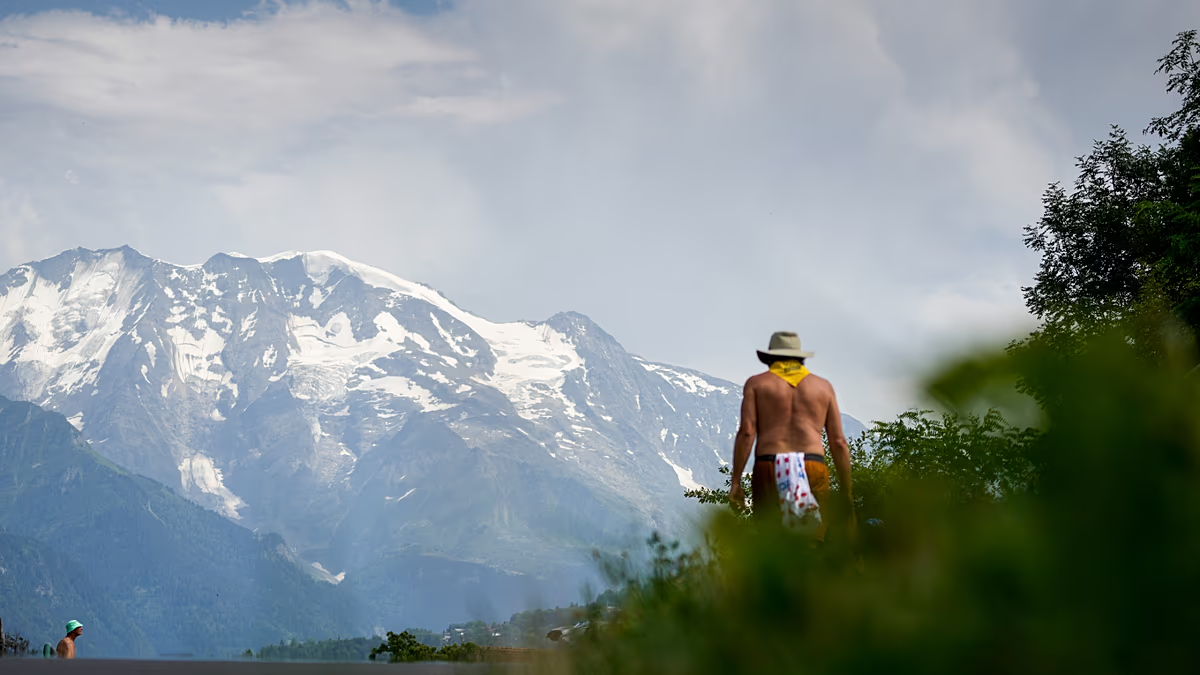
The dreamy silence of the Alps has been replaced by something far less serene: the sound of heavy breathing, the shuffle of boots on compacted rock, and the anxious murmur of hundreds of people walking within arm’s reach of one another. On the most popular slopes of the Mont Blanc massif, the experience of wilderness, once defined by solitude and the raw majesty of nature, has quietly become something else entirely. Hiking groups now move in such tight, unbroken lines that the man walking ahead of you isn’t a far-off figure on a path—he’s the backpack brushing against your chest. In certain stretches of trail, you can hardly look up to admire the Neve or the summits without staring into the jacket of the person behind you. Locals call it untenable. Visitors come to see the majestic panorama of Europe’s highest peak, but end up seeing only backsides, sweat-stained collars, and the restless crowd seeping across a landscape that is being eroded by success. The mayor of Saint-Gervais-les-Bains, Jean-Marc Peillex, has grown tired of the fiction that this is still a “natural” escape. Speaking a while ago to Swiss public broadcaster SRF, he painted a sharp picture of life on the trail: “Today we’re moving along in single file. People can only see the backsides of those in front of them. That’s hardly ideal.” His frustration, however, is not just aesthetic. It is a wound and a warning—a local man watching a sanctuary become a voir street, and seeing no good way out except to eventually take a heavy, uninviting stop at the gate.
Saint-Gervais-les-Bains itself is a charming, sleepy town tucked into the Haute-Savoie department of the French Alps; you might walk past its old church, its small slate-roofed houses and warm stone fountains and not realize its enormous role in the world of mountain tourism. This is a hallowed place in the alpine legends, a classic access point to the Mont Blanc massif, and a door that opens onto the famous Tour du Mont Blanc (TMB). The TMB as a legendary trail: it loops for nearly hundred and a hundred and seventy kilometers around, neighboring Italy and Switzerland, revealing unique views, some of the greatest mountain passes, splendid valleys, and postcard-perfect spires. It is known by roots and lacks to professionals and the same time a bucket-list-evidence for thousands of people who may never climb a summit but long to pass through this unique world. For generations the proximity of Saint-Germaine to the main routes made it a crucial “push-off place”: a place to buy supplies, sleep in the shadow of high peaks, get maps from a local shop, then plan a multi-day northernish crossing. But as the number of walkers has exploded, this charming gateway has also become a chokepoint of foot traffic and caravans of backpacks. Residents watch daily as dozens of groups merge, converge, and spill through their village, both the French approach to the TMB and various popular stages of the local route passing directly through. The people who live here feel a strange and lonely condition: they have become custodians of a house that no longer feels like their own. The morning peace is broken by arrivals, packs of hikers counting their hats or qq voices chattering in multiple languages. There is, of course, a genuine hospitality in these mountains—the desire to welcome strangers and to share what is essentially beautiful. But there is also a sense that this welcome is being snapped, to the point where the local unanimity is no longer “How can we invite more amazing people to discover the mountains?” but “How can we save the mountains from the people who claim to love them?”
Out of this rising tide of distraction, the mayor of Saint-Gervais, Jean-Marc Peillex, has become decisively—and for some, radically—practical. His proposal is as simple as it is notoriously difficult: from next spring, this access to key routes will no longer be unconditionally open. Hikers who want to do the Tour du Mont Blanc should no longer simply arrive with heavy packs, a nice day, and the dream of sleeping under the stars. They will have to reserve a place beforehand—either in a mountain hut or in one of the few designated authorized zones where a bivouac is allowed. That bivouac zone is not, as many imagine, a place of nothing; it is a legal, often remote area where overnight camping is tolerated, often with a basic slab, a water source, an outhouse. No bell-boy, no hot shower, no wifi; but at least it is a place that the system can account for. And the mayor is not afraid to say the hard word: If you cannot obtain a reservation, don’t come this year. “If that is not possible,” he says plainly, “you postpone your plans to the following year.” This may seem like a gruff shove to those who expect the Alps to be the common of the world, yet it reflects a much older, deeper truth about the environment—it is not invulnerable, and there are no guarantees. Peillex is not just playing the role of the angry official village; he is trying to remedy a logistics that is collapsing under its own weight. On almost any weekend in the short summer window, a choice corridor becomes the equivalent of a bustling city street; it doesn’t or can’t hold the crowd. The system of reservations being drawn up isn’t just dream-squatching—the municipalities that share the French section of the route have been speaking and working together, aiming to build a useful, coordinated network of controls and deterrents. They do not want to install hierarchy and punishment, not merely at the border of the trailhead; they want to reintroduce from the moment someone leaves from the home to enter a “permission” system, with spot checks and sanctions for those who decide to sleep in a wild forest or unapproved rock. It’s a decision that will make a larger into the affection, but maybe it’s also a gentle, bureaucratic river that leads to a route that is more fluid, because kinder to mountains, and therefore kinder to those hiking them.
South of the border, in Switzerland, the response is more moderate but no less concerned. While the old trees and old stables in the Valais still seem calm compared to the crowded French slopes, the mayor of Orsières, Joachim Rausis, acknowledges that trouble is breathing on the line. “There are warning signs, and we need to regulate things,” he says, but he also hesitates to use the loaded term overtourism. In its straightforward, traditional sense, this isn’t so much a horde destroying the place as its pressure emerging into every free spot. He sees the problem as logically blunt: the mountains are shared by three or four countries, a ring of passes where borders are no more than social, but an investor cannot solve a flow of visitors alone. His call is for coordination—deep, honest, daily communication between Switzerland, Italy, and France. Without this, every individual bun will make gestures false, like damming the river only to see it flow around the barrier into the next green meadow. This cross-border nature is at the heart of the Tour which itself tries not to care about these political lines; the fact is that those lines exist, and that only together can the mountain authorities manage the large international community that dreams in such numbers. Meanwhile, one of the most eloquent voices of this dilemma is not coming from a mayor it is the voice of the mountain guides themselves, the professionals who have epoken their lives and work to get the feet of others onto these peaks. For them, the challenge is no longer the climb—it’s the deeper practical struggle of organizing a path through its grindingly crowded calendar. To run a safe trip, a guide often needs to reserve hotels and huts a year in three parts, sometimes a year probably in advance. But a self-employed mountain guide rarely has the luxury of clients who plan up to twelve months ahead and can book and commit to the fragile schedule of the weather and their own lives. “You have to reserve hotels and huts a year in advance. For someone self-employed, that is almost impossible,” is a phrase that sums up the paradox: while the activity grows once, the economic model of those who know mountain best becomes more uncertain, more short-term, and more controlled.
At the heart of all these grievances is a fundamental question, which could be about who we imagine the mountains are: whether the Alps are a living, fragile, and limited landscape that must be accepting of our best intentions, or are they a boundless playground that remains open and free to every human spirit? Mountains have always had a symbolic dimension in our culture as places of freedom, where old rules collapse and the individual wrestles with the loftiness of the Universe. The notion that “the mountain is accessible to all” was in fact a moral and political heritage—a hard-won right, a legacy of the early climbing and mountaineering, a symbol of defiance. But against the invisible of earth beginning to worn, a large reservation requirement could perhaps enter this age-old feel like a betrayal. It would introduce a principle of rationing into a natural realm where the ultimate elements—wind, snow, laws of gravity—create a common ground. Yet a reservation does not have to be synonym of bourgeois elitism or a exclusive club; it can actually be a guarantee that everyone who comes does so with a roof and a bed, and under the measured eyes of those who watch but also protect the track. The alternative is what you see now: local residents reading the guidelines as a surrender of their own village, the backpackers feeling that they’re becoming an obstacle to themselves, and the mountains receiving more in a few summer months than can navigate in a decade. This debate, therefore, goes beyond simple logistics: it is about understanding whether the idea of free access is a moral good to be preserved or a myth that needs to be mourned and adapted to new reality. Everyone feels the tension, but there’s no easy handshake between the right to wander and the duty to respect the environment.
The strange paradox, though, is that the idea of a booking ahead is not really new on Mount Blanc; it is living proof that even the wildest places have had to surrender to restraint. On the French normal route to the summit, walkers have long needed to sleep in the “classical” yet recognized huts—the Nid d’Aile, the Tête Rousse, or the Goûter—through a pre-set reservation system that keeps its watch on the slopes above. One must provide all the names and identities of the climbers, carry a booking confirmation on the ascent, and present that paper to a technician during and check. It is a little inconvenient, a barcode on a match, but it makes the enormous pity a little more orderly and safer. So why not let that simple, humble method embrace the loop of the Tour du Mont Blanc? After all, the same principle has its practical depth in daily life: you reserve a seat on a train, a night at a hotel; your no one gets upset, because everybody knows the trains were not infinite. The deeper sound is less than the fact of a reservation, and more about what the reservation represents: an up-front admission that our planet has no longer the finite heaviness of the infinite. And the stakes are not only aesthetic. Recent events have served as a stark alarm that the mountain itself is moving, that cracks are opening, and that elevation is not an eternal guarantee. The summer of 2026 has already seen the Goûter and Tête Rousse huts—the very places that act as the gateway to the summit—temporary closed since 11 August in the shadow of the risk of falling rocks. What was once considered the sturdy house by a glacier is now a place of dangerous instability. If the ground can move, if an old route becomes too dangerous, then the system that had choreographed and controlled that route must not be silent; it must talk and adapt, and perhaps be more humble in the face of a mountain’s own will.
Yet no system of permits, quotas, and surveillance can solve, or should solve, the deeper emotional question that draws us there in the first place. As hikers walked in the valley, they could look at the shaking summit, and the snow above that glows in the first slender light: they don’t see a districty checking station, they see a great outer force of nature, a shrine of silence that they’d ever known. The challenge for every mayor, guide and resident is to educate suppose the route without strip-mining its soul, and to find a way to care for the regions without making the traveler pay for a sin that wasn’t only she committed. Maybe the true benefit of a restricted to the access won’t be measured in the number of people on the path, but by rather in the total number of honest encounters. When you can no longer just show up and carry a busload across the Gall, your desire becomes more considered, more prepared, more humble. People who still come with a booked place in a hut, a commitment, and certainty in the name of their own risk, may themselves arriving in the most serious sense: as guests, with the right to travel only if they accept the conditions of the host. The mayor of the small village may be seen as a gatekeeper of an old, stubborn world, but his guardianship is a form of respectful memory. If this news from the valley provides a specimen, maybe the mountain is not being closed—it is simply reminding us that the true adventure begins only when we understand that we are not alone, not unlimited, and not entitled to the earth’s goodness. And maybe, in that hesitation, the beauty is found again. The tracks that are so narrowed today, the sound clips of the hikers, the echoes of the a generation, are a path to the foundation for a new and more wisdom in the future. The walkers will eventually come, season after season, ___, and they will move in a single file that is always ****, but they will do so with the responsibility of great minds. As the mountains are quiet under the heavy light of an August afternoon, their’s still climb, but they climbed you what it means to belong to a mountain rather than use or consume it. And soon, perhaps, they will still pass the moment when the peak stood out for a while, and the sky again, the path was not ridden but was a fragile promised place. The question is if we can step into that uncertain sweetness with the care it does not require, and with the humility to let delight, not just the curve of the land, be the real guide.