






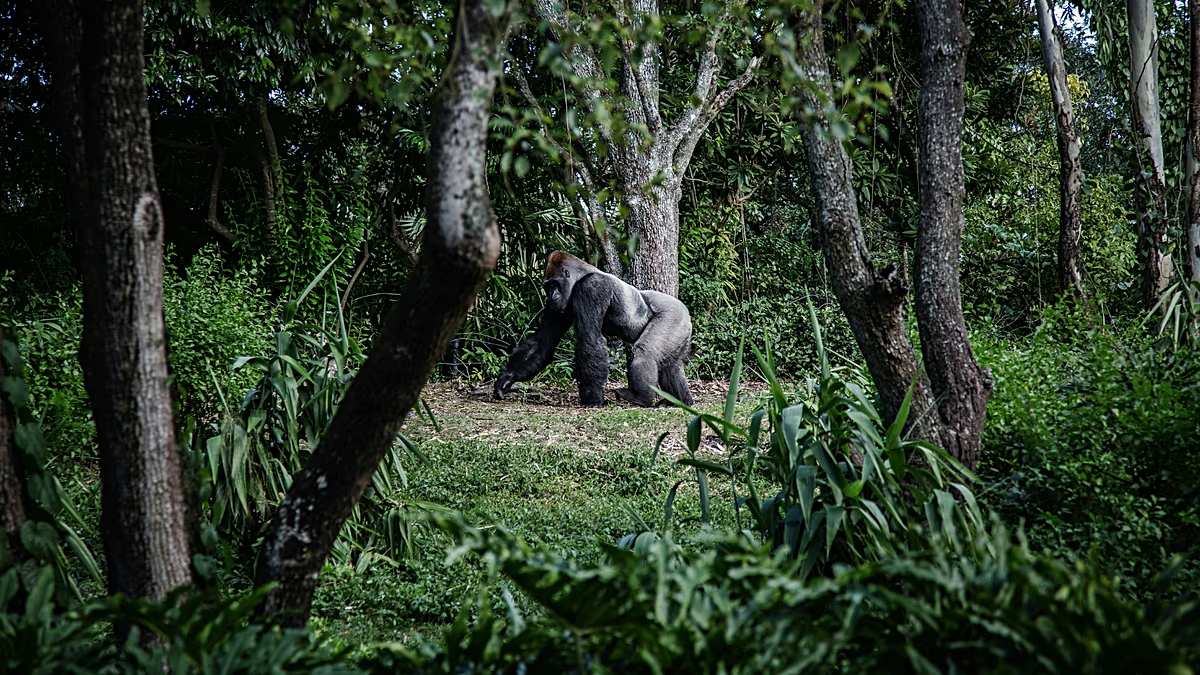
In the bright spring of April, viewers around the globe were once again spellbound by the familiar, comforting voice of Sir David Attenborough in his latest Netflix documentary, “A Gorilla Story.” This sweeping and emotionally resonant film chronicles the grand family lineage of Pablo, a legendary silverback mountain gorilla whom Attenborough first introduced to the world during his historic 1978 filming expedition. Decades later, the documentary follows Pablo’s descendants who continue to inhabit the misty, emerald-green peaks of Rwanda’s majestic Volcanoes National Park, offering a profound testament to the power of continuous wildlife preservation. Historically, such masterfully produced nature documentaries have repeatedly catalysed a phenomenon known as the “Attenborough effect”—a monumental shift in global public consciousness. Most famously, Blue Planet II sparked a sudden, massive revolution in how humanity viewed single-use plastics in 2017, driving millions to alter their daily habits and demand more sustainable, conservation-led travel experiences. When audiences see these colossal silverbacks on their screens, observing their remarkably humanlike expressions, complex family structures, tender parental affection, and gentle social interactions, a powerful bridge of empathy is established across oceans and continents. This immediate post-viewing inspiration frequently transforms into an urgent desire to witness these ancient creatures in person. Yet, while other fragile ecosystems have sometimes buckled under the weight of sudden, viral tourism spikes, Rwanda’s unique approach ensures that this newfound wave of human interest does not degrade the very wilderness that inspired it, showcasing a rare balance between our desire to connect with nature and our duty to protect it.
To understand exactly how this surging wave of global fascination is playing out on the ground, one must examine Rwanda’s highly deliberate, pioneering tourism framework, which stands in stark contrast to traditional mass-tourism models. Instead of standardizing access to meet swelling consumer demand, the Rwandan government and park authorities actively enforce strict regulatory caps to shield both the gorillas and their delicate volcanic habitat from human disturbance. Daily permits are restricted to a maximum of just 100 travelers for the entire country, with each single pass priced at a premium rate of $1,500 (approximately €1,300), and all treks are strictly limited to just one hour of quiet observation in the presence of a habituated gorilla family. To further minimize the risk of behavioral stress and the transmission of human pathogens—to which these closely related hominids possess no natural immunity—only eight guests are permitted to visit any single gorilla group on any given day. When global interest spikes, the administrative machinery does not expand to accommodate the crowd; the permit system remains firmly unyielding. By deliberately keeping access rare, highly controlled, and expensive, Rwanda has effectively decoupled tourist revenue from sheer foot traffic, establishing a sustainable blueprint that prioritizes the health and peace of the mountain gorillas above quick economic windfalls, transforming what might otherwise be a casual safari check-off into a deeply respected, high-value privilege.
This uncompromisingly exclusive system has altered not just the volume of visitors, but the very nature of traveler behavior and intention, transforming casual tourists into committed conservationists. Industry experts who manage these complex journeys daily, such as Lydia Eva Mpanga, are seeing this profound shift manifest in real-time. As the founder of Nkuringo Safaris—an esteemed, local operator boasting over eighteen years of direct experience guiding travelers through the wild terrains of Rwanda and Uganda—Mpanga notes that when global interest rises, the permit limits remain absolutely unbendable, which forces travelers to adjust their own tempos. Rather than turning away disappointed, potential visitors are adapting by adopting a far more deliberate and immersive style of travel. Mpanga’s consultants are observing a dramatic surge in intentional planning, with roughly five out of ten clients now booking double treks and choosing to extend their stays, compared to only two or three out of ten in former years. This statistic demonstrates that instead of treating a gorilla encounter as a quick, singular photo opportunity to be checked off a bucket list, travelers are giving the experience the time, emotional space, and respect it deserves, allowing themselves to truly sink into the rhythms of the ancient forest.
Beyond the rigid permit caps, the sheer physical and monetary demands associated with gorilla trekking serve as natural, self-governing filters that keep the experience serious and highly intentional. The $1,500 permit fee acts as an initial, powerful filter, attracting travelers who have thought deeply about the ethics of conservation and are willing to financially invest in the safety of these endangered primates. Furthermore, unlike traditional wildlife safaris where one might view animals from the cushioned comfort of an open-air vehicle, gorilla trekking is an exhausting, sweat-inducing pilgrimage that tests a traveler’s physical limits. Trekkers must venture deep into dense, trackless jungles, fighting through thick bamboo groves, navigating treacherous, muddy volcanic slopes, and enduring unpredictable downpours and high altitudes, all while carrying their own gear. This grueling physical journey ensures that those walking the forest floors are not impulsive sightseers seeking instant gratification, but rather passionate individuals who hold a profound reverence for the wild. Under the watchful eyes of expert trackers and trackers, these visitors willingly submit to stringent behavioral rules, understanding that in this primordial domain, human desires must always take a back seat to the comfort and safety of the gorilla families.
Crucially, the premium financial investment made by these dedicated travelers funds a beautifully balanced, circular economy that directly supports both local conservation efforts and the surrounding human communities. The substantial revenue raised from the $1,500 permit system does not accumulate in distant corporate bank accounts; instead, a significant portion is redistributed directly to the local communities living along the borders of Volcanoes National Park. This direct financial contribution funds vital local infrastructure, ranging from clean water supply systems and modern healthcare facilities to quality schools and local cooperative business grants. By ensuring that local residents receive tangible, life-changing benefits from tourism, this model has successfully transformed historic human-wildlife conflicts into a cooperative partnership. Former poachers and agricultural encroachers have now become the park’s most fierce protectors, working as trackers, guides, and rangers who actively safeguard the gorillas from snare lines and habitat destruction. This brilliant symbiosis proves that the true survival of an endangered species is inextricably linked to the prosperity of the human beings who share their borders, turning local communities into proud stakeholders in the preservation of their natural heritage.
Ultimately, transitioning from a cozy armchair in front of a television screen to standing face-to-face with a massive silverback in the mist-shrouded highlands of Rwanda is a lesson in patience, planning, and profound human humility. In our fast-paced modern world, where travel can often be booked instantly with a few swipes on a smartphone, Rwanda’s gorilla tourism model remains a beautiful, slow-tempo anomaly. The initial emotional decision sparked by watching David Attenborough’s scenic storytelling must mature through several months of meticulous logistical planning, from securing scarce permits and coordinating safari routes to aligning with limited lodge availability. This deliberate path guarantees that when a traveler ultimately stands in the dappled green light of the rainforest, watching a young gorilla play while its mother rests nearby, they aren’t just tourists passing through; they are active participants in a glorious, slow-motion conservation success story. By resisting the temptation of mass-market commercialization and choosing instead to honor the quiet sanctity of the forest, Rwanda continues to shine as a beacon of hope, showing the global travel industry that some of the world’s greatest wonders are meant to be intensely protected, patiently waited for, and deeply revered.