


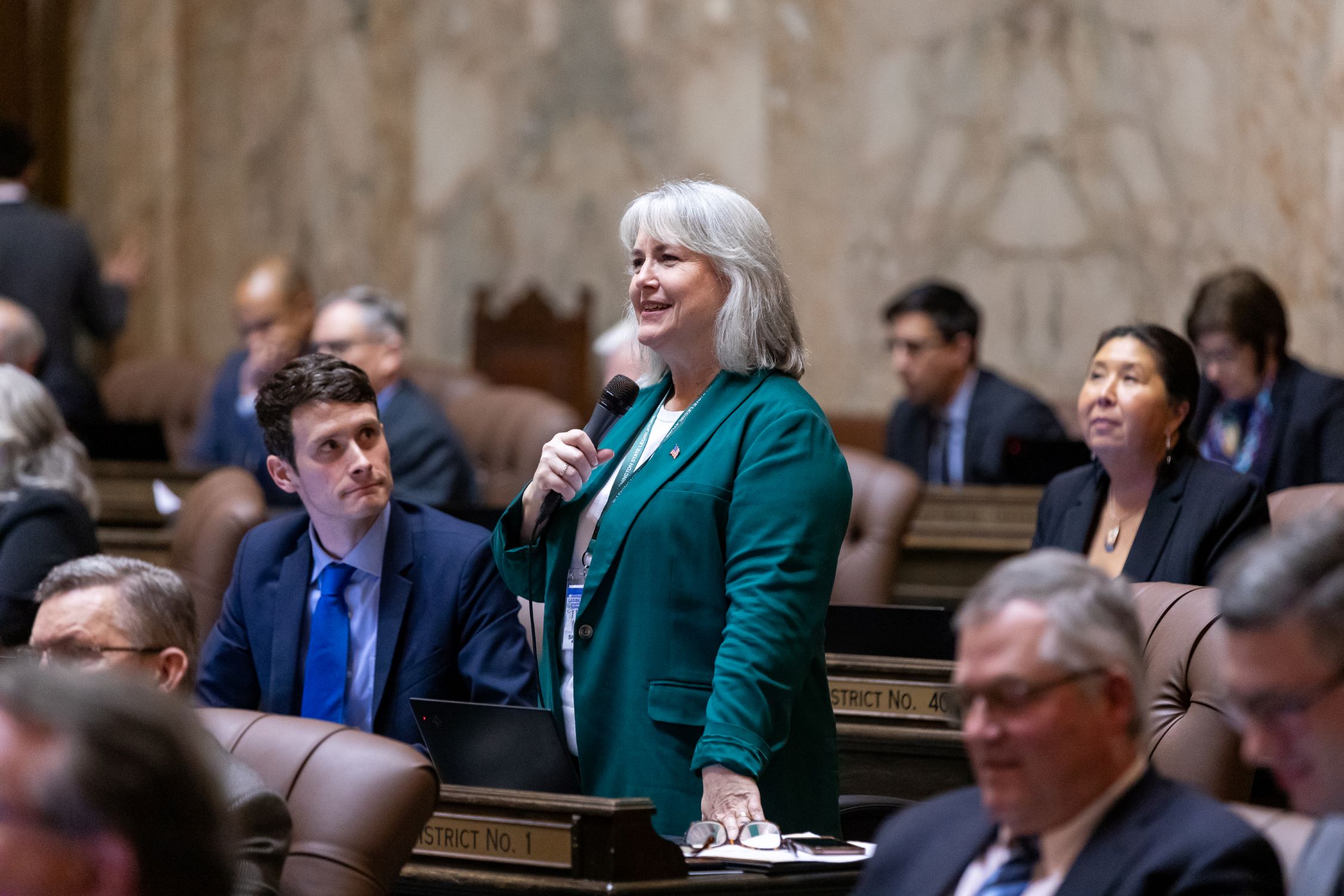
It is a striking, almost ironic twist of legislative fate: Washington state planted the seed for a consumer privacy revolution that swept the entire nation, yet it remains the one garden that refuses to bloom. The blueprints for the legislation adopted by more than twenty other states across the country were drafted in the state capital of Olympia, a framework so influential it became known simply as the “Washington model.” This model, which mandates that companies obtain consent before collecting sensitive data, grants consumers the right to correct and delete their personal information, and establishes strict rules for data brokers, has become the de facto national standard. Despite this outsized impact on the rest of the country, Washington itself has never passed a comprehensive privacy law of its own. For almost eight years, lawmakers have tried and failed to reconcile deep ideological differences over how consumers should fight back against data misuse, and the resulting gridlock has left the state’s own residents profoundly vulnerable in a digital age. Representative Shelley Kloba, a Democrat from Kirkland, has been the standard-bearer for this effort, introducing a bill every single year since 2021, only to see it die in committee without ever making it to the floor of the House of Representatives. The urgency of this failure has only grown in recent weeks, as Washington State Attorney General Nick Brown released a stark report in mid-August detailing the risks posed by the unregulated collection of personal data in the age of artificial intelligence. His report explicitly called on the Legislature to act, warning that without a baseline privacy framework, the state is ceding ground to a handful of powerful corporations who are treating citizen data as an unencumbered commodity. Yet, as the political winter session approaches, the fundamental questions that have stalled this legislation for the better part of a decade remain entirely unresolved, trapped in a cycle of good intentions and irreconcilable demands.
The saga began back in January 2019, when then-State Senator Reuven Carlyle introduced the Washington Privacy Act, a sweeping proposal designed to give citizens greater control over their digital footprints and rebuild a fundamental trust between consumers and the technology they depend on. At the time, the idea was breathtakingly ambitious, positioning the Evergreen State to leapfrog the European Union’s General Data Protection Regulation and create the gold standard for the American tech economy. It promised consumers the right to access, correct, and delete the information companies held on them, and mandated an “opt-out” mechanism for targeted advertising, meaning that a company could not sell or share a user’s data for ad purposes unless the user explicitly permitted it. The bill sailed through the Washington State Senate with nearly unanimous support, a resounding 46-1 vote that suggested smooth sailing lay ahead. But the bill hit a brick wall in the House of Representatives. The core of the controversy centered on a single, explosive legal mechanism: the private right of action. Carlyle’s original bill, which was heavily influenced by the tech industry that powers Washington’s economy, proposed enforcement solely through the Attorney General’s office, giving companies a single, negotiating-friendly regulator to deal with. Consumer rights advocates argued this was a toothless tiger. They insisted that without the threat of private lawsuits—where ordinary citizens or class-action attorneys could sue companies for violations—the law would be nothing more than a paper tiger, destined to be ignored by corporate giants who would simply calculate the cost of fines as just another business expense. On the other side, tech companies and their lobbyists argued that allowing private plaintiffs to sue would unleash a flood of frivolous litigation, turning every minor administrative error into a multi-million dollar legal battle and enriching trial lawyers at the expense of startups and innovation. This chasm proved unbridgeable in 2019. In 2020, the bill was resurrected and passed the Senate a second time, but it once again died in a contentious House-Senate conference committee, a victim of the exact same ideological split that had crippled it the year before. The two chambers simply could not agree on whether the consumer, or the state, should be the primary enforcement arm.
Since that double defeat, Representative Kloba has taken up the mantle, but the ghosts of 2019 and 2020 still haunt the debate like unruly specters. Her proposed legislation, the People’s Privacy Act, has tried to thread a needle that has proven incredibly difficult. Initially, her bill aligned enforcement with the state’s existing Consumer Protection Act (CPA), a legal framework that allows a plaintiff to seek actual damages, attorney’s fees, and even treble damages up to a statutory cap. However, to appease the business community, she placed a relatively modest cap of $25,000 on total recovery for a private party. This approach still infuriated the business community, who see any private enforcement, regardless of the cap, as a green light for class-action litigation. The deadlock persists year after year, with Kloba unable to secure the support needed to bring her measure to a vote, and the bill languishing in committee as the calendar resets every January. However, recent comments suggest a potential thaw in what has been a decade-long political deep freeze. Kloba stated this winter that she is now willing to consider “separating” the enforcement rules. Her emerging compromise involves bifurcating the law so that some violations—perhaps only those involving outright data security lapses or the unauthorized sharing of sensitive health or financial records—would be eligible for a private right of action, allowing victims to speak directly to a judge. Other, less severe administrative violations, such as a failure to timely respond to a consumer’s data request, would be subject only to civil penalties imposed and collected by the Attorney General’s office, thus avoiding a cascade of minor litigation. This represents a significant departure from her previous all-or-nothing stance, indicating a pragmatic shift toward getting something passed rather than continuing to chase a universally beloved bill that will never exist. She has pointed out that the legal landscape has evolved considerably over the last eight years, and that learning from the successes and failures of other states is a natural part of legislative maturation, hinting that the next session may finally produce a legislative compromise.
The political gridlock takes on a much darker hue when one considers the dramatic technological shifts that have occurred since Carlyle first filed his bill. The rise of generative artificial intelligence and large language models (LLMs) has fundamentally rewired the data ecosystem, making the old privacy debates—focused on data brokers, cross-contextual advertising, and cookie banners—seem almost quaint. AI models are voracious consumers of data. They scrape billions of text documents, images, and personal records from the open web, absorbing everything they are fed without the original user’s knowledge, consent, or context. This means that the personal data collected under the old “notice and consent” paradigm is now being repurposed in ways that the original collection rules never contemplated. A user who checked a box allowing a bookstore to email them coupons might now find their purchase history contributing to an AI model that decides their creditworthiness. Carlyle himself admitted in a recent interview that his original 2019 bill was designed for a pre-AI world, a legal architecture built for a simpler time when data was mostly siloed in databases and used primarily for marketing. He acknowledged that if he were drafting the legislation today, he would have included a much stronger “data minimization” provision—a legal requirement that companies only collect the absolute minimum amount of personal data required to provide the specific service requested by the user, and that they delete it once that service is rendered. Experts like Cobun Zweifel-Keegan of the International Association of Privacy Professionals argue that this minimization principle is now the only effective shield against the AI data vacuum. Without it, a company can legally hoard your email, your location history, and your purchase habits under the guise of “improving services,” only to later feed that same treasure trove into an AI training algorithm to create autonomous chatbots or predictive policing tools, entirely decoupled from the original purpose of the data collection.
The fight over the private right of action is increasingly framed not just as a civil liberties issue, but as a crucial tool for regulating artificial intelligence and holding powerful algorithms accountable. Kara Williams, counsel at the Electronic Privacy Information Center (EPIC), argues that relying solely on a state Attorney General to enforce privacy laws is a recipe for failure, given the limited resources, staff, and funding of state agencies relative to the sheer scale of data processing and the legal sophistication of big tech. She posits that the threat of private lawsuits is the only way to ensure that companies actually take the law seriously, transforming compliance from an afterthought into a boardroom-level imperative. On the other side of the aisle, lobbyists like Rose Feliciano of TechNet, a trade association representing some of the largest technology firms in the world, including Amazon and Google, push back fiercely. Feliciano argues that a private right of action doesn’t actually benefit consumers; it simply creates a litigation bonanza for trial lawyers. She contends that the threat of treble damages and class action lawsuits would force companies to spend billions on defensive legal fees, diverting capital away from engineering and innovation, and ultimately raising costs for all consumers. The Attorney General’s office, currently led by Nick Brown, maintains a delicate balancing act. The report he released calls for comprehensive legislation while explicitly acknowledging the need for “robust enforcement,” but it carefully steers clear of dictating the exact legal mechanism, hoping to avoid inflaming the very tensions that have doomed previous efforts. The political reality is that the tech industry holds immense sway in Washington state, home to Microsoft and Amazon, and any bill that fails to appease that opposition is likely to meet the same fate as its predecessors, regardless of the moral urgency of the underlying issue.
Looking ahead, the window for meaningful legislation may finally be creaking open, driven by the sheer urgency of the AI revolution and a growing recognition among even the most intransigent parties that legislative paralysis is no longer a sustainable option. Carlyle’s reflection that “perfect is the enemy of the good” is an apt epitaph for the past eight years of failure. He has cautioned that Washington’s insistence on strict private enforcement clauses has allowed a de facto regulatory vacuum to persist, while other states with weaker enforcement mechanisms have at least provided their citizens some legal protections. Kloba’s willingness to compromise on the enforcement mechanism is a hopeful sign that she recognizes this reality. She has observed that many states have passed laws and subsequently refined them over time, and she believes Washington should adopt a similar pragmatic approach rather than waiting for an unattainable unanimous consensus. She recently stated, “Over the last eight years, various laws have been put in place in different states and we’ve seen them then go back and improve them over time, and so I think it’s time to have that conversation.” But the fundamental issue remains that the proliferation of personalized data is no longer just a commercial concern; it is a matter of civil rights in the age of algorithmic decision-making. As the nation moves toward regulating AI-based determinations in housing, credit, and employment, Washington is uniquely positioned to lead the way, given its role as the birthplace of the privacy controversy. But leadership requires action, not just influence. If the state can find a middle ground—marrying stringent data minimization rules with a hybrid enforcement model that gives the Attorney General broad power while offering consumers a narrow, limited right to sue over specific egregious violations—it could finally shed its status as the tragic trendsetter that lost its own narrative. Until then, the story of Washington state remains a cautionary tale of how ideological purity can paralyze practical progress, leaving millions of residents without the very protections the rest of the country takes for granted, even as the data giants continue to tighten their grip on the flow of information.