



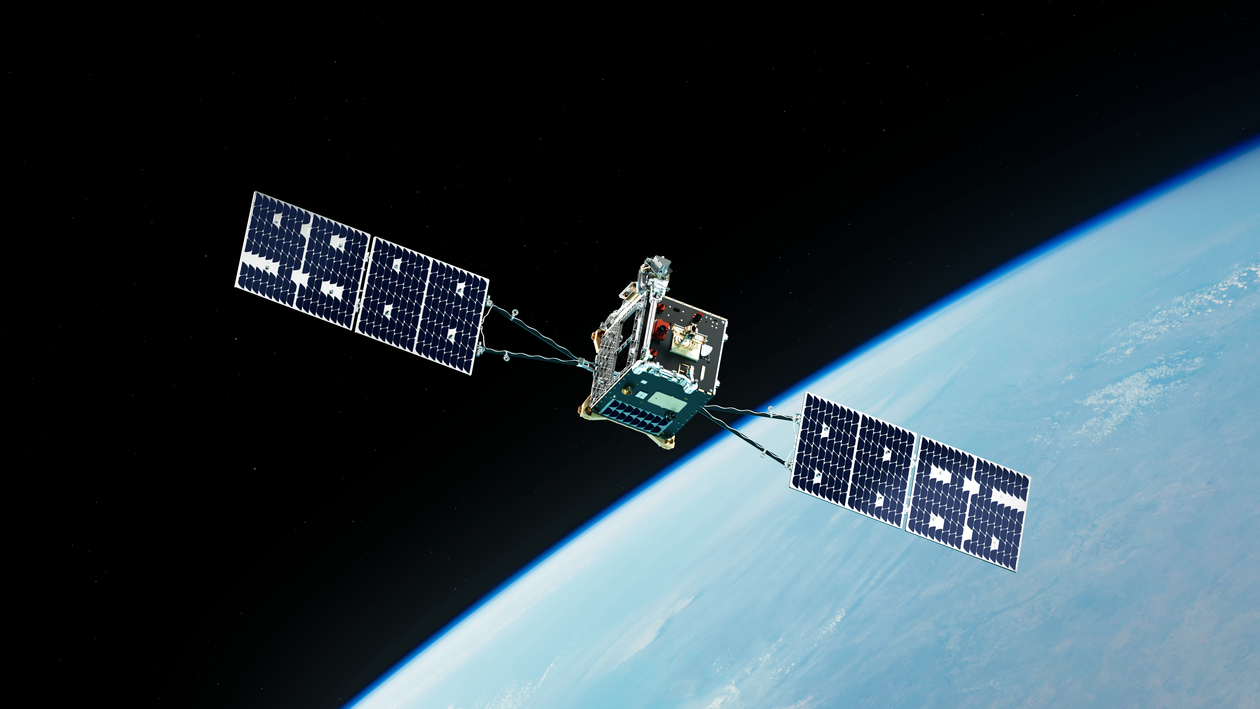
Spaceflight has a way of turning the most human emotions into engineering problems. Joy becomes telemetry, anxiety becomes checklists, and grief becomes an anomaly report. But when a spacecraft goes silent, the feeling underneath is unmistakable. Starfish Space knows that feeling now. The Tukwila, Washington-based startup reported that it can no longer receive data from its first full-scale Otter space vehicle, a mission called the Small Spacecraft Propulsion and Inspection Capability, or SSPICY. It was meant to be a turning point: a $15 million NASA mission to inspect inoperable satellites and demonstrate that a new generation of commercial spacecraft could maneuver close to dead or derelict objects in orbit. That kind of capability is essential if humanity is going to clean up space junk, refuel satellites, or repair broken infrastructure in orbit. But the mission ended prematurely. In a LinkedIn post, the company said Otter 24C was not able to complete all objectives, and that Starfish and NASA are exploring opportunities to fulfill the mission’s aims through other Starfish missions. There’s no explosion to report, no fiery ending. Just silence where there used to be signal. For a company whose entire business model depends on the ability to rendezvous with objects in space, losing your first full-scale vehicle before it could do that is a brutal irony. But it is also a reminder that space exploration rarely follows the script. The first attempt is often the hardest, and sometimes it is the one that teaches the most. Maybe that is why the company’s update sounds less like a eulogy and more like a commitment. The mission is not dead; it will live on through other Starfish missions, and the loss of Otter 24C will become part of the foundation for whatever comes next.
To understand what happened, you have to go back to Oct. 1, when Otter 24C rode a SpaceX Falcon 9 rocket into low Earth orbit. The launch was flawless, and the deployment was exactly what the team had prayed for. Shortly after arriving in orbit, Starfish established two-way contact with the spacecraft and successfully commanded it, downlinking significant telemetry during early operations. For a brief, beautiful moment, all the years of design and construction seemed worth it. Then, during the commissioning process, the signal stopped. No data, no response, no second chance. The team investigated, and the culprit turned out to be a small but devastating flaw: the fault protection system on the satellite bus built by Astro Digital contained an error that turned off the radio and prevented any attempt to re-establish communications. It wasn’t a bad thruster, a power failure, or a collision with space debris. It was more like accidentally locking yourself out of your own car in a parking lot, except the car is orbiting Earth at 17,000 miles per hour and no spare key exists. Spacecraft fault protection is supposed to save a satellite in an emergency, not destroy it. An error in that system is particularly cruel. Starfish, NASA, and Astro Digital jointly reviewed the situation and concluded that the spacecraft was unrecoverable. That single line in a press release represents hundreds of hours of troubleshooting, speculation, and reluctant acceptance. Mission engineers likely tried every trick in the book: rebooting sensors, sending commands through alternate paths, waiting for the spacecraft to emerge from safe mode. In the end, none of it mattered. The radio stayed off, and the silence became permanent. Sometimes the most advanced space program in the world is at the mercy of a few lines of code.
The public statements from Starfish and NASA sound measured and composed, as they often are in the space industry. But behind the jargon is a human story about dealing with disappointment and choosing to keep going. Starfish emphasized that developing new capabilities in space requires taking on difficult challenges, learning quickly and applying lessons to what comes next. The work completed through Otter 24C, the company said, will directly contribute to future Otter missions. That is not just optimistic marketing. Spacecraft development is iterative; every failure, even a brutal one, feeds new safeguards into the next design. Starfish also made clear that it is working with Astro Digital to fix the fault protection system and update testing procedures for future Otters. That is a concrete, honest response. Greg Stover, the director of NASA’s Advanced Research and Technology Division, added a broader perspective, saying commercial capabilities like Starfish’s are critical for a competitive U.S. space economy and strong American leadership in low Earth orbit. He also said technology demonstrations allow NASA to quickly test new systems, learn from their performance, and iterate, pushing the boundaries of what is possible with every mission. “NASA will continue taking on bold challenges in close collaboration with our industry partners.” That statement matters. It means the agency is not turning its back on Starfish; it is treating the loss as part of the process. In the world of orbital startups, failure can be stigmatized. Investors watch, customers worry, and competitors may quietly smile. But the strongest teams respond by being transparent. Starfish’s willingness to name the problem and share the blame with Astro Digital is a sign of maturity. It also tells customers that the company will be honest with them even when things go wrong. The next Otter will carry the scars of this experience in its software and in the memory of its team, and that will make it stronger.
Despite the loss, Starfish Space is not slamming on the brakes. In fact, a number of significant missions are already lined up, each with the potential to turn Otter 24C’s legacy into something more than a failure. The company has a satellite disposal job for the Pentagon’s Space Development Agency. It has two commercial satellite servicing missions in geostationary Earth orbit. It has two servicing missions for the U.S. Space Force. These are not speculative contracts on a wish list; they are commitments from serious customers who need what Starfish is trying to build. The demand for in-orbit servicing is growing quickly. Satellites are becoming more numerous, more expensive, and more essential to everyday life. When one breaks down, the old answer was simply to leave it there and launch a replacement. But that approach is getting harder to sustain, especially as Earth orbit becomes crowded. The ability to inspect, reposition, refuel, or safely deorbit a satellite is becoming a strategic advantage. Otter 24C was supposed to be a proof point. It did manage to get into orbit and show that the company could communicate with its spacecraft. But the ultimate goal of catching up with an inoperable satellite and inspecting it would have to wait. That wait, however, will not be nearly as long as the years it took to get this far. The next Otter is already part of the plan, and it will benefit from everything learned before the signal disappeared. For a startup, having such a busy manifest is a vote of confidence. The loss of one mission is painful, but the pipeline remains strong, and the need for these services only grows with each new satellite launched. Commercial space is not for the faint of heart, and Starfish is building a company that can weather heartbreak.
In the meantime, there is a smaller story of hope happening in orbit right now. Starfish continues to test Otter Pup, a prototype spacecraft launched last year. Last week, the company posted a video on LinkedIn showing Otter Pup making a close approach to a target satellite known as ElaraSat. The footage is the kind of thing that would make any space enthusiast’s heart beat a little faster: two small objects, moving carefully toward each other against the blackness, no atmosphere, no margin for error. Starfish says it is preparing for a docking attempt, and the company is calling it a chance to make history. Why is that so significant? Docking two spacecraft in orbit is one of the hardest maneuvers ever attempted. The speeds, distances, and forces involved are unforgiving. A successful docking would prove that Starfish’s technology can do the one thing that makes satellite servicing possible: physically connecting with another object in space. It would also give the team a much-needed victory after the loss of Otter 24C. There is something poetic about Otter Pup stepping into the spotlight. It was a smaller project, a prototype, perhaps easier to overlook next to a full-scale vehicle funded by NASA. But now it carries the hopes of the entire company. In space, as in life, the underdog sometimes gets the chance to rewrite the story. The journey to that docking attempt will be tense. Every meter of relative distance will be measured, every command will be scrutinized. If it succeeds, the name Otter Pup will be remembered alongside that of Otter 24C as two essential pieces of the same climb. And even if the first attempt does not succeed, the company will learn, adjust, and try again. Around them, the world will be watching quietly, rooting for the little spacecraft and the people who refuse to stop reaching.
The loss of Otter 24C is, by any standard, a setback. A NASA mission with a $15 million price tag did not achieve its main objective. A spacecraft built to be the future of satellite servicing is now just another object in orbit, unreachable and unresponsive. But the human story cannot be reduced to those details. At the heart of this mission were people who believed they could do something that had rarely been done before. They were not reckless; they were ambitious. They will spend long nights reviewing data, rewriting test procedures, and checking every line of code. They will also get back to work. The company has future missions with the Space Force, the Space Development Agency, and commercial operators. It has a prototype in orbit getting ready to attempt something historic. It has the support of NASA, which has learned over six decades that failure is not the opposite of success; it is part of the path to success. Greg Stover’s words—”NASA will continue taking on bold challenges”—should be read not as a dismissal of the loss but as a promise to keep going. For the rest of us, watching from Earth, this story is a reminder that progress in space is hard-won. It comes in fits and starts, through disappointments and breakthroughs, through lost signals and recovered lessons. Otter 24C is silent, but the effort it represented is not. The next spacecraft will be smarter. The next mission will be stronger. And one day, the concept of reaching out in orbit to touch, repair, and guide a satellite will be routine. On that day, someone should remember the little Otter that fell silent before it could finish the job. It acted as a pioneer, and it will not be forgotten. In every engineering change, in every new radio test, in every docking attempt, Otter 24C will still be there, speaking in the only way a lost spacecraft can: through the people it taught to listen.