



One afternoon, in a quiet residential neighborhood, an older woman lost her footing and fell. She wasn’t entirely without help—her phone was on the table nearby, and an emergency button was within reach. But she didn’t call out. She didn’t press the button. She stayed where she was, perhaps hoping she could get up by herself, perhaps too embarrassed to admit what had happened. It wasn’t until the next morning, when she finally needed an ambulance, that her family learned she had been hurt. That story belongs to Michael Nassirian’s mother-in-law, and it is the reason Thessai exists. A Bellevue, Wash., startup led by Nassirian, a former Microsoft HoloLens executive, Thessai is trying to change the way we care for older adults who live alone. Its approach is radically quiet: no cameras, no continuously listening microphones, no wearable devices that need to be charged or remembered. Instead, small motion sensors placed around the home feed an AI system that learns each person’s normal patterns—when they wake, how often they move between rooms, how frequently they use the bathroom, how much time they spend in the kitchen or the living room. Over days and weeks, the software builds a baseline that is unique to that individual. When something falls outside that baseline—an unusually long stretch of inactivity, sudden movement at three in the morning, a front door opening at two a.m.—a notification is sent through a mobile app to a designated caregiver. The goal is not to monitor every step like a surveillance system, but to notice the moments that matter. It is a system built on the belief that older adults should be able to live independently without being watched like children, and that families deserve a way to check in on their loved ones without intruding on their privacy.
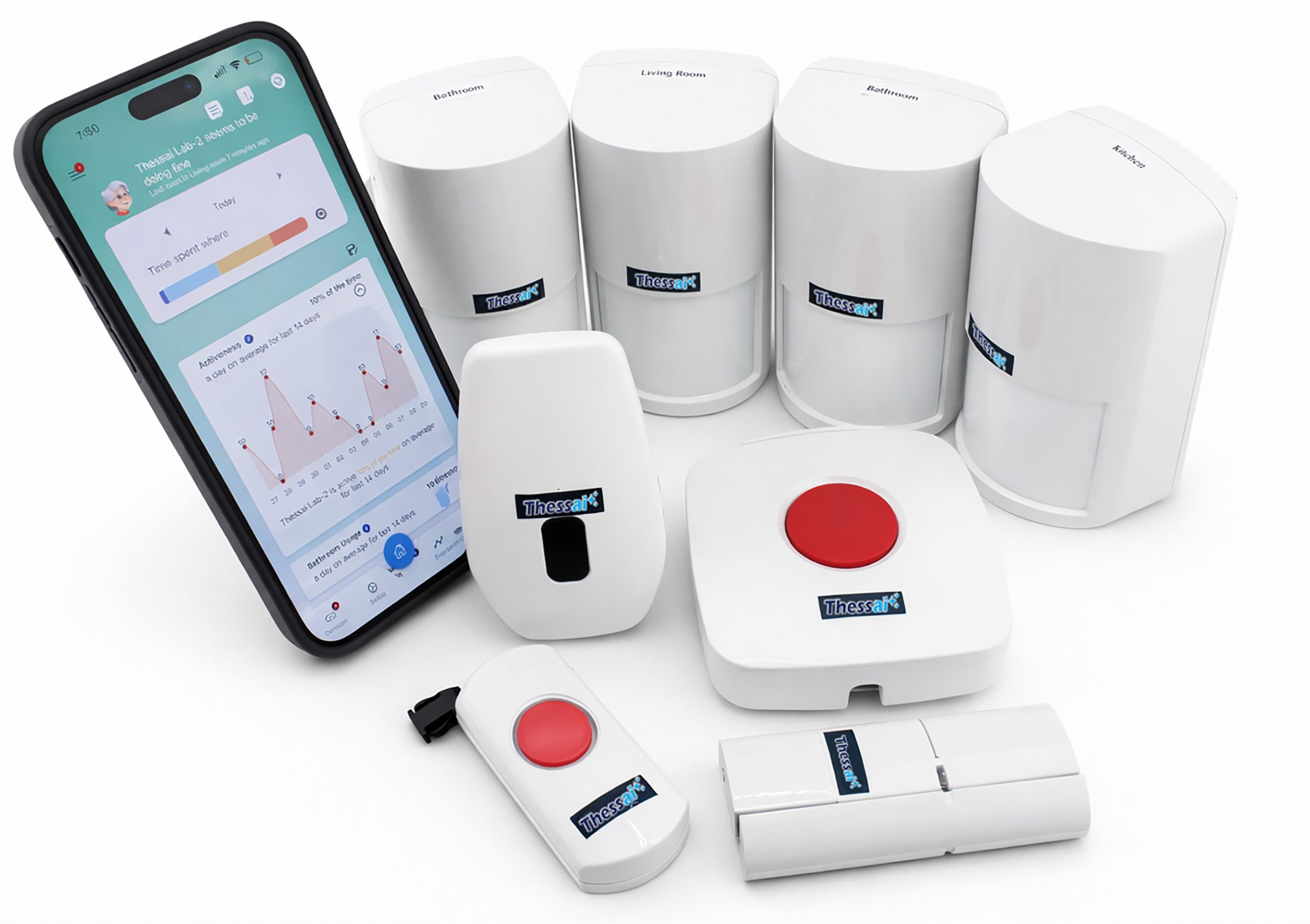
The heart of Thessai’s system is deliberately unremarkable. A small hub plugs into the home’s Wi-Fi, and a handful of battery-operated motion sensors are placed in the rooms where an older person spends the most time—typically the living room, kitchen, bedroom, and hallway. The sensors do not capture video or audio. They simply record a timeline of motion. From the moment the system is installed, it begins learning. It notices that this person usually wakes at seven, makes coffee, sits in the armchair until lunch, moves to the bedroom in the evening, and visits the bathroom twice during the night. Over time, the AI becomes sensitive to changes that might signal a problem. If there is no motion for an unusually long time in the middle of the day, the caregiver’s phone gets a gentle alert. If the resident starts getting up at two in the morning and wandering, the system flags that too. If a person with dementia who never goes outside at night opens the front door, someone can check in before a dangerous situation unfolds. The alerts are not one-size-fits-all. Caregivers can tune the system to reduce false alarms, so a parent who routinely sleeps late doesn’t set off a panic at eight in the morning. And crucially, the older adult remains in control of their own privacy. Through the companion app, they can switch off sensors in certain rooms. A sensor in the bathroom can be turned off entirely, leaving monitoring to the kitchen and living room only. Nassirian stresses that the entire design bends to the comfort of the older person. “We designed it to the last bit of the person’s privacy,” he says. This is not surveillance in the traditional sense. It is more like a quiet companion that notices when something feels wrong. For an older person who values independence, the system offers a way to stay at home longer without having a caregiver in the same room or a camera watching every move. For adult children, it turns vague worry into something manageable. Instead of calling every few hours and wondering if they are being a bother, they can trust a system that has learned their mother’s or father’s habits and will speak up when it matters. The technology does not replace human connection; it helps families focus their attention on the moments that truly require it.
One of the most heartbreaking lessons Nassirian learned is that falling is not just a physical event; it is an emotional one. When he asked why his mother-in-law and so many other older adults remain silent after a fall, he heard the same three responses. First, “I’m Okay.” Second, “I don’t want to bother you.” Third, and most important, “embarrassment.” Older adults do not want to advertise that they are frail. They do not want to feel like a burden. So they downplay injuries, hide symptoms, and reject devices that label them as vulnerable. This instinct, however understandable, can have serious consequences. A fall that isn’t reported can turn into a long, painful night on the floor, dehydration, a delayed ambulance ride, a longer recovery. For decades, the default answer to this problem has been emergency pendants and smartwatches with fall detection. The logic is simple: if you slip, press the button, or let the watch sense the impact. But research suggests these tools are only useful if people actually use them. A review of nearly 120 fall-detection studies co-authored by a University of Alberta researcher found that older adults who fall often don’t use their devices to reach a caregiver. They may forget to charge them, take them off at night, or refuse to wear them at all because they feel stigmatized. A device that sits on the nightstand is useless. A watch that feels like a badge of aging will be discarded. That is why Thessai is part of a growing movement toward passive, ambient monitoring. No one has to remember to do anything. The home itself becomes the sensor. Other companies are exploring similar territory: Cherish makes radar-based sensors that can detect breathing and movement through walls, while Butlr uses thermal heat detection to understand occupancy and behavior. Thessai differentiates itself by learning the individual’s own rhythms and by putting the older person’s privacy and comfort first. The result is a system that does not require daily buy-in or technical savvy. It works quietly in the background, offering protection precisely because it does not demand participation.
Michael Nassirian’s path to founding Thessai is a study in how the right experience can converge around a deeply personal problem. For nearly two decades at Microsoft, he worked on Office, Windows, and later HoloLens, where he was a partner quality architect—someone whose job was to make sure complex technology actually worked for the people using it. Before that, he spent about fourteen years at Texas Instruments in test engineering. He holds a master’s degree in biomedical engineering from the University of Texas at Austin. That combination of disciplines—biomedical engineering, hardware quality, and mixed reality—gave him the tools to build a product that feels both deeply human and technically sophisticated. His journey into elder care began almost by accident. After his mother-in-law’s fall, the family looked for a way to keep tabs on her, but the only real options were wearables and cameras, which she flatly refused. So Nassirian went to Home Depot, bought a set of motion sensors, placed them around her home, and wrote his own software to alert his wife if her mother stopped moving. It was a simple, homemade solution, but it worked. Soon, relatives and friends began asking if he could set up similar systems for their own parents and grandparents. What started as a clever way to help his wife care for her mother began to look like something bigger. In 2024, Nassirian formally founded Thessai and has self-funded the company so far. The team is small but global: four employees in the United States and seven in Singapore. The company soft-launched in May and already has a few hundred customers, split between individual families and senior-care operators. One of its early supporters is Chuck Lytle, the founder of Bellevue-based senior housing companies Lytle Enterprises and Leisure Care, who now sits on Thessai’s advisory board. That connection has helped the startup understand the realities of senior living and shaped its strategy for reaching independent-living communities, which Nassirian says have become the strongest market so far.
Part of what makes Thessai appealing to families is its straightforward product lineup. The Basic package costs $195 plus $38 per month and includes motion sensors plus a hub that connects to the home’s existing Wi-Fi. The Premium package costs $249 plus $59 per month and adds a panic button and two-way voice check-ins through the hub, allowing a caregiver to speak directly to the older person through the device. The sensors run on batteries that Nassirian says last at least a year and a half, so maintenance is minimal—no complex setup, no medical alert call centers, no subscription that feels like a utility bill. For senior-living operators, Thessai offers an Enterprise package with a dashboard that can monitor multiple residences at once. Independent-living communities, rather than memory-care facilities, have been the early adopters. Memory-care facilities already have staff watching residents closely, so they don’t need a passive monitoring system as much. But independent-living operators are pitching Thessai to prospective renters as a “smart home” feature—a way to reassure both the older adult and their adult children that living independently does not mean living unmonitored. The demand for this kind of product is clearly growing. Americans overwhelmingly want to remain in their own homes and communities as they age. AARP’s 2024 Home and Community Preferences Survey found that 75% of older adults want to stay in their homes, and 73% want to stay in their communities. At the same time, the number of households headed by people 80 and older is projected to double by 2040. That creates a massive market for technology that helps people age in place safely, without sacrificing privacy. Thessai is also working with the Department of Veterans Affairs on bringing the system to veterans, including those in rural areas, with the option to run on the VA’s own secure network. This partnership points to a broader future: passive monitoring as a basic tool of elder care, not just a luxury for tech-savvy families.
Thessai is not settling into its current shape. Nassirian has a long-term vision that would make even the small motion sensors disappear entirely. He wants to use a home’s existing Wi-Fi signals to detect movement—an approach that researchers at Harvard and Carnegie Mellon have been studying for years. By analyzing how Wi-Fi signals bounce off objects and bodies, it may eventually be possible to know whether someone is walking, sitting, or has fallen, without any sensors at all. That would be the ultimate privacy-preserving monitoring system: no hardware to install, no batteries to change, no visible sign that the home is being watched. “I’m in technology,” Nassirian says. “I’m not going to sit still.” But even as he looks toward the future, his focus remains on the human problem at the core of the business. Thessai exists not because people need more gadgets, but because a mother-in-law fell and didn’t want to be a bother. It exists because adult children lie awake at night wondering if their parents are okay. It exists because older adults deserve to live with dignity and independence, and because a system that respects their privacy is more likely to be accepted than one that watches them like a surveillance camera. The company’s goal is to provide quiet reassurance—for the older adult who wants to stay in their own home, and for the family that wants to be alerted when something is wrong. In a way, Thessai is trying to preserve the best of an older world, where neighbors checked on one another and family gathered nearby, using modern technology to recreate that safety net in a world where families are often thousands of miles apart. Nassirian’s story is a reminder that some of the most meaningful innovations begin with ordinary moments of care. He didn’t set out to build a company; he set out to help his wife and her mother. In doing so, he discovered a way to help countless other families face one of the hardest parts of aging: the moment when a parent needs help but won’t ask for it. Thessai offers a gentle answer—one that listens for silence, notices absence, and, when necessary, speaks up on behalf of someone who was too embarrassed to say a word. That is technology with a heart, and it may be exactly what an aging society needs.