


Paragraph 1: The Setting and the Prize
On a crisp October evening in Seattle, the University of Washington’s Allen School of Computer Science & Engineering transformed into a bustling marketplace of ideas. The occasion was the annual Research Showcase, a beloved tradition where the brightest PhD students unveil their latest work through a forest of posters, each a window into the future of computing. Among the crowd, a familiar presence: Madrona, the Seattle-based venture capital firm that has been a stalwart supporter of the event for nearly two decades. Since 2006, Madrona has presented its prize to student projects that strike that delicate balance between rigorous research and real-world commercial promise. It’s not just about clever algorithms or elegant proofs; it’s about ideas that could leap out of the lab and into a product, a startup, or a game-changing tool. The energy in the room was palpable—students huddled around their posters, explaining intricate diagrams to professors, investors, and fellow researchers, while the scent of coffee and faint hum of conversation filled the air. The Madrona Prize, with its cash award and coveted recognition, is a rite of passage for many Allen School students, a signal that their work matters beyond academia. As dusk fell, the judges—a mix of Madrona partners and faculty—circulated, probing, questioning, and occasionally nodding with approval. They were looking for that spark of originality, a clear path to impact, and a story that could captivate. By the end of the evening, one project would rise above the rest, and the story of how AI itself could be the key to squeezing AI onto the smallest devices would take center stage.
Paragraph 2: The Winning Project – AI Agents as Hardware Whisperers
The laurel rested that night on the shoulders of Zhihan Zhang, a PhD student in the Allen School, whose project addressed a growing, gnarly problem: how to make AI models small and efficient enough to run on the tiny, low-power chips that power everything from sensor nodes to wearables. Experts currently perform this task by hand—a painstaking process of shrinking models, tuning device software, and wrestling with strict limits on memory, power, and heat. Zhang’s audacious idea was to ask whether AI agents themselves could do this job. He built a system that lets an AI agent load its work onto real hardware, measure the results, and then iterate—essentially giving it a playground where trial and error is not just possible but encouraged. In his tests, the leading AI models failed spectacularly without this hardware feedback loop, but when given the ability to test on actual chips, the agent achieved what human experts had done, and it did so within just seven rounds. This is a striking result because it suggests that the very thing AI models are usually criticized for—being disconnected from physical reality—can be overcome with a simple feedback mechanism. The implications are vast: instead of relying on human experts for every new device, we could have AI agents that rapidly tailor AI models to specific hardware, slashing development time and opening doors to edge computing applications that were previously too costly or too complex to deploy. Zhang’s work is not just an academic exercise; it’s a practical toolkit that could democratize the field of AI optimization.
Paragraph 3: Real-World Tests and the Embedded Arena Benchmark
To prove the approach wasn’t a fluke, Zhang and his collaborators took it out of the abstract and into the wild—quite literally. One of their test cases involved a solar-powered camera trap designed to spot elk in their natural habitat. The challenge: the computer vision model had to be shrunk by a staggering 250 times to fit onto the camera’s constrained hardware while still reliably detecting elk day and night. The AI agent, guided by its ability to test on the actual device, managed to achieve exactly that, turning a dream into a deployable reality. The second scenario was equally compelling: a wearable device that records children’s speech for developmental research. Here, the need was to compress a speech-processing model enough to run on a tiny, battery-powered wearable that kids could wear comfortably for hours. Again, the agent succeeded, demonstrating that its method generalizes across vastly different domains. To ensure the research community could build on this work, the team released their benchmark, dubbed Embedded Arena, as open-source code. This isn’t just a one-off solution; it’s a testing ground for future researchers to compare their own AI-driven optimization agents against, fostering a new area of study. The collaboration behind this project—featuring Allen School faculty members Shwetak Patel, Vikram Iyer, Natasha Jaques, and Kurtis Heimerl, along with a robust team of collaborators including Alexander Metzger, Jiuyang Lyu, Chun-Cheng Chang, Jiayi Shao, Yujia Liu, Emmanuel Azuh Mensah, Edward Wang, and Gregory D. Abowd—highlights the interdisciplinary nature of the work, blending machine learning, systems, and hardware design.
Paragraph 4: The People’s Choice Award – VibeSys and the Art of Custom Software
While Zhang took home the main prize, the People’s Choice award—a testament to a project’s crowd appeal—went to Keisuke Kamahori for VibeSys, a project that takes the concept of AI-driven customization to another level. VibeSys uses AI agents to write custom software for a specific chip and a specific task, then continuously refines it, rather than relying on the general-purpose tools that are designed for common setups. The first application, VibeServe, tackles the behind-the-scenes software that receives user requests and routes them through an AI model—the often-overlooked but critical plumbing of any AI service. On Amazon’s Trainium2 chips, the software built by VibeSys handled up to 2.7 times the workload of an existing, hand-tuned system. That’s a huge performance gain, and it’s achieved without a human engineer poring over hardware manuals. Instead, the AI agent explores the design space, writes code, tests it, and iterates until it finds a superior solution. The project, developed with Shihang (Vic) Li and faculty members Simon Peter and Baris Kasikci, suggests a future where hardware-software co-design is not just for experts but is an automated, intelligent process. For the audience, the appeal was clear: this is a tangible, exciting demonstration of AI not just doing a task, but doing it better than humans in a highly specialized domain. The posters at the showcase were crowded, and Kamahori’s explanations drew nods of fascination—people could see the immediate potential for cost savings and performance boosts in data centers, edge devices, and beyond.
Paragraph 5: The Runners-Up – VideoNet and DNA Synthesis Security
The Madrona Prize’s first runner-up, Tanush Yadav, presented VideoNet, a project that confronts a different kind of challenge: evaluating how well AI models understand specific actions in video. VideoNet is a meticulously curated test set covering more than 1,000 actions across 38 fields, from a particular bouldering move in climbing to a specific type of surgical stitch. The deep exploration here is about nuance—how well can AI models recognize the subtle differences between, say, a beginner’s stitch and a master’s? The findings are sobering: leading AI models struggle with these distinctions compared to ordinary people. In the study, when shown just three examples, human participants improved their accuracy by about 14 percentage points, while AI models improved by only about 3 percentage points. This underscores a fundamental gap in current AI’s ability to learn from a few examples and generalize to fine-grained tasks. The work, involving Allen School faculty Ali Farhadi, Hanna Hajishirzi, and Ranjay Krishna, along with former faculty member Yejin Choi (now at Stanford) and collaborators Mohammadreza Salehi, Jae Sung Park, Vivek Ramanujan, and Rohun Tripathi, offers a rigorous benchmark that could shape future efforts in video understanding. The second runner-up, Henry Wong, took home recognition for a project with profound security implications: securing benchtop DNA synthesizers. These machines allow users to “print” synthetic DNA, a powerful tool for biotechnology but also a potential vector for malicious use, such as creating dangerous pathogens. Wong’s work focuses on protecting the screening software that is supposed to prevent such abuse. His conclusion is sobering: even if the hardware were perfectly secure, the problem wouldn’t fully be solved, because the software itself is vulnerable to attack. This project, with Allen School faculty member Jeff Nivala and former faculty member Tadayoshi Kohno (now at Georgetown), highlights a desperate need for security in a field where the stakes are literally life and death.
Paragraph 6: The Bigger Picture – A Future Shaped by AI and Human Ingenuity
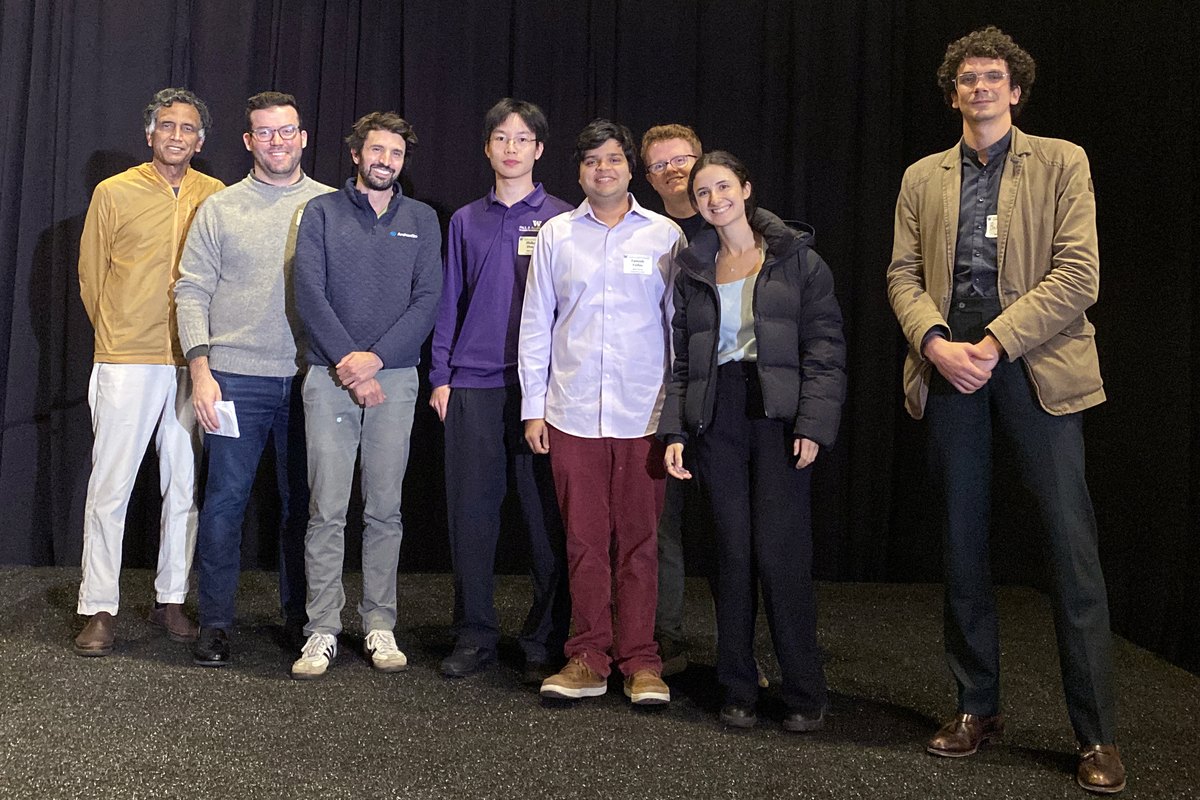
As the evening wound down, the winners posed for photos, and the conversations spilled out into the cool Seattle night, the broader significance of what had been showcased began to sink in. The projects honored at the 2026 Madrona Prize share a common thread: they all grapple with the tension between AI’s immense potential and the practical, messy constraints of the real world. Whether it’s Zhang’s AI agents shrinking models for solar-powered cameras, Kamahori’s VibeSys writing custom chip software, Yadav’s VideoNet probing the limits of visual understanding, or Wong’s efforts to secure the future of biotechnology, these are not abstract theories—they are foundations for products and systems that could reshape industries. The Madrona Prize has always been a harbinger of what’s next, and this year’s cohort signals a shift toward a more automated, more efficient, and more secure AI-driven world, but also one that must be designed with care. For the PhD students who spent countless hours on these projects, the recognition is validation, but the real reward is knowing their work could one day leave the lab and help a researcher spot an elk from a camera trap, a doctor make a better incision, or a developer build an AI service that runs on a fraction of the energy. The showcase ended, but the ideas it launched into the world will continue to evolve, guided by the same curiosity and rigor that filled the room that Thursday afternoon. And Madrona, with its keen eye for commercial potential, will be watching—likely eager to support the startups that emerge from these seeds. For now, the future of computing looks brighter, smaller, and infinitely more intelligent, thanks to the work on display at the Allen School.