


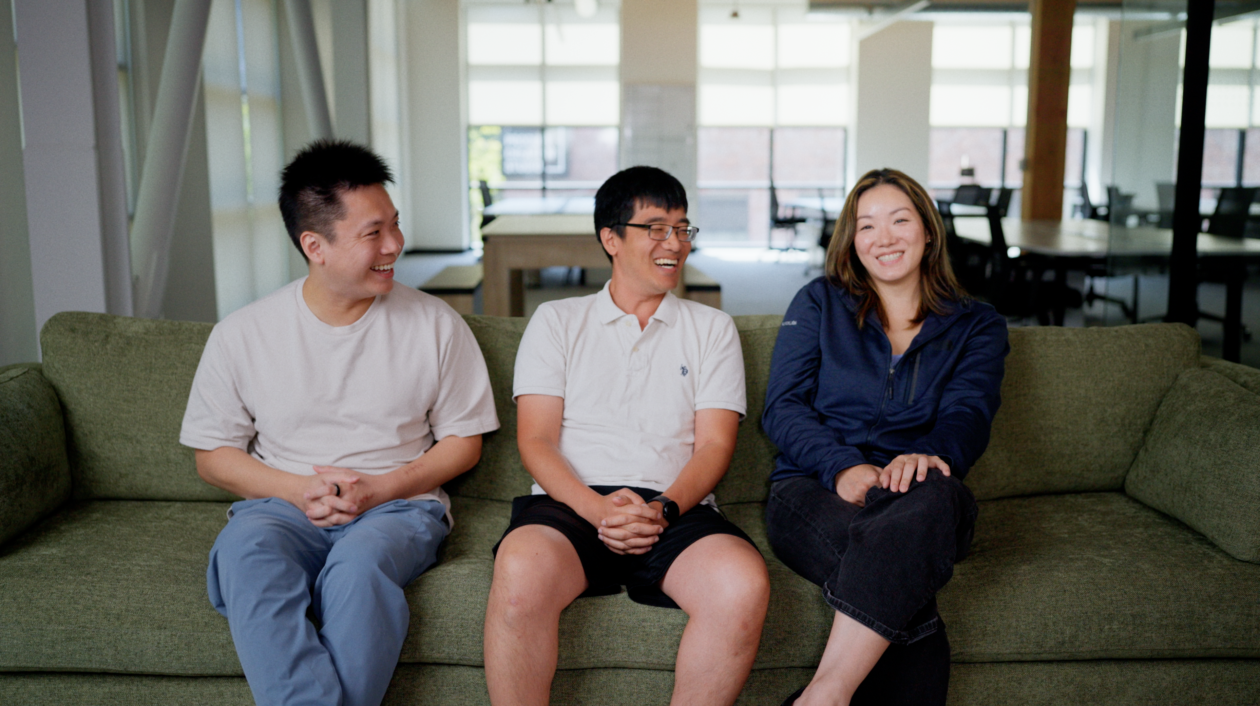
Think about the last time you had a truly great conversation with a friend. The words mattered, of course, but so did the way your friend tilted their head when you paused, the quick laugh that said “I get it,” the slight nod that kept you going. That texture of human exchange—all the nuance in the back-and-forth that turns talking into understanding—is exactly what has been missing from every voice assistant, chatbot, or digital avatar you’ve ever interacted with. For too long, talking to a machine has meant simplifying yourself to fit the machine. You speak slowly, you use keywords, you avoid ambiguity, and even then you’re never quite sure whether the thing on the other end is actually listening or just waiting for its turn to speak. Nuance Labs, a small research-driven startup in Seattle, is betting that this is the wrong way to build artificial intelligence. The company, founded in early 2025 by three former Apple PhD researchers—Fangchang Ma, Edward Zhang, and Karren Yang—has just raised $50 million in Series A funding to pursue a radically different vision: AI that perceives and responds to real-time human expression, not just words. That means tone, gaze, timing, gesture, hesitation, and all the little signals that carry meaning in a face-to-face conversation. With this latest round, Nuance Labs has now raised $60 million total, building on a $10 million seed round from last year. But more important than the number is the message it sends: that some of the most experienced investors in the industry believe the future of human-AI interaction depends on teaching machines to converse the way people actually do.
The technology Nuance Labs is developing is different from the typical chatbot or voice assistant you’ve seen before. Most AI systems that interact with people rely on what is essentially a chain of separate tools: one model transcribes your speech into text, another model generates a text response, a third model converts that text into spoken words, and a fourth model animates a face or avatar. Each of these steps happens one after another, creating lag, awkward pauses, and a robotic, disjointed experience. Nuance’s approach is to collapse all of that into a single “full-duplex” foundation model. In the world of communication, full-duplex means that both sides can send and receive at the same time—like two friends interrupting each other with excitement, or a listener’s facial expression changing while the speaker is still talking. That’s how humans actually communicate, and it’s what Nuance is trying to replicate. The model ingests live audiovisual signals—including tone of voice, eye contact, gaze direction, and conversational timing—and streams back real-time facial and vocal responses that feel natural and reactive. In a demo video that accompanied the funding announcement, Nuance showcased an avatar designed to function as an active listener. As the user spoke, the avatar’s expressions shifted subtly: a small smile at the right moment, a thoughtful blink, a nod of encouragement. It wasn’t a flashy special effect; it was the kind of quiet responsiveness that makes a conversation feel real. That’s exactly the point. Nuance’s CEO, Fangchang Ma, says that existing avatars and voice tools fail because they force humans to adapt to the machine rather than the other way around. The most productive collaboration, he argues, comes from being able to express yourself freely—in words, tone, gesture, and expression—just as you would with a friend or close colleague. That’s the experience Nuance is building toward.
The people behind this vision bring both serious technical credentials and a personal connection to the Pacific Northwest. Fangchang Ma studied at MIT before moving to Apple, where he worked in the company’s engineering office in Seattle. There he met Edward Zhang, who earned his PhD in computer graphics from the University of Washington and shared Ma’s curiosity about how to make machines feel less mechanical. Together with Karren Yang, another PhD researcher with a deep background in machine learning and computer vision, they founded Nuance Labs with the explicit intention of making it a premier research lab in Seattle rather than in Silicon Valley. That decision was deliberate. In an interview with GeekWire last fall, Ma and Zhang talked about the appeal of building a cutting-edge AI lab in a city known more for coffee, rain, and a long history of engineering talent than for the hype cycles of the Bay Area. Seattle has a rich pool of technical people, particularly in areas like computer graphics, speech processing, and real-time systems, thanks to the deep presence of major tech companies and the University of Washington. But the founders also seemed drawn to something less tangible: the chance to build a different kind of company culture, one that values thoughtful research over frantic feature shipping. There’s a certain understated confidence to building in Seattle, a way of saying that you don’t need to be at the center of the tech universe to do world-changing work. Nuance Labs is still small—just 27 employees—but that’s by design for a research lab at this stage. The team is focused on deep problems in modeling, data, evaluation, and real-time serving, and the new funding will be used to bring in more researchers and engineers who want to work on those problems at the frontier of human-AI interaction.
If this technology works as intended, the potential applications go far beyond making chatbots more pleasant to talk to. Nuance is targeting situations where real-time human expression actually drives outcomes. Consider sales: a salesperson might practice a pitch with an AI avatar that reads the room—notices when the pitch is dragging, when the customer looks confused, when a joke might land. Customer service could become less about holding for a representative and more about speaking to an AI that can hear frustration in your voice and respond with the appropriate measure of empathy and clarity. Professional coaching is another natural fit: imagine an interactive avatar that can help you prepare for a difficult conversation, giving you real-time feedback on your tone, pacing, and emotional presence. And in education, a patient, always-available virtual tutor could notice when a student is losing confidence or disengaging, and adjust its approach to rekindle curiosity. The common thread is that none of these things are really about information retrieval. They’re about understanding people. For all the progress we’ve made with large language models, the deepest form of communication is still a face-to-face exchange where meaning lives between the words as much as in them. Nuance’s founding team believes that the barrier to this kind of AI has never been just about intelligence—it’s about responsiveness. It’s about having a model that can perceive and respond in real time, rather than one that processes your input, thinks for a second, and then delivers a canned answer. When you’re talking to a good listener, you don’t feel like you’re being processed. You feel understood. That feeling, or at least a convincing version of it, is what Nuance hopes to bring to AI.
The $50 million Series A round was led by Lightspeed Venture Partners, a returning investor that clearly sees something special in Nuance’s research-first approach. Existing backers Accel and South Park Commons also participated, and the round included new investments from NVIDIA and Define Ventures. That mix of names is notable. Lightspeed and Accel are major players who typically invest in companies with strong product and revenue trajectories, and their continued support suggests confidence in Nuance’s technical direction. NVIDIA’s presence is particularly interesting, given that the company sits at the center of the AI infrastructure boom and might be expected to have its finger on the pulse of where AI is going next. Define Ventures, which focuses on healthcare innovation, points to another set of possibilities: perhaps AI that can read human emotion could transform patient interactions, mental health support, or clinical communication in ways we haven’t fully imagined. With a total of $60 million in funding, Nuance Labs has enough runway to make meaningful progress without being forced into premature commercialization. The company plans to release a research preview of its model later this year, giving users their first hands-on chance to test the interactive face-to-face avatar. That public preview will be an important moment, not just for Nuance but for anyone who has ever felt frustrated by a customer service bot or unsettled by an avatar that stares through you. It will be an early test of whether this technology can leave the lab and begin to feel like a real presence—something that can sit across from you, metaphorically or literally, and hold up its end of a human conversation.
In a world increasingly saturated with AI tools that generate text, images, and voices, it’s easy to forget that the most powerful forms of intelligence are often expressed in the subtlest ways. A pause can mean more than a paragraph. An eyebrow raise can change the meaning of a sentence. A glance away can signal discomfort, just as a warm smile can turn a transactional exchange into a connection. Nuance Labs has chosen to put its name and its reputation on that very idea—that the future of artificial intelligence is not just about generating more information more quickly, but about understanding the nuance in everything we say and don’t say. The company’s founders come from some of the most rigorous research environments in the world, and they’ve chosen Seattle as the place to build something meaningful. They’ve attracted high-profile investors, built a small team of passionate researchers, and developed a demo that hints at a future where AI doesn’t feel like a tool so much as a conversational partner. If they succeed, the way we interact with machines will change in a profound way. We may stop thinking of AI as something we command and start thinking of it as something we talk to. The funding announced today is a snapshot of a moment in time, a vote of confidence in a vision that is equal parts humanistic and technological. But the real proof will come later this year, when the research preview is released and we all get a chance to see whether an avatar can actually look us in the eye, read our mood, and respond in a way that feels less like code and more like company.