


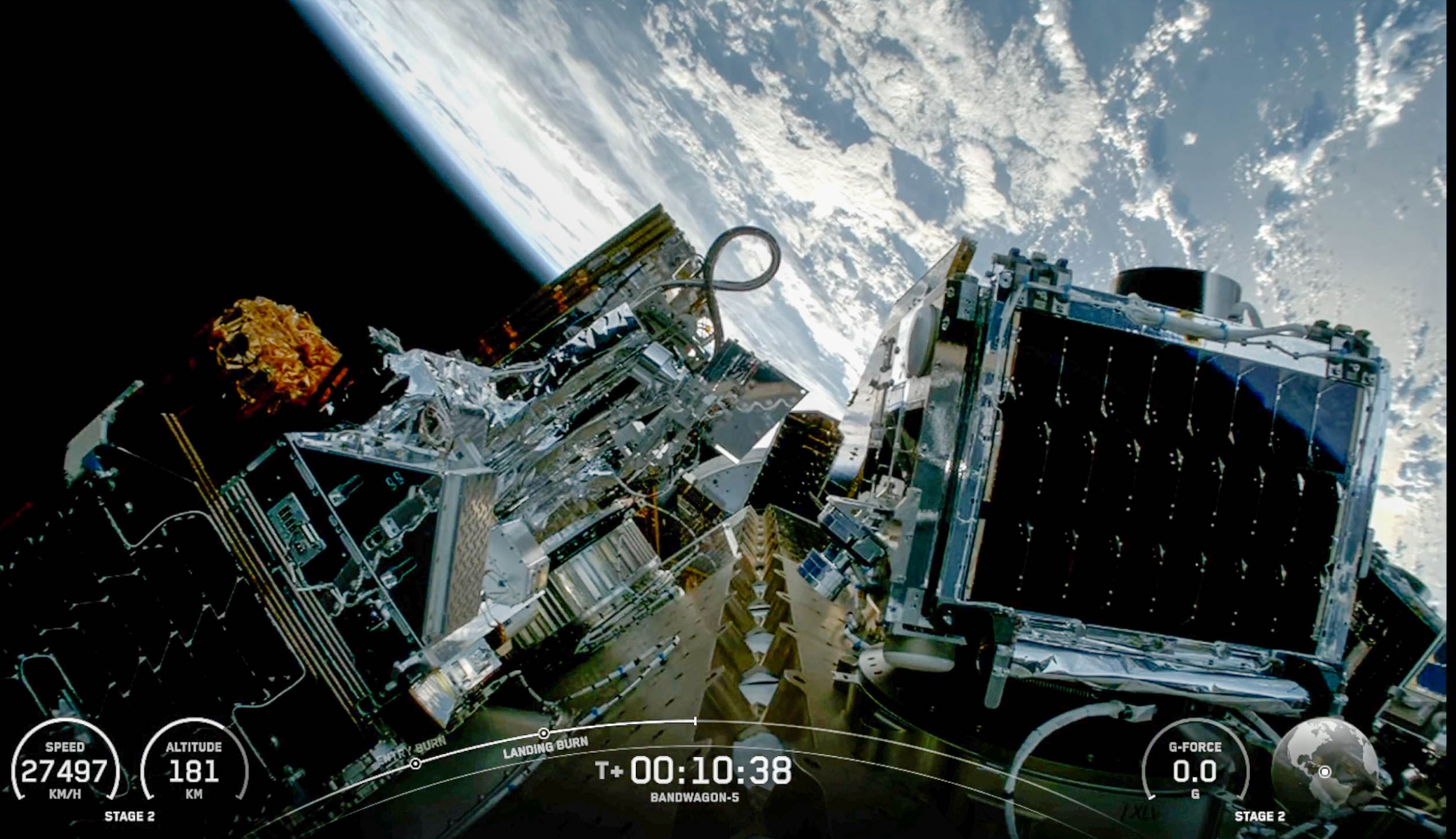
It was still dark over Cape Canaveral when the latest chapter in Portal Space Systems’ ambitious story began to unfold. At 7:04 a.m. EDT, a SpaceX Falcon 9 rocket roared off from Space Launch Complex 40, carrying the startup’s first free-flying spacecraft, Starburst-1, on the Bandwagon-5 rideshare mission. For the small but determined team based in Bothell, Washington, those first minutes of powered flight were the culmination of months of around-the-clock work, but their true test was just beginning. About 57 minutes into the mission, the desk-sized satellite separated cleanly from the Falcon 9 upper stage, slipping into Earth orbit with no fanfare beyond the quiet confidence of engineers watching from ground stations. Within hours, the company’s leadership could share the news that their spacecraft had established communications with Earth, stabilized its attitude, and deployed its solar array to become fully power positive. It was a moment of deep relief and pride, made even sweeter by the knowledge that this marked only the second significant milestone in the company’s young history—and their first true orbital platform. Earlier in March, Portal had already made good on its promise by launching Mini-Nova, a tissue-box-sized technology demonstration payload that rode a Falcon 9 to validate critical control and power systems in the harsh environment of space. But Starburst-1 was different. It was a complete, free-flying spacecraft, the first of its kind for Portal, and it represented the tangible arrival of a startup that had emerged from stealth only two years earlier.
For Portal’s founders, Tuesday’s success was never just about reaching orbit. It was about proving that their philosophy of speed could hold up in an industry where delays are often seen as inevitable. In a statement released shortly after the deployment, co-founder and CEO Jeff Thornburg captured the spirit of the company when he explained why Portal had chosen to self-fund Starburst-1 rather than wait for the slower, more traditional path of government contracts and prolonged development cycles. “Speed can’t just be part of the product. It has to be part of the company building it,” Thornburg said. “Our customers need spacecraft that move quickly in orbit and a company that moves with the same urgency to get them there. We put our own capital behind Starburst-1 because proving hardware in flight is how we earn their confidence.” Those words reflect a deep, almost personal commitment to shaking up the space industry. Portal is not content to design spacecraft that simply coast through orbit; they want vehicles that can shift rapidly and decisively, responding to dynamic mission needs with agility. By injecting their own money into the project, the founders signaled to prospective customers that they are willing to take risks alongside them, sharing the burden of proving new capabilities. The gamble appears to be paying off. From the introduction of the Starburst vehicle concept in November 2025 to the successful launch less than a year later, the company has moved at a pace that would make more established aerospace firms dizzy. And with a video of the launch and deployment posted to LinkedIn by Thornburg, the world got a first-hand look at what that urgency looks like in practice.
The success of Starburst-1 is particularly meaningful because of what the spacecraft represents technically. Starburst is an ESPA-class vehicle, a compact design tailored for a specific orbital regime where it can execute rapid maneuvers with remarkable flexibility. It is not merely a satellite; it is a building block for a broader vision. The spacecraft shares the majority of its core systems and manufacturing processes with Supernova, Portal’s larger and more ambitious vehicle that is being built for rapid travel across different orbital regimes. In many ways, Starburst-1 is the scout for Supernova, gathering flight data and proving out hardware that will directly inform both platforms. This shared architecture is a deliberate strategy, allowing Portal to iterate quickly and avoid the costly process of starting from scratch with each new design. The co-founders—Thornburg, VP of engineering Prashaanth Ravindran, and Ian Vorbach—celebrated the launch by calling Vorbach from Kennedy Space Center immediately after the separation, a small but telling moment of camaraderie. They know that the data coming down from Starburst-1 will be instrumental in refining the Supernova program, which is already booked to fly on a dedicated Falcon 9 mission in 2028. That mission, known as Motus Via Sol, will carry multiple Starburst spacecraft alongside the first Supernova, marking the next big leap for the company. For now, the team is savoring the quiet victory of a successful deployment, while knowing that the real work of analyzing on-orbit operations is only beginning.
As impressive as the spacecraft itself is, the mission is also serving as a test bed for cutting-edge technologies from three partner companies, each with a distinct role to play in the future of space operations. Zenno Astronautics has contributed its Supertorquer, a superconducting magnetic attitude-control system that uses Earth’s magnetic field to orient the spacecraft, conserving precious onboard propellant that can then be reserved for major maneuvers. The system is also being evaluated for its ability to generate a magnetic field that could shield sensitive electronics from harmful radiation—a potentially revolutionary capability for long-duration missions. TRL11, meanwhile, has sent up its Fovea M1 camera system, designed to provide live high-definition video of Starburst-1 and its surroundings. The camera has already delivered visual confirmation of the solar array deployment, giving engineers and the public alike a rare look at hardware working in space. Atomic-6 brought Space Armor, a set of protective tiles engineered to withstand high-speed impacts from orbital debris while preventing the creation of additional secondary debris—a concern that is becoming increasingly urgent as low Earth orbit grows more crowded. These payloads represent more than just commercial agreements; they are evidence that Portal is building an ecosystem of partners who see value in the company’s rapid-flight approach. By opening up Starburst-1 to external experimental technologies, Portal is positioning itself as not just a satellite maker, but a platform for innovation, helping to move the entire space industry forward in small but meaningful steps.
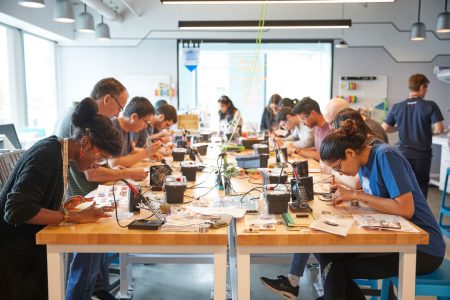
The financial and institutional backing behind Portal reflects the confidence investors and the military have placed in this young company. Since emerging from stealth in 2024, Portal has raised a total of $75 million in funding, including a significant $50 million round that closed in April. The investor list reads like a who’s who of space and defense venture capital: Geodesic Capital, Mach33, Booz Allen Ventures, AlleyCorp, and FUSE all contributed, alongside critical Small Business Innovation Research (SBIR) and Strategic Technology and Research (STRATFI) awards from the U.S. military. This combination of private capital and government support gives Portal both the resources and the legitimacy it needs to compete in a crowded field. GeekWire got an inside look at Portal’s 8,000-square-foot Bothell development and testing lab earlier this year, where engineers were busy assembling and validating the very hardware that would soon find itself in orbit. That lab, once a hive of activity, is already being outpaced by the company’s growth. What was once a modest space filled with test fixtures and prototype components is now giving way to something much larger. The company is in the process of transitioning its satellite manufacturing operations into a new 65,000-square-foot facility, also in Bothell, which is slated to be fully operational by next year. The new facility is designed for scale, with the capacity to produce up to 16 Starburst spacecraft and 12 Supernova spacecraft annually—a level of throughput that would have seemed unimaginable when the company was still designing its first concepts on paper.
Looking ahead, Portal’s trajectory appears as ambitious as the spacecraft it builds. The successful launch and deployment of Starburst-1 is not an end point but a foundation, laying the groundwork for a future in which rapid, maneuverable satellites are the norm rather than the exception. The company’s willingness to self-fund a mission to prove its hardware sends a powerful message to the market: Portal is serious, and it is willing to put its own skin in the game. As the Bothell facility ramps up and the 2028 Mission Motus Via Sol approaches, the company is poised to move from proving ground to production mode. Each day that Starburst-1 operates in orbit is an opportunity to learn, refine, and build confidence among the commercial and defense customers who are watching closely. For Thornburg and his team, the launch on Tuesday morning was a validation of everything they have believed since those early days in stealth mode: that the space industry needs a new way of doing business, one where speed and execution are not afterthoughts but guiding principles. The quiet pride in their voices, the celebratory call to a co-founder, the almost casual confidence of announcing a successful solar array deployment—all of it points to a company that is finding its stride. The mission itself, still in its early days, promises more discoveries in the weeks and months to come. But for now, Portal Space Systems can look up at the night sky and know that a piece of their small Washington startup is up there, moving with purpose, and carrying the hopes of a team that refuses to wait for the future to arrive.