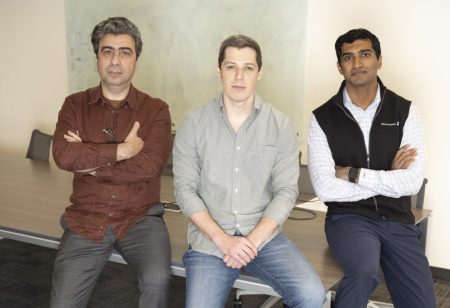




In the fast-paced, cyclical world of technology entrepreneurship, it is a familiar story: a founding team builds a successful platform, sells it for a handsome sum, and then looks for the next big impossible problem to solve. For the trio behind the former home-improvement unicorn Pro.com—Raji Subramanian, Matt Williams, and Zachary Harl—that next challenge has emerged from the ashes of their previous venture, and it is a radical pivot. Pro.com was a digital marketplace aimed at making home renovations and services as seamless as ordering a ride. After its acquisition by the real estate tech giant Opendoor in 2021, where the three served in prominent executive roles, they have now surfaced with a new venture called OnTrade. OnTrade, however, is not about fixing leaky faucets or repainting living rooms. Instead, it is a sophisticated, AI-powered software platform designed for the wealth management industry. On the surface, this appears to be a stark departure from drywall and contractors. Yet, as the founders explain, the underlying philosophy is identical: they have identified a massive, underserved market suffering from a severe bottleneck in supply—not of goods, but of human expertise and access. Just as Pro.com sought to democratize the $400 billion home services market by connecting homeowners with vetted professionals, OnTrade aims to democratize financial advice, tackling what the founders see as a profound crisis of accessibility in the world of high-net-worth and middle-class investing.
To understand the depth of OnTrade’s strategy, one must first appreciate the impressive, eclectic pedigree of its founders—a blend of consumer internet, big tech infrastructure, and institutional finance that perfectly equips them for this ambitious pivot. The CEO, Raji Subramanian, is a veteran of Amazon, having joined in the late 1990s when it was a fledgling online bookstore. She was an early engineer who helped build two of the most transformative platforms in modern history: the Amazon Marketplace, which turned the company into a global retail colossus by allowing third-party sellers to reach millions, and AWS (Amazon Web Services), the cloud computing behemoth that powers a vast swath of the internet. Later, she led the digitalization of books for the Kindle, fundamentally changing how humanity reads and purchases literature. Across the table, President Matt Williams brings a similarly robust consumer-tech background. He founded LiveBid, a real-time auction platform that was acquired by Amazon in 1999, spending over a decade there before leaving to become the CEO of Digg, the once-mighty social news aggregator, and later serving as an entrepreneur-in-residence at the legendary venture capital firm Andreessen Horowitz. The third member, Chief Investment Officer Zachary Harl, provides the deep financial and risk-management expertise necessary for navigating the heavily regulated world of money management. Harl spent years at the investment banking behemoth Bank of America, ascending to the role of Chief Investment Officer, where he managed the bank’s massive asset portfolios and navigated complex balance-sheet risks through multiple market cycles. His credentials are underscored by his service on the U.S. Treasury Borrowing Advisory Committee under Secretaries Steven Mnuchin and Janet Yellen, where he helped advise the federal government on debt management strategy. Their paths converged at Opendoor, where Williams and Subramanian led the Pro.com integration and product strategies, and Harl joined as Chief Risk Officer in 2023. It was there, witnessing the vast inefficiencies in how American households managed their biggest financial decisions—buying, selling, and renovating homes—that they realized the same structural flaws plague the financial advisory industry, albeit with even higher stakes.
The core thesis of OnTrade hinges on a powerful, human-centric observation: the wealth management industry does not have a demand problem; it has an access problem. As the founders are quick to point out, the industry is bracing for what financial experts call the “Great Wealth Transfer.” As baby boomers age, an estimated $50 trillion to $80 trillion in assets is expected to pass down to younger generations (Gen X, Millennials, and Gen Z) over the next two decades. This seismic shift is creating an unprecedented wave of new clients who will need financial guidance—from rolling over 401(k)s to managing inheritances and planning for retirement. Simultaneously, the number of qualified financial advisors is stagnating or even shrinking. Traditional financial advisory firms operate on a brutal economic model: an advisor can realistically manage only a finite number of client relationships to provide personalized, high-quality service—often between 100 and 150 households. Because the cost of hiring and training new advisors is prohibitively high, most firms ration their services. They focus their attention on ultra-high-net-worth individuals (those with millions in liquid assets) who generate the most revenue in fees. As a result, the “mass affluent”—people with, say, $250,000 to $1.5 million in investable assets who desperately need help planning for retirement, college savings, and tax efficiency—are often underserved, receiving generic, cookie-cutter advice or being relegated to digital self-service tools that cannot replace human nuance. OnTrade’s founders saw this as a tragic irony: while Wall Street incentivizes massive scale, the actual delivery of financial wisdom is artisanal and gated behind wealth. They are building OnTrade to break down this glass ceiling, allowing a single advisor to scale their empathy and expertise to serve thousands of clients without personally burning out, thereby ensuring that a teacher, a nurse, or a small business owner gets the same quality of sophisticated financial planning as a tech mogul.
So, how does OnTrade work its magic? The founders intentionally avoided the “rip and replace” strategy that plagues many fintech startups. They understand that financial advisors are notoriously loyal to their existing tech stacks, which include Customer Relationship Management (CRM) systems like Salesforce or Redtail, portfolio accounting platforms like Orion or Addepar, trading software, and compliance tools. Asking advisors to abandon these entrenched systems—which contain years of client data and ingrained workflows—is a recipe for failure. OnTrade’s brilliant approach is to act as an intelligent integration layer, or a “command center” that sits on top of this existing infrastructure. It uses application programming interfaces (APIs) to connect the dots, pulling data from all these disparate sources into a single, unified interface. But the real innovation lies in the AI agents OnTrade deploys. These are not simple chatbots; they are specialized vertical AI agents trained on the specific workflows, regulatory jargon, and operational idiosyncrasies of the wealth management industry. Imagine a Thursday afternoon when the stock market dips 3%. Traditionally, an advisor would have to spend hours manually scanning their client portfolios to identify who is overexposed, who has unrealized losses that could be harvested to offset taxes, and who might be panicking and need a reassuring phone call. OnTrade automates this drudgery. Its AI agents continuously scan portfolios, flagging tax-loss harvesting opportunities that a human might miss, alerting advisors to accounts that have drifted from their target asset allocation, and even drafting personalized, client-ready reports that explain complex market movements in plain English. Crucially, the founders emphasize a “human-in-the-loop” design. The AI never sends anything to a client directly. It prepares the draft, does the heavy lifting, and then a human advisor reviews, edits, and approves every communication. This maintains the critical fiduciary trust and human connection that clients demand, while erasing the tedious hours of administrative work. This is the essence of what they call “vertical AI”—taking the general-purpose “brilliant PhDs” of the AI world (like the underlying large language models) and putting them through a rigorous bootcamp in financial compliance, estate planning, and portfolio theory, so they can actually perform trusted, professional work in a specific field.
The timing of OnTrade’s public emergence is nothing short of fortuitous, directly coinciding with a massive wave of consolidation and validation in the wealth-tech space. Just days before their official profile hit the tech press, the financial services giant Vanguard announced a blockbuster deal to acquire the robo-advisor and digital wealth platform Altruist, reportedly valuing the company at a staggering $4 billion. This acquisition sent shockwaves through the industry, serving as a massive, market-level validation that software is the future of financial advice. However, it also highlights the key strategic difference between OnTrade and its newly acquired competitor. Altruist, like many established players, built a “full stack” solution. They built their own custodian, their own brokerage system, and their own software, essentially forcing advisors to move their clients’ assets onto Altruist’s platform to use the tools. This is a heavy lift and creates significant switching costs. In contrast, OnTrade is pursuing a purely software-centric, non-custodial model. As President Matt Williams puts it, they do not ask firms to replace their existing tools or move their clients’ money. They plug into what is already in use. This non-disruptive approach allows them to collaborate with the giants of the industry rather than compete with them. Established players like Orion Advisor Solutions, Envestnet, and Addepar—who provide the industry’s underlying data and accounting infrastructure—are viewed not as enemies, but as potential partners. OnTrade simply sits on top of them, layering on the intelligence. This distinction is crucial. In a market where advisors are already drowning in point solutions, OnTrade offers a way to get exponentially smarter without undergoing a painful, risky migration of their entire business infrastructure. It is the difference between telling a homeowner to tear down their house to install a new smart system, versus simply retrofitting the existing wiring—a lesson in pragmatism the founders learned well from their days rebuilding the notoriously fragmented housing market.
Ultimately, OnTrade’s ambition extends far beyond just selling software to financial firms; it is a mission to fundamentally shift the “unit of scale” in financial services. Historically, if a wealth management firm wanted to grow from managing $1 billion to $10 billion in assets, the only way to do it was to acquire another firm and bring on their advisors, or to hire dozens of new, expensive human advisors. The labor of the advisor was the unit of scale. OnTrade’s thesis, as articulated by the founders, is that this unit is shifting from “the number of people a firm employs to the intelligence and agency it can deploy.” By giving each human advisor an army of digital AI analysts who work diligently in the background, the economics of the industry are completely transformed. A small, independent financial planning firm with just three advisors can suddenly operate with the efficiency and capacity of a giant wirehouse like Morgan Stanley, without the massive overhead. This allows them to lower their minimum account thresholds, taking on clients with $100,000 to invest rather than $1 million, because the margin is now protected by the AI’s efficiency. When asked about the enormity of the task, the founders draw a parallel to their past successes. Subramanian recalls how Amazon Marketplace democratized retail for small businesses, and how Yahoo Finance (where she later ran engineering) opened up real-time market data that was once the exclusive province of institutional trading floors, handing it to retail investors for free. Williams, reflecting on his broader career, notes that outside of health, wealth, and real estate—the basic pillars of the American Dream—there are few sectors where technology can so profoundly impact an underserved population. By combining their deep technical knowledge with Harl’s institutional finance rigor, OnTrade is positioning itself to be the operational backbone for the next generation of advisory firms. It is a hopeful, humanizing vision that acknowledges the irreplaceable value of the human relationship in finance while powerfully leveraging technology to remove the artificial scarcity of time and expertise. In doing so, they hope to ensure that as the biggest wealth transfer in history unfolds, the beneficiaries are not just the wealthiest heirs, but also the hardworking middle class who can finally afford the personalized guidance they have always been promised.