




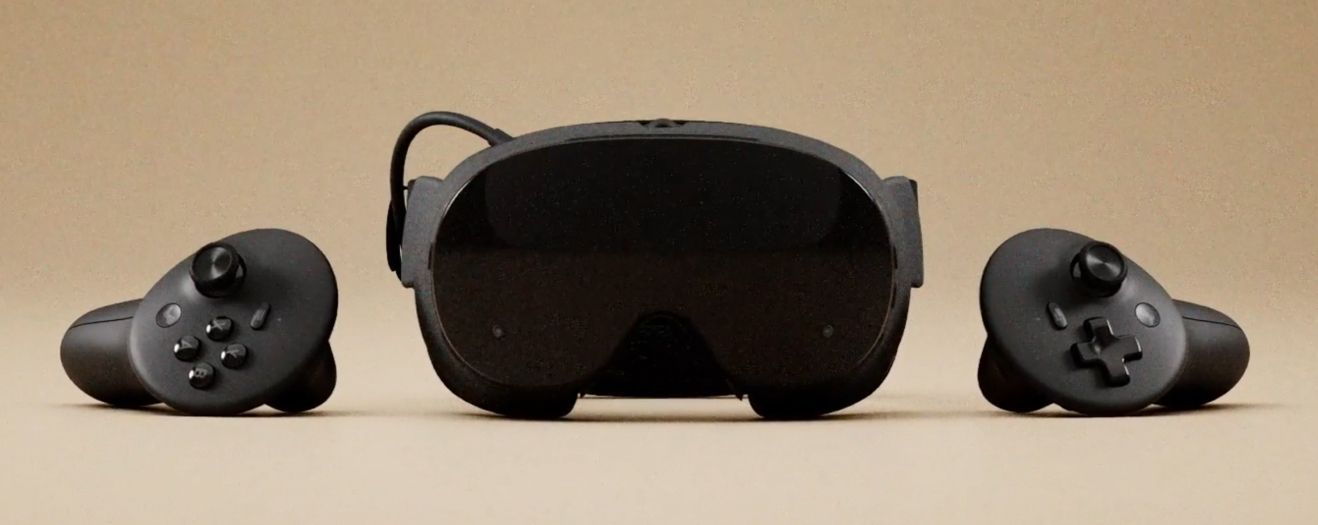
On Monday, Valve did what Valve does best: it dropped a major piece of hardware into the world without a massive press event, letting the internet wake up to the news and spend the morning decoding a spec sheet. The Steam Frame, a standalone virtual reality headset, is now officially launched, and even though it had been teased back in November 2025 as part of the same initiative that produced a new Steam Machine, the actual release still feels like a surprise. For anyone who remembers the Valve Index, that 2019 VR system that required a relatively permanent setup with base stations mounted across the room, the Frame is a philosophical departure. It’s entirely wireless and self-contained, consisting of a lightweight headset and a pair of hand controllers, and in that sense it owes a lot more to the Meta Quest 2 than to anything Valve has made before. But the Frame is unmistakably Valve: underneath that plastic shell, it is essentially a specialized PC, running SteamOS 3, the Linux-based operating system that already powers the Steam Deck. It is not a peripheral and it is not a console in the traditional sense; it is a computer you wear on your face. That distinction matters, because it means the Frame is designed to live in the world of Steam, with all the open-endedness, the massive library, and the chaotic DIY energy that implies. Valve has a long history of treating hardware less as a revenue stream and more as an experiment to push PC gaming into a new shape, and the Frame seems to fit that pattern. The original Steam Machine concept tried to make the idea of a living-room PC make sense. The Steam Deck turned portable PC gaming into something people actually wanted. The Frame, by contrast, is Valve’s latest attempt to figure out whether virtual reality can escape the niche it has occupied since the 2010s. That’s a timely question, because the headset market is now in a strange and uncertain place, and the broader tech economy has made this one of the most expensive moments in recent memory to design, build, and ship any kind of computing device. Before getting to all that, though, it’s worth understanding exactly what the Steam Frame is, how it works, and why Valve is choosing to release it now, rather than waiting for better times.
From a technical standpoint, the Steam Frame is a genuinely impressive piece of engineering. It runs on a Snapdragon 8 Gen 3 processor, a high-end mobile chip that makes it possible to pack serious computing power into a headset that doesn’t need to be plugged into a wall or a PC. There is 16GB of RAM, a microSD card slot for expandable storage, and two 2160 x 2160 LCDs, one for each eye. That resolution is noticeably sharp, and because there are no external sensors or base stations to set up, the Frame is portable in a way that the Index never was. You can throw it into a bag, take it to a friend’s house, and be in a VR world within minutes. One small quirk: it does not ship with its own power supply. Instead, it recharges over USB-C, using the same kind of plug as a Steam Deck. Some users will see this as a sensible way to cut down on cables and adapters; others will see it as a mildly annoying omission for such an expensive device. In terms of software, the Frame is not a console that plays every game in your Steam library. It runs SteamOS 3, which gives it a familiar interface and access to the same sort of library management that Steam Deck owners already know, but Valve has introduced a verification system specifically for the Frame. Similar to the Deck’s compatibility badge, this system lets you know at a glance whether a game has been tested and confirmed to work well with the hardware. At launch, only around a hundred games have been hand-tested and certified. That might sound like a small number, but it is not trivial for a VR platform. VR games are often shorter and more experimental than conventional PC games, and a curated list of titles that are known to run properly is arguably more useful than a giant library of unknown quantities. As a bonus, every Frame ships with Half-Life: Alyx, Valve’s 2020 VR masterpiece, bundled right in. That is a very strong way to sell the device, because Alyx is still considered by many to be the gold standard of virtual reality gaming. If you have never tried VR before, starting with Alyx is like starting with the best thing the medium has to offer.
From a pricing and availability standpoint, the Steam Frame is not trying to be an impulse purchase, and Valve is not pretending otherwise. The base model, with 256GB of internal storage, costs $1,059. If you want more space for your library, a 1TB version costs $1,299. Those are serious, enthusiast-level prices, especially when you consider how much of the VR mass market was built around cheaper headsets like the Meta Quest 2. For comparison, the Steam Deck won over millions of people in part because its starting price was shockingly reasonable for a fully-fledged PC. The Frame is not going to have that advantage. Instead, Valve is clearly aiming this product at the most committed part of the VR audience, the people who already own dozens of VR games and are willing to pay a premium for comfort, ease of use, and the ability to run their Steam library without dealing with external tracking. To handle the initial launch and reduce the impact of scalpers, Valve is using a lottery system for the first batch of Frames. Customers can sign up for either model until Thursday morning, after which Valve will randomize the list and email the people who have been selected to buy a unit. This is the same approach Valve used for the recent Steam Machine, and it is an acknowledgement that there may be far more buyers than units available. Early reviews of the Frame have been quite positive. Many reviewers emphasize that it is one of the most comfortable headsets they have worn, with good weight distribution and a face cushion that doesn’t crush your nose. The software is also praised for being frictionless, letting players get into a game with almost no fiddling. But those same reviews always seem to arrive at the same uncomfortable conclusion: more than a thousand dollars is a very hard sell for a category that has not yet become mainstream. The Frame may be a joy to use, but it is impossible to recommend to anyone except the most dedicated VR enthusiasts. There is no way around the fact that this is a luxury product, and Valve seems to know it.
Part of the reason the Frame has such a steep price tag is not entirely Valve’s fault. Right now, the global hardware market is in the middle of a phenomenon that has been called RAMaggeddon. AI companies are buying up enormous quantities of memory and storage for data-center construction, which has sent the cost of RAM and SSDs skyrocketing. Anyone who has tried to build or buy a new PC this year has likely felt a cold chill at checkout. A solid-state drive that used to be affordable can now cost as much as a small console, and memory modules have doubled or tripled in price. Valve ran into this exact wall with the launch of the new Steam Machine back in June, and the company is almost certainly running into it again with the Steam Frame. It is a problem that will affect every consumer-hardware maker on Earth for the foreseeable future. You cannot sell a VR headset and pretend it is 2021; the silicon inside it simply costs more now. That doesn’t let Valve off the hook, but it does explain why a product that might originally have been intended to undercut the competition has landed at a premium price. The RAMaggeddon also makes the broader business of launching new hardware much riskier. Consumers are already suffering from sticker shock everywhere, and they are likely to hold onto their existing devices longer rather than spend money on something new. A headset is an especially hard sell because, unlike a phone or a laptop, it is not something that most people use for work. It’s a leisure item, and a very expensive one at that. The combination of high component costs and cautious consumer spending makes the Steam Frame’s launch a tightrope walk. The hardware may be excellent, but excellent hardware doesn’t matter if no one can afford it.
Perhaps the most interesting part of the Steam Frame story is not the device itself, but the timing. For the past several years, the VR market has been dominated by Meta. A recent PC Gamer article noted that Meta still commands roughly 54% of the VR headset market, which is a staggering share. But 2026 has seen Meta make distinct cutbacks, and the company has increasingly turned its focus toward AI research and wearable computing rather than virtual reality. This is a significant reversal. Not long ago, Meta was spending billions of dollars each year on VR and AR development, driven by the belief that virtual reality would be the next major computing platform. The company made enormous strides in making VR accessible, helping to normalize the idea of a standalone headset that anyone could buy and enjoy. Yet VR never quite lived up to the hype it generated in the late 2010s. Enthusiasts still exist, and the medium still has passionate advocates, but it has not become the ubiquitous, everyday technology that the future-seers promised. Instead, the AI arms race has, to some extent, eaten its lunch. The same data-center boom that caused RAMaggeddon has also changed the priorities of the biggest tech companies. Hardware and talent that might have gone into consumer devices are now flowing into AI training clusters. The people who once dreamed of virtual worlds are now building chatbots and image generators. In that context, the Steam Frame feels a little like a message from a different era. It is a product built around a vision of the future that the industry has partially abandoned, a bold statement that VR is still worth making. Valve, in effect, is positioned to pick up where Meta has left off, offering a high-quality VR experience to the people who still believe in the medium. But because of the hardware market, it is doing so at the worst possible moment. When a thousand dollars is the barrier to entry, even the most passionately committed VR fans need to think twice.
On paper, Meta’s retreat should have opened a huge door for Valve. With the market leader pulling back, there was a real opportunity for a company with Valve’s resources, platform, and reputation to step in and become the new champion of virtual reality. The Steam Frame could have been that champion. It is lightweight, powerful, comfortable, and deeply integrated with Steam, and it bundles one of the best VR games ever made. But then RAMaggeddon hit, and the price of the components needed to build such a device quickly became a problem rather than a benefit. Valve’s plan may have made perfect sense as recently as last year, but the current state of the hardware market makes the Steam Frame a tough lift. It is not doomed, by any means. Valve is not a company that needs to sell tens of millions of units to be happy, and the lottery system suggests that the company is more interested in a controlled, fair launch than in immediate mass-market success. The Frame will almost certainly find a home with enthusiasts, with people who have been waiting for a wireless VR headset that doesn’t require them to live inside Meta’s walled garden, and with PC gamers who trust Valve’s hardware ethos. It will probably become a niche product with passionate fans, much like the Steam Deck in its early days. But the Deck eventually moved beyond its niche and became a mainstream success, and whether the Frame can follow that path is an open question. If component prices ever fall, if the RAMaggeddon subsides, and if VR has a second moment in the sun, the Frame could be in exactly the right place to benefit. For now, though, it is a beautiful, well-made, expensive ticket to a future that the rest of the tech industry is no longer sure it wants. Valve has made its decision, and the Frame is here. It remains to be seen whether this is stubbornness, vision, or a bit of both—and whether the market will reward Valve for refusing to give up on a dream.