


Microsoft’s Bold New Vision: The All-in-One Copilot App
In a landscape where artificial intelligence companies are constantly pushing boundaries, Microsoft has just made a decisive move that could reshape how we think about workplace productivity. The technology giant unveiled its ambitious new Copilot app this Friday, a comprehensive platform that seamlessly blends AI-powered chat, coding capabilities, and autonomous agents into a single unified experience. While Microsoft executives carefully avoided the “super app” label, the scope and ambition of this release speaks volumes about where the company sees the future of work heading. This isn’t just another update or feature enhancement—it’s a fundamental reimagining of how AI can be woven into the fabric of our daily professional lives.
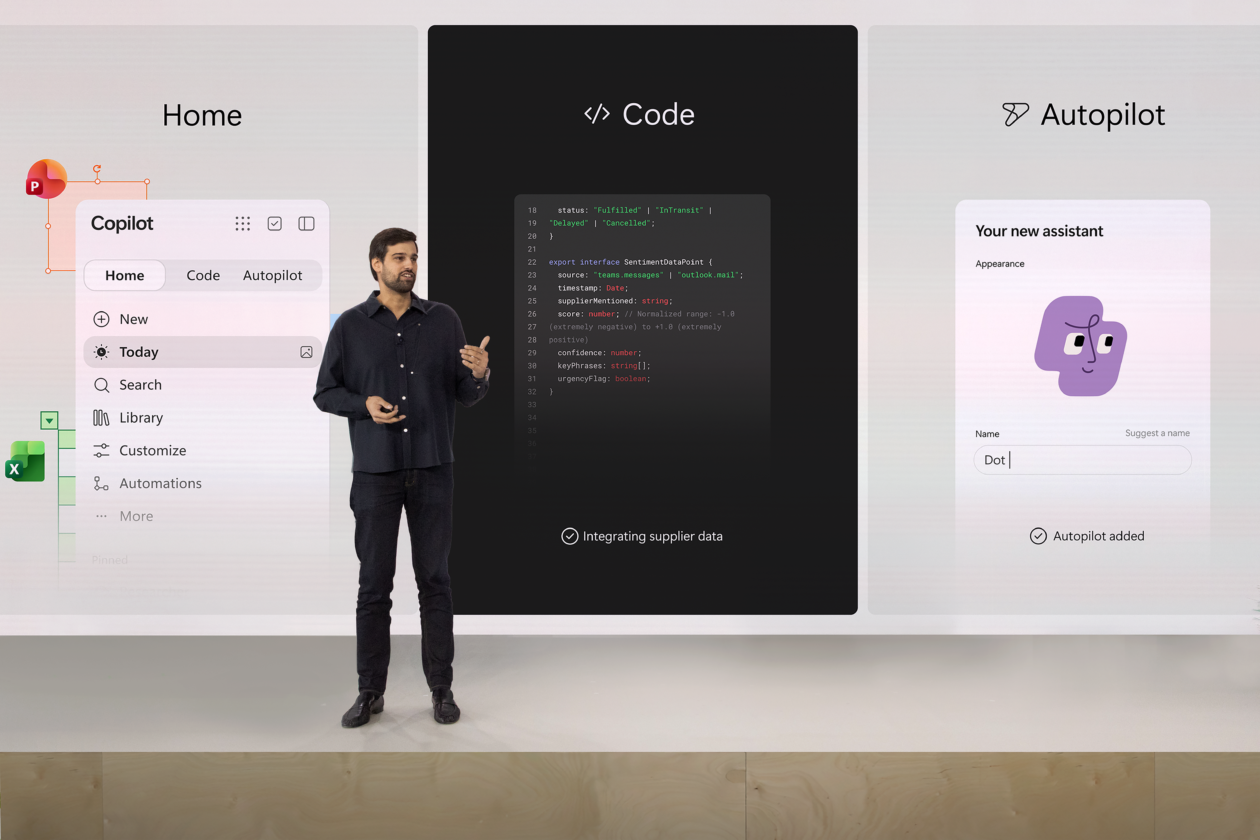
The new Copilot app introduces three distinct sections that work in concert to handle virtually any task a knowledge worker might face. “Home” serves as the central hub, combining conversational AI with Microsoft’s new Cowork agent, creating a space where users can interact with AI naturally while tackling everyday tasks. The “Code” section democratizes software development, allowing people to build their own applications and tools simply by describing what they want—no programming expertise required. Perhaps most intriguingly, “Autopilot” enables users to create their own persistent AI agents that work continuously in the background on their behalf. What’s particularly striking is that Microsoft has embedded full versions of Word, Excel, and PowerPoint directly into the Copilot environment, eliminating the need to switch between different applications. Users can now create, edit, and collaborate on documents with AI assistance and teammates without ever leaving the app, a level of integration that feels genuinely revolutionary.
This launch represents Microsoft’s strategic response to the growing challenge from AI-native companies like OpenAI and Anthropic, which have been aggressively bundling chat, coding, and agent capabilities into their own applications and marketing them directly to businesses. Interestingly, Microsoft’s relationship with these companies is complex—it uses their models alongside its own in Copilot, maintains substantial investments in OpenAI, and yet must compete with them for enterprise customers. During a company event held Wednesday, Microsoft executives directly contrasted their approach with that of their competitors, pitching their solution as fundamentally more secure and enterprise-friendly. Jacob Andreou, the executive vice president leading Copilot, took a subtle jab at rivals who run their agents on users’ local machines, noting that sending a company’s most sensitive files into a virtual machine on a local device was “a complete nonstarter” for most organizations. This positioning reflects Microsoft’s deep understanding of what corporate IT departments actually need: security, compliance, and control.
The company’s broader strategy was laid out by CEO Satya Nadella, who positioned Copilot as a hedge against dependence on any single AI research lab. His argument was elegant in its simplicity: companies should maintain the ability to test different AI models against their own benchmarks and swap between them as needed. He emphasized the importance of what he called “private evals”—a company’s own set of tests for AI models—and the ability to “hill climb,” a term gaining traction in AI circles for steadily improving results against those tests. Nadella’s warning was pointed: any company that lacks this flexibility has essentially handed the knowledge it builds with AI to someone else. To underscore this point, Microsoft demonstrated a model selection menu that allows users to choose between OpenAI’s GPT, Anthropic’s Opus, or an automatic mode that selects the best model for each request. During the presentation, Microsoft also showcased its own MAI models alongside those of OpenAI, Anthropic, and xAI, making clear that they intend to be a player in the model wars, not just a spectator.
The journey to this launch has been years in the making, with Nadella first promising a “super app” at Microsoft’s Build developer conference in June, saying that the company would bring “coding to all knowledge work within one Copilot super app” by summer. That promise evolved into a commitment to deliver within the fiscal quarter ending September 30, and Friday’s announcement meets that deadline with just days to spare. However, the rollout will be gradual: the Code feature, already in the hands of a few customers in the Frontier early-access program, spreads more widely at the end of the month, with general availability following in the coming weeks. Autopilot expands to private preview later this month, while Office integration within Copilot begins reaching consumers and Frontier customers soon after. This phased approach suggests Microsoft learned valuable lessons from previous launches about the importance of careful deployment and refinement.
The pricing model reveals much about Microsoft’s thinking on how AI should be commercialized. The company now offers two distinct payment approaches: a traditional per-user monthly license covering everyday uses like chat and AI-assisted document creation, and a usage-based model for more intensive agent work, including Cowork, Code, and Autopilot capabilities. This hybrid approach, which Nadella described as evolving “beyond per-seat to per-seat-plus-consumption,” reflects a recognition that different AI workloads have fundamentally different cost structures. Jared Spataro, Microsoft’s chief marketing officer for AI at Work, articulated this clearly: there are two kinds of AI at work, and they call for two very different ways of paying. The usage-based services are off by default, giving administrators control through spending limits at the company, group, or individual level via Microsoft’s Agent 365 management tools. Consumer Microsoft 365 subscriptions will also receive usage-based billing options later this year, expanding the model beyond just the enterprise market.
Perhaps the most fascinating aspect of this launch is the evolution of Autopilot, which grew directly from Microsoft’s experiments with OpenClaw, the open-source personal AI agent that captured widespread attention earlier this year. In the spring, Nadella had characterized OpenClaw as a security risk comparable to “a virus,” but by June, Microsoft had integrated similar concepts into its work, introducing an always-on personal agent called Scout. The new Copilot drops the Scout name entirely, instead allowing users to create and customize their own Autopilots. This shift reflects a nuanced understanding of what makes AI agents both powerful and problematic. As Andreou noted, the very autonomy and flexibility that make a great long-running agent valuable are “the same thing that makes them absolutely terrifying to an IT admin.” Microsoft’s solution is to run each Autopilot in the cloud within a company’s Microsoft 365 environment, complete with its own identity, memory, and email address, allowing users to tag it in Teams or Outlook like a coworker. In demonstrations, an Autopilot named Dot monitored inventory for a retail chain, flagged potential shipping problems affecting eighteen stores, and provided daily summaries—all without human intervention.
The adoption question looms large over this ambitious launch. Microsoft reported over thirty million paid Microsoft 365 Copilot seats in July, up dramatically from twenty million in April, yet this still represents only about seven percent of the more than four hundred fifty million commercial Microsoft 365 seats the company reported earlier this year. The new Copilot arrives three weeks after Microsoft reorganized its financial reporting to reflect its bet on AI agents, creating a new segment called Agents and Infra, moving GitHub’s cloud revenue into its Microsoft 365 business. Under this new structure, Microsoft 365 cloud revenue reached an impressive one hundred billion dollars in fiscal 2026, up about nineteen percent, though the company doesn’t disclose how much of that comes specifically from Copilot. Nadella’s vision extends beyond simply selling applications to connecting “the entire trajectory of a ‘job to be done,'” fundamentally changing how work gets accomplished. Whether this ambitious bet pays off will become clearer as the features roll out more broadly and as Microsoft shares additional details at its Ignite conference in San Francisco this November. For now, the company has made its position clear: the future of work isn’t just about better tools—it’s about fundamentally reimagining how we work alongside intelligent agents.