



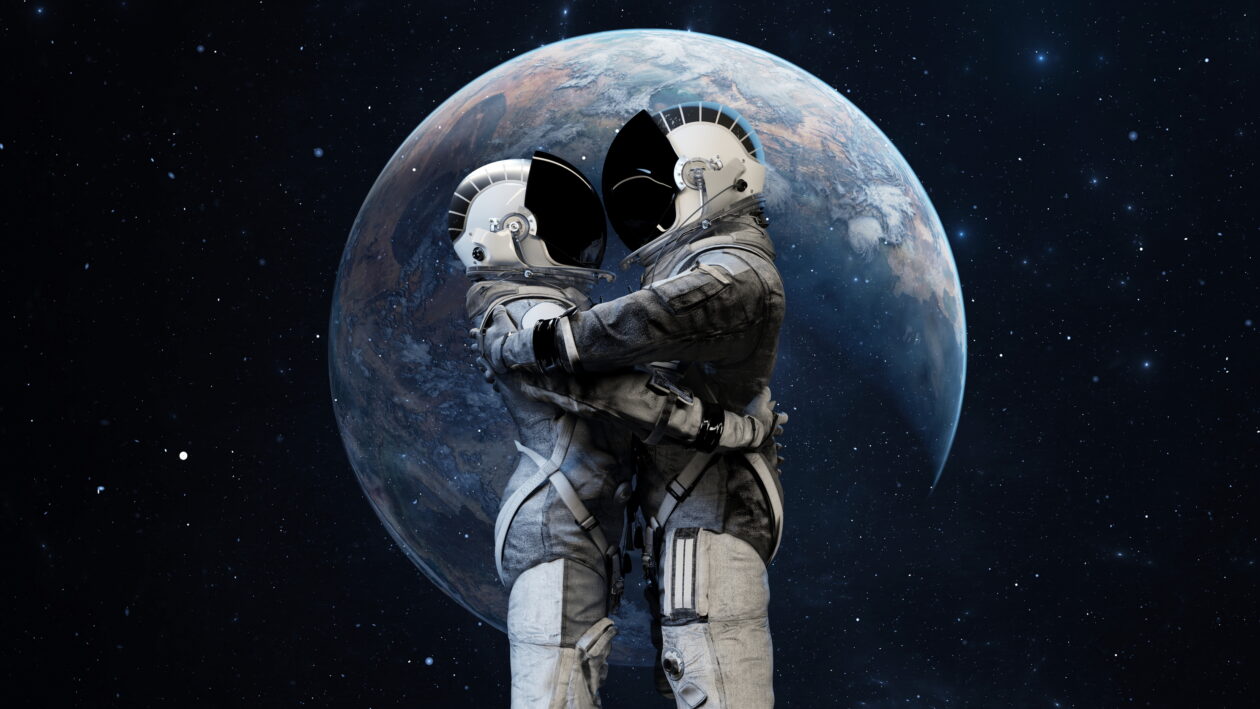
The intersection of cosmic exploration and human intimacy has long been a source of nervous laughter, a subject relegated to the margins of serious celestial science and treated as little more than a punchline for late-night talk shows or science-fiction fan conventions. Yet, beneath the inevitable chuckles and double entendres that filled the room during a Deep Tech Week session at Thinkspace Seattle, titled “From Homo Sapiens to Homo Stellaris,” lay a profound and pressing realization: if humanity is to ever truly live among the stars, we must first figure out how to love, couple, and reproduce in the weightless void. The panelists, a distinguished group of space medicine researchers and former space agency officials, wasted no time in addressing the physical comedy of zero-gravity companionship. Dr. Shawna Pandya, the chief of space medicine at the Florida-based Advanced SpaceLife Research Institute (ASRI), painted a vivid picture of the physics involved, noting how Newton’s Third Law of Motion dictates that without the anchoring pull of gravity, any physical thrust would instantly send partners drifting to opposite ends of a spacecraft. This physical reality led early, daring designers to conceptualize highly specialized, science-fictional spacesuits equipped with structural flaps, tension straps, and strategically placed harnesses—giving a literal and highly technical new meaning to the colloquial term “love handles.” But as the laughing subsided, a quiet, almost solemn atmosphere settled over the Seattle audience, as the researchers steering the panel began to guide the conversation away from the clumsy logistics of orbital copulation and toward the far more intimidating, deeply complex biological realities of what happens after the act of intimacy is complete. It became clear that the physical choreography of sex in space is merely a minor engineering puzzle compared to the daunting, uncharted labyrinth of human gestation.
The shift in focus from the mechanics of physical intimacy to the deeply complex biology of pregnancy revealed a stark, sobering truth that lies at the very heart of our starry-eyed cosmic ambitions: having sex in space is a relatively simple logistical challenge, but growing a new human being in a low-gravity, high-radiation environment is a biological minefield. Dr. James Logan, the former chief of medical operations at NASA’s Johnson Space Center, encapsulated this sentiment perfectly by stating that the physical, operational side of intimacy would be the easiest part of the entire cosmic endeavor, whereas the true, terrifying obstacles reside in the silent developmental processes that must follow. On Earth, our biological blueprints have evolved over billions of years under the constant, protective embrace of a steady one-G gravitational field and a thick, shielding atmosphere that deflects hostile cosmic rays. Every single cell in our bodies, from the motivated sperm trying to navigate toward an egg to the complex biological signaling systems that govern the very first divisions of a fertilized zygote, relies on gravity as an invisible, organizing compass. Recent scientific studies have thrown a cold, clinical light on this delicate process, revealing that the weightless conditions of microgravity severely impair the natural navigation systems of sperm, disrupt the complex biochemical handshakes of fertilization, and derail the early, highly sensitive stages of mammalian embryo development. Without the structural baseline of Earth’s gravity, the fundamental cellular building blocks of life lose their spatial orientation, struggling to divide, migrate, and organize into the complex, functional tissues required to form a healthy, viable fetus. This means that even if future space travelers can easily manage the mechanical hurdles of zero-G companionship, the microscopic, chemical whisperings necessary to generate new life are deeply scrambled when stripped of the terrestrial foundation that has nurtured our species since the dawn of time.
Adding to this already daunting biological hurdle is the insidious, ever-present threat of deep-space radiation, whose destructive impacts may remain entirely invisible for years, only to manifest as a tragic legacy in generations down the line. To illustrate this terrifying reality, Alex Layendecker, the visionary founder and director of the Advanced SpaceLife Research Institute (ASRI), pointed to groundbreaking and highly unsettling research involving female mice flown aboard the International Space Station. These mice spent substantial time exposed to the harsh, radiation-drenched orbital environment before being safely returned to Earth to live and mate with terrestrial males in a normal, healthy one-G setting. While the immediate first generation of offspring born to these space-faring mothers appeared structurally normal, healthy, and unremarkable upon birth, the true genetic damage had merely gone underground, waiting to strike like an epigenetic time bomb. When the grandchildren of those original cosmic travelers were born, the researchers uncovered a chilling and completely unexpected “smoking gun”: this third generation suffered from a significantly altered phenotype, exhibiting dramatic differences in overall body mass, physiological development, and abnormal behavioral characteristics that their parents had miraculously escaped. This transgenerational mutation suggests that exposure to the cosmic environment, with its unrelenting background rain of high-energy galactic cosmic rays and solar particles, mutates the delicate packaging of our genetic code in ways that skip past the immediate children and warp the lineage of generations yet unborn. For prospective human parents dreaming of raising families in the quiet reaches of the cosmos, this research delivers a harrowing, deeply emotional warning: the true tax of our journey into the stars may not be paid by the pioneers who make the journey, but rather by their grandchildren, who will inherit bodies fundamentally reshaped by an environment they never chose to visit.
These sobering reproductive and genetic discoveries cast a massive, shadow-laden cloud of doubt over the grand, optimistic visions of space colonization championed by Silicon Valley tech billionaires and popularized in classic science fiction. For years, figures like Tesla and SpaceX founder Elon Musk have captured the global imagination with bold, sweeping promises of sending a million human settlers to Mars to build a self-sustaining, multiplanetary civilization, while television epics depict a future of blue-collar Martian suburbs, schools, and cozy lunar neighborhoods. However, these dazzling dreams are built on a fragile, scientifically unsupported foundation: the naive assumption that human beings can successfully, safely, and repeatedly raise multiple generations of healthy children in the low-gravity environments of other celestial bodies. Dr. Logan directly challenged this techno-optimism during the panel, asserting that based on his decades of medical experience at the highest levels of NASA, he does not believe that Mars’s one-third gravity, let alone the Moon’s incredibly weak one-sixth gravity, is physically sufficient to support normal, healthy human gestation, birth, and childhood development. If these partial gravity fields prove to be biologically insufficient, the grand dream of establishing thriving, multi-generational human cities on foreign worlds will instantly crumble, reducing Mars and the Moon to sterile, lonely industrial outposts—clinical, dust-blown service stations where transient adults rotate in for grueling work shifts but never put down roots, raise infants, or build true communities. This reality faces humanity with a terrifying, mathematically certain existential crisis, because if we are biologically confined to our single, fragile home planet, we remain evolutionary hostages to a ticking geological clock, waiting for the inevitable asteroid impact, supervolcano eruption, or self-inflicted ecological catastrophe that will eventually write the final, unremembered chapter of the human story on a dead Earth.
Faced with this terrifying potential for permanent planetary confinement and eventual extinction, the dialogue surrounding space medicine has begun to shift toward radical, highly controversial territories that sound like they belong in the pages of speculative fiction: the genetic engineering of our own species. Rather than foolishly waiting for our fragile, Earth-evolved bodies to magically or evolutionarily adapt to the hostile, lethal environment of deep space over millions of years, some pioneering researchers suggest we must actively and intentionally modify our own genetic blueprint to survive. Dr. Shawna Pandya pushed the boundaries of this intense philosophical debate by pointing to a compelling, provocative argument featured in the MIT Technology Review, which suggests that we must fundamentally reframe our collective ethical understanding of genetic modification. In this modern, space-age light, genetically altering astronauts and future interstellar pioneers is not an unethical boundary or a dangerous game of playing God; rather, sending vulnerable, unshielded human beings into the high-radiation, bone-leaching, and gravity-deprived vacuum of deep space without providing them with molecular, genetically engineered armor is the true, unforgivable ethical failure. This radical paradigm shift would require us to consciously redesign the human genome, actively creating a new branch of our species—Homo stellaris—engineered with radiation-resistant cells, self-repairing DNA, and specialized reproductive systems tailored specifically to carry pregnancies and raise children under alien skies. That we are even having these profound, philosophically heavy discussions today represents an enormous, mature departure from the historical culture at agencies like NASA, where the juvenile “giggle factor” surrounding sex and reproduction in space was once the single greatest obstacle to scientific progress, forcing researchers to hide their work in the shadows for fear of public laughter and political funding cuts.
As we stand on the precipice of this brave new world, organizations like the Advanced SpaceLife Research Institute (ASRI) are aggressively working to turn these theoretical, far-reaching discussions into a disciplined, actionable scientific reality. To guide this monumental, multi-generational effort over the coming decades, ASRI has drawn up a highly ambitious, comprehensive 30-year roadmap focusing entirely on human reproductive biology and outer-space gestation, known officially as the Sexual Health and Reproductive Planning (SHARP) initiative. Recognizing that the United States can occasionally be bogged down by ideological and conservative regulatory hurdles in reproductive science, ASRI is actively looking to expand its scientific footprint into Europe, where the legal and policy frameworks are often far more open-minded toward cutting-edge biological research, while also building collaborative partnerships in progressive tech hubs like Seattle. Alex Layendecker expressed his profound hope that ASRI’s pioneering efforts will quickly inspire the creation of a vast, collaborative global network, noting that solving the intricate mystery of space reproduction cannot be achieved by a single institute, but will eventually require the dedicated minds of thousands of global researchers, doctors, and ethicists working together in unison. Ultimately, humanity’s transition away from juvenile, embarrassed giggles toward a serious, clear-eyed, and empathetic study of sex, pregnancy, and birth in space represents a crucial, beautiful milestone in the psychological maturation of our entire species. It serves as a poignant, deeply humanizing reminder that our grand journey into the stars is not merely a triumph of cold metal, roaring booster rockets, and sophisticated guidance computers, but is fundamentally an act of profound love—an enduring, courageous effort to shield, nurture, and carry the warm, delicate, and miraculous spark of terrestrial life safely across the silent, freezing, and infinite dark of the cosmic ocean.