



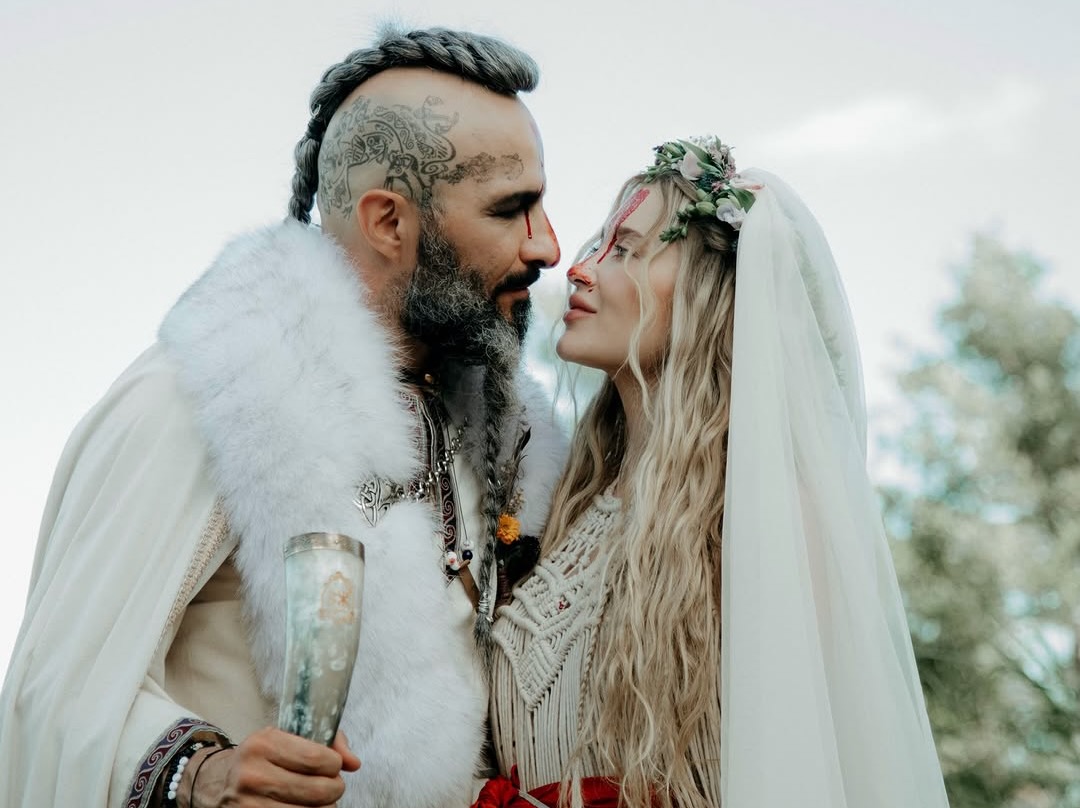
In a world where artificial intelligence can conjure a photorealistic image of a person who never existed, or a video of a celebrity saying something they never said, we’ve grown justifiably suspicious of anything that looks too perfect. And yet, when Hadi Partovi posted the first pictures from his summer wedding, sharing a glimpse of a Viking village that appeared plucked straight from an HBO epic, he knew the reaction he’d get. So before the likes and comments poured in, he added a short, quiet disclaimer: “100% real, no AI.” Partovi, a prominent tech educator and co-founder of the non-profit now called CodeAI (formerly Code.org), understood the irony perfectly. In an age where every other scroll past our feed is another algorithmically generated “truth” designed to dazzle or fool, an actual, human spectacular event could be dismissed as just another piece of synthetic slop. But he wanted people to know otherwise — not because the wedding was expensive or famous, but because it was built by hand, heart, and a deep respect for both the past and the creative potential shared by ordinary people armed with tools and a dream.
The nuptials took place in July on the Swedish island of Birka, a UNESCO World Heritage Site and the base of what was once a thriving Viking settlement. As Partovi later explained to GeekWire, “The idea: to create a fully functioning village, circa 826 AD.” With the island as the canvas, the couple and their team built a real, physical world—no screen-based illusions. Two hundred “villagers” were staged as merchants, armorers, goat herders, and a blacksmith, many sourced from the local pool of actors and Viking history experts. In fact, some directly came from the cast of Netflix’s The Last Kingdom. Guests were given currency not of paper, but of custom hand-aged gold and silver coins—which Partovi himself personally aged, with his own hands, over weeks before the event. Those coins could be spent on period-etched attire, weaponry, or handmade jewelry. The phone policy: immaculate. Once guests touched the island, they left everything modern behind—no iPhones, no cameras, no watches. They were housed in a “phone library.” Everyone disrobe to wear authentic clothes. Vikings didn’t carry phones, and for a day, neither did anyone else. The only concession, as Partovi laughs, was prescription glasses—and even those had to be hidden under adjustable leather straps. The couple arranged for Brave hooded wolf-to-the – face; the Viking goal was to make it the most authentic, immersive Viking experience ever created in history, and they went to impossible lengths to do exactly that.
And adding to the emotional appeal is how this whole creative monolith came about. Beneath the hammers, the swords, and the battle axes (because a Viking battle was, of course, Partovi’s idea), the genesis was more personal. When asked who gave birth to the concept, Partovi credits his new wife, Becca Oystila, who said, “Of course the longships and the battle were my idea. But I said, ‘Should we do the Viking theme?’ And when she saw that, everything else wrote itself.” So the extravaganza was, at nearly every turn, a collaborative act of love. Oystila is the founder and CEO of Booka, an LA-based beauty and events platform connecting clients with vetted professionals. Her business area, with clients like Billboard, Soho House, and the Gold Gala, is built on the same principle of creating vivid moments—the same cinematic-quality looks. At the wedding, Booka booked the onsite team of makeup artists for intricate hair braiding and face painting, disguising their craft into the village setting. Partovi’s second ceremony theme also illustrated his Persian culture: a traditional Persian wedding ceremony in the Hall of Mirrors at Stockholm’s Grand Hotel, complete with décor inspired by the ancient Persian cities of Persepolis, Esfahan, and Shiraz, peacocks, fountains, and fires. The weekend event was enormous, but the underlying message was personal: To a beloved community, to the union of two lives dedicated to passion projects that weave together creativity and practicality.
The afternoon’s guest list read like a luminous who’s who of tech and venture capital. Among the attendees were Partovi’s twin brother and Neo CEO Ali Partovi, Rover cofounder Aaron Easterly, Sequoia Capital’s Alfred Lin, investor Emily White, and Uber CEO Dara Khosrowshahi. Yet the conversation over dinner more likely aligned with the theme of the ring—and of the future. Partovi’s Code.org has evolved into CodeAI, pivoting from computer science education to make the focus on artificial intelligence, as Partovi stated in June that “AI was replacing coding as the primary focus.” So the Viking wedding was also a you-see-a-grows-whirl an opportunity to meet the humans behind the algorithms. The strict no-phones policy, which Partovi instituted by not giving guests a Viking horn to drink from but also their realistic coins, created an experience that didn’t screen out the message. He talks proudly of the moment the guests, forced to be present, collectively disembarked, taking on their peculiar characters, shouting in Old and feeling the battle dust. The result was that the wedding didn’t get captured (except for a few tactical rifles tucked away) but that it could be lived.
That contrast—a tech entrepreneur at the center of AI education—spending days organizing a celebration that’s committed to turning off all digital signals—is worth pondering. The main point isn’t that old is better, but that we are now at a point where reality can miss the people, and we need to recognize the human touch behind the glamour. Partovi’s joke in the LinkedIn post, “It’s 100% real, no AI,” is a statement about the power of AI, but it’s equally about the power of our own artistry. Through the two days and two weddings, Partovi and Oystila managed to combine the ancient and the cutting-edge: they replaced the cellphones of everywhere with physical currency, they replaced algorithm feeds with human-to-human conversation, and they celebrated their cultural heritage in an extreme immersion that could never be synthesized or generated. It’s a stunning paradox: to build a monument to meaning, they had to borrow from our most dazzling technology—from AI saying we still drive human passion. It teases the idea that, in an era of the synthetic, authenticity is the luxury of the one who can afford it—and maybe the responsibility of the maker to protect it.
In the end, Hadi Partovi walked down the aisle with a sword, a braided mohawk, and a fake skull tattoo on his head, yes. But he also brings with fire, family, and a realization. He modeled the prophecies of his business, but for this moment, for him, the mission was really about the human, the ancient drum, the village spirit that IA digital can’t replicate. Requested if the rebellious mohawk would be his new business look, he laughed. “My blue contact lenses and mohawk were for the day only,” he said. “I grew my beard out for six months for this!” It’s the unglamorous truth and the charm of a human undertaking: we endure, modify, plan—and we finish. The original spark: a proposal to make a story. The rest, as he said, wrote itself. And maybe that’s the highest point of his teaching: that whether you’re teaching K-12 kids to be coders, or building a Viking settlement in Sweden, the magic starts with a living person saying, “Let’s do it.” That’s the kind of slop no algorithm could ever produce.