




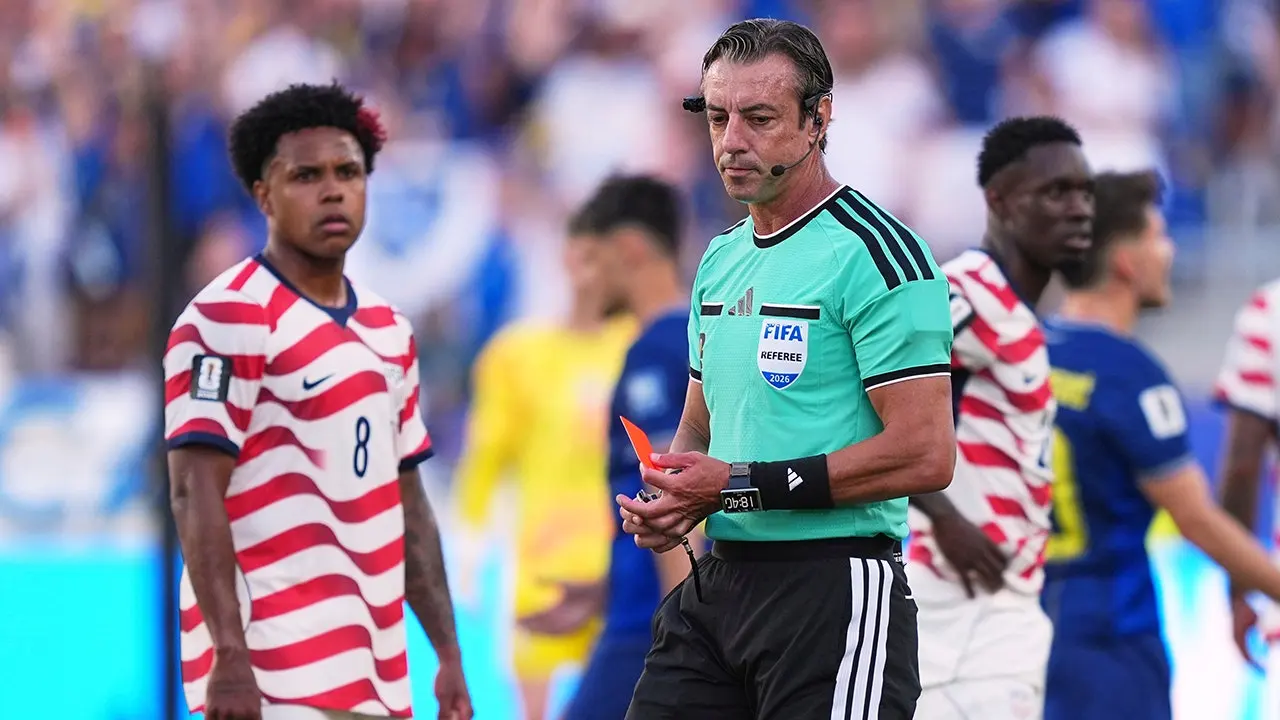
The beautiful game is often defined by its razor-thin margins and the sudden, dramatic shifts in fortune that can turn a night of triumph into one of profound heartbreak. This bitter reality was on full display during the United States Men’s National Team’s hard-fought 2-0 victory over Bosnia and Herzegovina. What should have been a night of pure celebration quickly became a devastating blow for USA’s breakout star, Folarin Balogun. In a high-stakes moment, Balogun found himself contesting a ball with defender Tarik Muharemovic, a routine physical battle that unfortunately ended with the American striker’s foot landing on Muharemovic’s right ankle. Initially, the play seemed like a standard, albeit clumsy, collision in the heat of battle. However, the modern game’s ultimate arbiter—the Video Assistant Referee (VAR)—stepped in. Brazilian referee Raphael Claus was called to the monitor, and after analyzing the slowed-down footage, he brandished a red card. Just like that, the euphoria of the win evaporated for Balogun, who realized he would be barred from playing in the monumental Round of 16 clash against Belgium.
The cruelty of the situation was compounded by the absolute finality of international football’s regulatory framework. In the immediate aftermath, hopes of a rescue through administrative channels were swiftly crushed. A FIFA official, speaking with The Athletic, made it abundantly clear that the American squad had absolutely no recourse; there is no appeal process for a direct red card or its subsequent suspension. The official referred to a starkly worded section of the tournament’s governing rules, which dictates that a sending-off automatically triggers a suspension from the very next match, with judicial bodies retaining the power to hand down even harsher penalties if they deem it necessary. For Balogun, this rigid bureaucracy means his fate is entirely sealed, forced to watch his country’s biggest match of the tournament from the sidelines, powerless to help his teammates on the pitch.
In moments of adversity, the true character of a locker room is revealed, and Balogun’s teammates wasted no time forming a protective shield around him. Midfielder Weston McKennie was particularly vocal, channeling the collective frustration of the squad in his post-match comments. Speaking with absolute candor, McKennie labeled the lack of an appeal mechanism as “bogus” and openly questioned the referee’s consistency. He pointed out the perceived double standards of the tournament’s officiating, noting that similar physical challenges had occurred throughout the competition without yielding anywhere near the same level of punishment. McKennie’s raw emotion highlighted the intense bond of this American generation—a brotherhood that refuses to let one of their own carry the burden of a controversial decision alone.
This sentiment was fiercely echoed by U.S. head coach Mauricio Pochettino, who stepped in not just as a tactician, but as a protective guardian for his young forward. Pochettino was unreserved in his criticism of the card, adamantly stating that there was absolutely no malice or intent behind Balogun’s actions. To the veteran manager, the play was a textbook example of the physical realities of elite soccer: two players fighting tooth and nail for a 50-50 ball, resulting in a completely natural, accidental landing of the foot. Pochettino’s defense was vital, helping to shield Balogun from the inevitable onslaught of public criticism and media scrutiny. By reframing the incident as a normal, albeit highly unlucky, football action, the coach sought to keep his young striker’s spirit intact ahead of the emotional road that lies ahead.
While the red card is a painful setback, it also writes Balogun’s name into the legendary and often dramatic annals of World Cup history. The young American has landed in highly exclusive, albeit bittersweet, company. He is now only the third player in the history of the tournament to score a goal in a knockout stage match and subsequently get sent off in the same game. The other two players to share this bizarre and prestigious curse are bona fide football royalty: Brazil’s magician Ronaldinho, who experienced the same roller coaster of emotions during the legendary 2002 quarterfinal clash against England, and French icon Zinedine Zidane, can turn a simple match into a historical drama, whose infamous red card in the 2006 World Cup final against Italy remains one of the most talked-about moments in sports history. To be mentioned in the same breath as such icons, even under these unfortunate circumstances, underscores the massive impact Balogun is already having on the world stage.
This incident also adds another dramatic chapter to the United States’ historic struggles with discipline on the world’s biggest stage. Balogun’s expulsion marks the fifth time an American player has received a red card in World Cup history. The legacy began in 1990 with Eric Wynalda against Czechoslovakia, followed by Fernando Clavijo in 1994 against Brazil, and the chaotic duo of Pablo Mastroeni and Eddie Pope against Italy in 2006. Now, as the current squad gears up to face Belgium without their star forward, they must find a way to transform this anger and disappointment into a powerful rallying cry. The road to the quarterfinals has suddenly become much steeper, but adversity has a way of forging champions. The USMNT will need to draw on every ounce of their collective grit to keep their World Cup dream alive and play for their fallen teammate.