





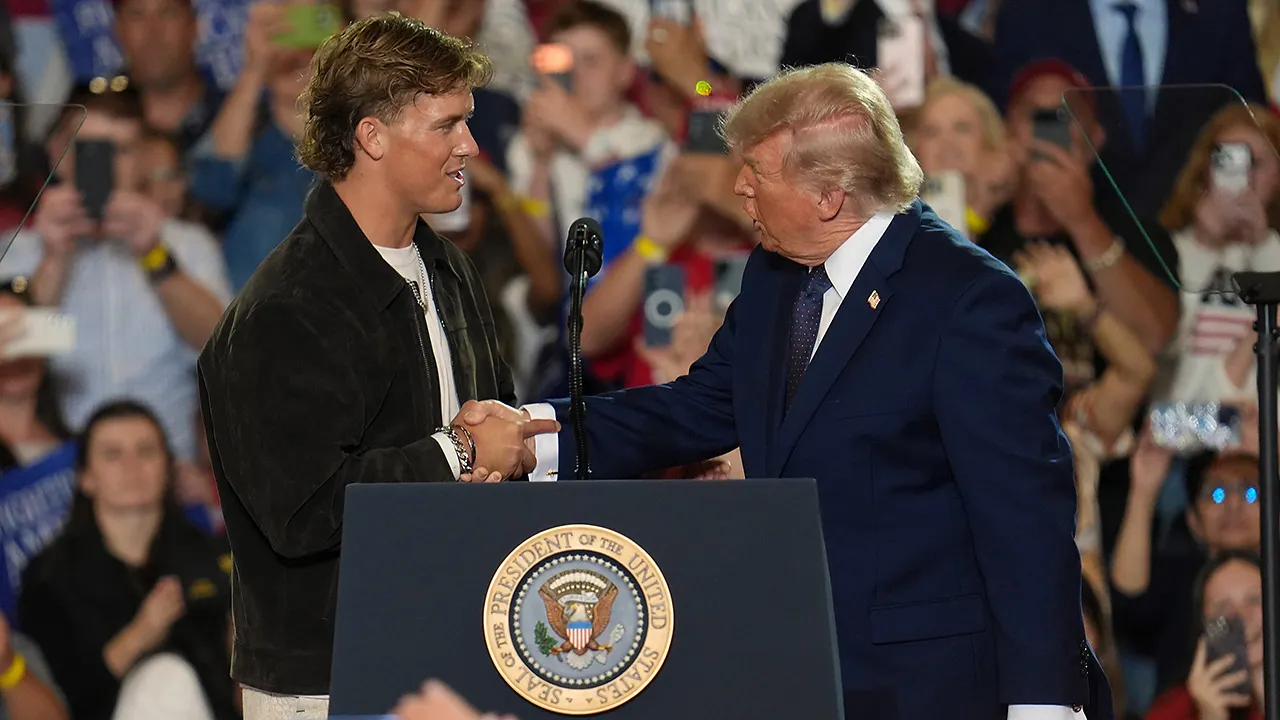
For generations, the athletic arena was widely considered one of the few remaining sanctuaries where political differences were checked at the stadium gates, replaced instead by a collective devotion to the love of the game, camaraderie, and the pursuit of excellence. However, the contemporary landscape has dramatically shifted, transforming professional sports into a primary battleground for the ongoing cultural and political divisions of American society. This friction recently exploded into the national spotlight when Jaxson Dart, the promising young quarterback for the New York Giants, stepped onto a political stage to introduce former President Donald Trump at a high-energy campaign rally at Rockland Community College’s Eugene Levy Fieldhouse in New York. For Dart, a young athlete still navigating the massive, often overwhelming scale of the professional spotlight, the moment was undoubtedly meant to be an expression of personal admiration, civic engagement, and genuine enthusiasm during a rally meant to support Representative Mike Lawler. Yet, in our highly polarized and hyper-reactive media ecosystem, such an endorsement does not exist in a vacuum, and the consequences of public alignment are swift and unforgiving. Almost immediately, the twenty-three-year-old quarterback found himself at the epicenter of a raging storm of public opinion, facing intense and bitter backlash from progressive commentators, left-wing media outlets, and passionate sectors of the football fandom who felt his public political alignment alienated a diverse audience. The event serves as a stark, modern parable of the immense pressures faced by contemporary public figures, who are frequently forced to choose between authentic self-expression and the safety of calculated public neutrality. Instead of merely celebrating a sports star’s civic engagement, the public responded with a deeply divided roar, illustrating how quickly an individual’s personal convictions can be scrutinized, deconstructed, and weaponized under the relentless glare of national media.
Seeing one of his newest and most high-profile young champions facing a wave of public condemnation, Donald Trump did what he has historically done for those who stand by him: he stepped forward to offer a robust, unwavering public defense. Speaking with his daughter-in-law, Lara Trump, on her Fox News program “My View with Lara Trump,” the former president made it clear that he had no intention of letting the young quarterback stand alone in the crosshairs of cultural controversy. With his characteristic populist appeal and unique communication style, Trump reframed the media backlash as a badge of honor, arguing that while Dart might be experiencing a temporary wave of harassment from vocal critics on the left, he is simultaneously receiving an overwhelming, quiet surge of love and support from a silent majority. Trump remarked that “when Jaxson gets harassed a little bit, he’s also loved more… because we have more people than they do.” He suggested that the visible anger of a few vocal opponents on social media does not reflect the broader sentiment of the American public, nor does it diminish the loyalty of millions who share their values. Furthermore, Trump shared a fascinating perspective on the psychology of his support, noting that many people who publicly criticize his movement are actually secret supporters behind closed doors, pointing to his interactions with wealthy and influential individuals in supposedly left-leaning enclaves like Los Angeles who privately confess their support to him. This defense was not merely political; it was also characteristically warm and personal, as Trump openly marveled at Dart’s physical presence and charisma during the rally itself, humorously lamenting that he wished he possessed the quarterback’s model-like good looks, while fondly recalling how the young athlete had embraced him and expressed his respect. By humanizing the young quarterback and framing him as a handsome, courageous conservative, Trump sought to transform Dart from a target of media ridicule into a symbol of pride, resilience, and conservative strength for his millions of supporters across the nation.
To fully understand why Jaxson Dart chose to step onto that political stage in New York, one must look beyond the immediate headlines and examine the human story of his upbringing, faith, and cultural roots, which reveal a young man acting entirely in alignment with his identity. Raised in the deeply conservative state of Utah, Dart’s worldview was forged from an early age in a community that places a high value on tradition, religious devotion, family, and personal responsibility. As an active member of the Church of Jesus Christ of Latter-day Saints, commonly referred to as the Mormon faith, Dart’s life has been guided by principles that often align closely with traditional conservative ideologies, emphasizing hard work, community service, and moral integrity. His passions outside of football—such as hunting, fishing, and spending time in the great outdoors—are deeply connected to a rugged, self-reliant way of life that is widely celebrated and cherished in the American West. When he transitioned to playing college football at the University of Mississippi, the legendary Ole Miss, Dart found himself immersed in another deeply traditional and politically conservative culture, further reinforcing his personal identity and comfort with expressing his beliefs. This background makes his decision to support a conservative leader like Donald Trump completely consistent with who he has always been, rather than a calculated political stunt or a sudden bid for attention. Far too often, the public forgets that professional athletes are real people with unique personal histories, families, and deeply held beliefs that exist independent of their athletic endeavors or the desires of their fan bases. Dart is not a corporate brand designed to please every consumer; he is a young man from Utah who values his faith, his heritage, and the freedom to speak his mind, even when doing so invites the wrath of the cultural mainstream.
The fallout from Dart’s political endorsement did not stop at the stadium gates or on social media timelines; it inevitably infiltrated the highly sensitive and tightly knit community of his own locker room, testing the limits of team unity. In the world of professional sports, a team is composed of individuals from vastly diverse racial, socioeconomic, geographic, and cultural backgrounds, all expected to put aside their differences for the sake of a singular, competitive goal. This delicate chemistry was put to the test when Giants edge rusher Abdul Carter publicly expressed his disagreement and criticism of Dart’s political endorsement in a post on the social media platform X. Although Carter quickly deleted the post, the brief exchange illustrated the deep, unspoken tensions that can arise when national political divisions pierce the sanctuary of a sports franchise, revealing how difficult it is to separate politics from the workplace in modern America. It raises a difficult question that modern sports organizations and teammates must grapple with: how can athletes maintain a unified front on the field when their personal and political worldviews represent opposing ends of a highly polarized national spectrum? This internal friction highlights the intense social tightrope that young athletes must walk, knowing that any expression of personal belief can potentially alienate colleagues, sponsors, and fans who view them purely through the lens of their performance. While critics might argue that athletes should keep their opinions to themselves to preserve team harmony, others contend that forcing young men to hide their true convictions creates an artificial and ultimately unhealthy environment of silence. The momentary clash between Dart and Carter serves as a powerful microcosm of the broader American struggle, where citizens are searching for ways to coexist, work together, and respect one another despite holding deeply incompatible views of the nation’s path forward.
The controversy surrounding Jaxson Dart also highlights a glaring double standard that has emerged in the realm of athletic political activism over the past several decades, casting a shadow over the concept of civic engagement. Throughout history, sports figures have used their massive platforms to advocate for social change and political candidates, from Muhammad Ali’s opposition to the Vietnam War to the widespread “Athletes for Obama” movement that helped galvanize young voters in 2008. In many of these historical instances, the mainstream media, athletic organizations, and corporate sponsors celebrated these public declarations as acts of courage, moral clarity, and commendable civic leadership. However, as the political landscape has polarized, the response to political expression has become highly selective, with progressive causes often receiving institutional praise while conservative stances are met with swift condemnation, calls for cancellation, and public shaming. When a conservative athlete like Dart decides to step forward and voice his opinions, he does so with the full knowledge that he will likely face a level of professional risk and social isolation that his progressive peers rarely encounter. This disparity reveals a troubling trend in modern culture, where the championing of “diversity and inclusion” often stops short of welcoming diversity of thought and political ideology. By stepping onto that stage and refusing to hide his convictions, Dart demonstrated a willingness to accept the consequences of his beliefs, highlighting a fundamental human desire for authenticity in an era where public figures are heavily pressured to conform to focus-group-approved narratives. This situation reminds us that true freedom of expression must apply to all individuals, regardless of whether their political views align with the prevailing cultural zeitgeist.
Looking beyond the immediate media storm and the political crossfire, Donald Trump’s defense of Jaxson Dart ultimately focused on the young man’s immense physical talent, leadership qualities, and bright future in the NFL. Despite their brief interaction, Trump expressed genuine admiration for Dart’s leadership qualities, observing that whenever the young quarterback is on the field, he possesses the rare, magnetic ability to move the team forward and inspire those around him. Trump’s optimistic prediction that Dart has “tremendous potential” and will achieve greatness—provided he stays healthy—shifts the focus back to where it ultimately belongs: the sports field, where merit, hard work, and performance are the ultimate arbiters of success. In a society that is increasingly obsessed with labeling and dividing people based on political affiliations, this episode serves as a powerful reminder of our shared humanity and the need for tolerance. Jaxson Dart is not merely a political symbol or a casualty of the culture wars; he is a twenty-three-year-old athlete with a passion for his craft, a deep commitment to his faith, and a lifetime of achievement ahead of him. As he begins his second season with the Giants, his success will not be measured by the political rallies he attends or the criticisms of his detractors, but by the grit, determination, and character he displays on the gridiron. Ultimately, the story of Jaxson Dart is a human story about standing up for what one believes in, facing the inevitable winds of opposition with grace, and continuing to strive for excellence in the face of national scrutiny.