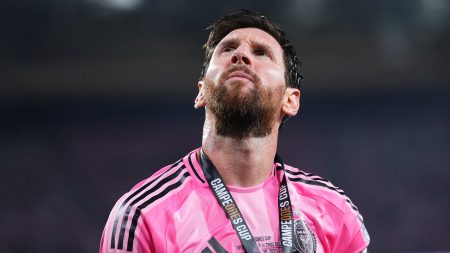






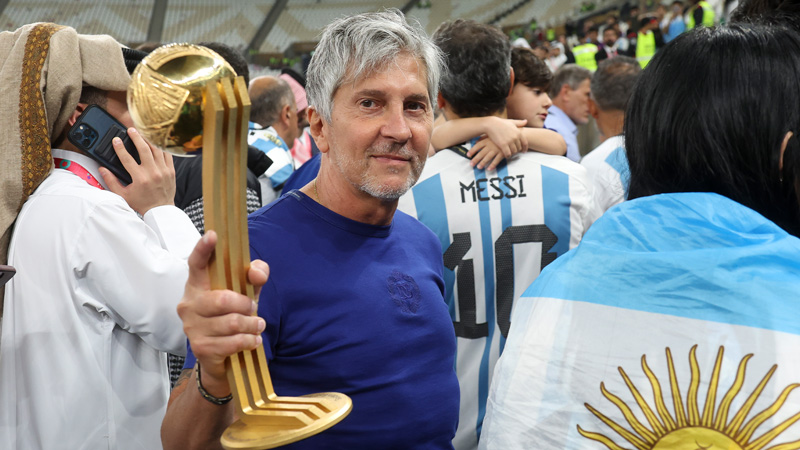
The global football community was plunged into deep mourning on Saturday following the announcement that Jorge Messi, the devoted father, guiding light, and lifelong manager of Argentine football icon Lionel Messi, had passed away at the age of 68 in a hospital in his beloved hometown of Rosario, Argentina. The heartbreaking news was first shared by Club Atlético Newell’s Old Boys—the Rosario-based club where both father and son shared deep, historic roots—in a poignant social media tribute. The club revealed that Jorge had been undergoing intensive treatment in recent months for an undisclosed, progressive illness that ultimately claimed his life. In their public statement, Newell’s Old Boys beautifully captured the essence of Jorge’s indispensable role in the footballing pantheon, describing him as the foundational pillar and the visionary strategist who, through a rare combination of discipline, rigor, and unconditional love, nurtured and shielded the career of the man widely regarded as the greatest football player of all time. This sentiment of profound loss was quickly echoed across the international sports landscape, with the South American Football Confederation, CONMEBOL, releasing an official message of condolence that extended its deepest respect, warmth, and affection to Lionel and the entire Messi family during this period of immeasurable grief.
This painful loss casts a retrospective and highly emotional light on Argentina’s recent campaign in the World Cup, where Lionel Messi courageously led his national team to a hard-fought, runner-up finish while quietly carrying the immense burden of his father’s failing health. During the tournament’s opening match against Algeria, the world watched as a visibly overwhelmed Lionel wept openly on the pitch after scoring the first of his three goals, a moment of raw vulnerability that contrasted sharply with his usual stoic composure. He later admitted to the public that his tears were born from a deeply personal, painful reality entirely unrelated to the pressures of the sport, expressing his profound gratitude to his teammates, coaches, and the entire Argentine delegation for wrapping him in a blanket of solidarity and strength when he felt most fragile. Unfortunately, the family’s private pain was exacerbated by a wave of speculative and invasive media reporting regarding Jorge’s condition, prompting the Messis to release a sharp, protective statement confirming his health issues while passionately advocating for their right to privacy. The family’s public response condemned the lack of sensitivity, respect, and basic human ethics exhibited by certain media outlets, reminding the world that beneath the dazzling veneer of global celebrity lies a normal, vulnerable family navigating the universal tragedy of watching a patriarch slip away.
To truly understand the depth of the bond between Jorge and Lionel Messi, one must look back to the humble, grit-lined streets of Rosario, where Jorge lived a life defined by hard work, unrealized athletic dreams, and working-class resilience. Long before he was negotiating multi-million-dollar contracts in the boardrooms of Europe, Jorge was a chemical technician and a dedicated steelworker, balancing the grueling demands of industrial labor with his own passion for football. He had once been a promising midfielder himself, rising through the competitive youth ranks of Newell’s Old Boys, only to have his athletic aspirations cut short when he was called up to complete his mandatory military service in Argentina—a common reality of his generation that forced him to abandon his dreams on the pitch. Rather than harboring bitterness, Jorge redirected his passion, discipline, and understanding of the game into his third son, Lionel, recognizing early on that the quiet, unusually small boy possessed a transcendent talent that required both fierce protection and a colossal leap of faith. It was Jorge who made the audacious decision in the early 2000s to pack up their lives and travel across the Atlantic to Barcelona, holding the hand of a fragile, homesick teenager who required expensive growth hormone treatments, embarking on a high-stakes gamble that would forever alter the history of modern sports.
The early years in Spain were not characterized by immediate glory, but rather by intense loneliness, economic uncertainty, and a shared, silent struggle that forged an unbreakable psychological bond between father and son. Decades later, Lionel would vividly recall the emotional toll of those initial years at La Masia, Barcelona’s youth academy, describing how he and his father would retreat to their modest apartment and cry in separate rooms, each desperately trying to hide their despair from the other to avoid compounding their mutual homesickness. Jorge, carrying the immense weight of a father who had uprooted his entire family for a dream that had no guarantee of success, frequently checked on his son’s emotional well-being, gently offering Lionel the option to pack their bags and return to the familiar comforts of Rosario if the burden became too heavy to bear. Yet, in those quiet, tear-stained moments of doubt, it was Lionel’s determination to stay and Jorge’s unwavering willingness to suffer alongside him that kept them anchored in Catalonia, laying the groundwork for a professional career that would yield an unprecedented eight Ballon d’Or awards and culminate in the ultimate triumph of the 2022 World Cup in Qatar.
As Lionel’s talent blossomed into a global phenomenon, Jorge transitioned seamlessly from a protective father into the mastermind of his son’s sprawling professional and financial empire, serving as his primary agent, business advisor, and legal shield. He masterfully negotiated Lionel’s historic contracts with FC Barcelona, orchestrated his high-profile transfer to Paris Saint-Germain, and later facilitated his groundbreaking move to Inter Miami in the United States, while simultaneously managing a complex portfolio of global image rights, real estate ventures, luxury hotels, and restaurants. However, this level of astronomical success and public scrutiny inevitably brought severe challenges, most notably in 2013 when both father and son were accused by Spanish tax authorities of using offshore companies to shield earnings from Lionel’s image rights. Demonstrating his characteristic desire to protect his son from the fallout of the business world, Jorge took full responsibility for the financial oversight, promptly paying over 5 million euros ($6.6 million) in back taxes and interest to resolve the dispute, illustrating that even in the face of legal and public relations crises, his primary instinct was always to serve as a lightning rod to ensure Lionel could focus entirely on his genius on the pitch.
In the wake of Jorge’s passing, the narrative surrounding his life has transcended the mechanics of sports business, focusing instead on the extraordinary character of the man who raised a global icon with his feet firmly planted on the ground. Claudio Tapia, the president of the Argentine Football Association (AFA), released a deeply moving statement paying tribute to Jorge not merely for his role in creating a footballing legend, but for his success as a parent who instilled deep-seated values of humility, respect, and social consciousness in his son. To honor Jorge’s immense contribution to the nation’s cultural identity, the AFA decreed a mandatory moment of silence at all matches across every division of Argentine football, ordering players, referees, and coaching staffs to wear black armbands as a visible mark of collective mourning. As Argentina grieves, the legacy of Jorge Messi remains securely etched in the hearts of millions, remembered not just as the manager of a superstar, but as a devoted father from Rosario who dared to dream alongside his son, proving to the world that behind the greatest player of all time stood a quiet, resilient man whose love and sacrifice made the impossible possible.