


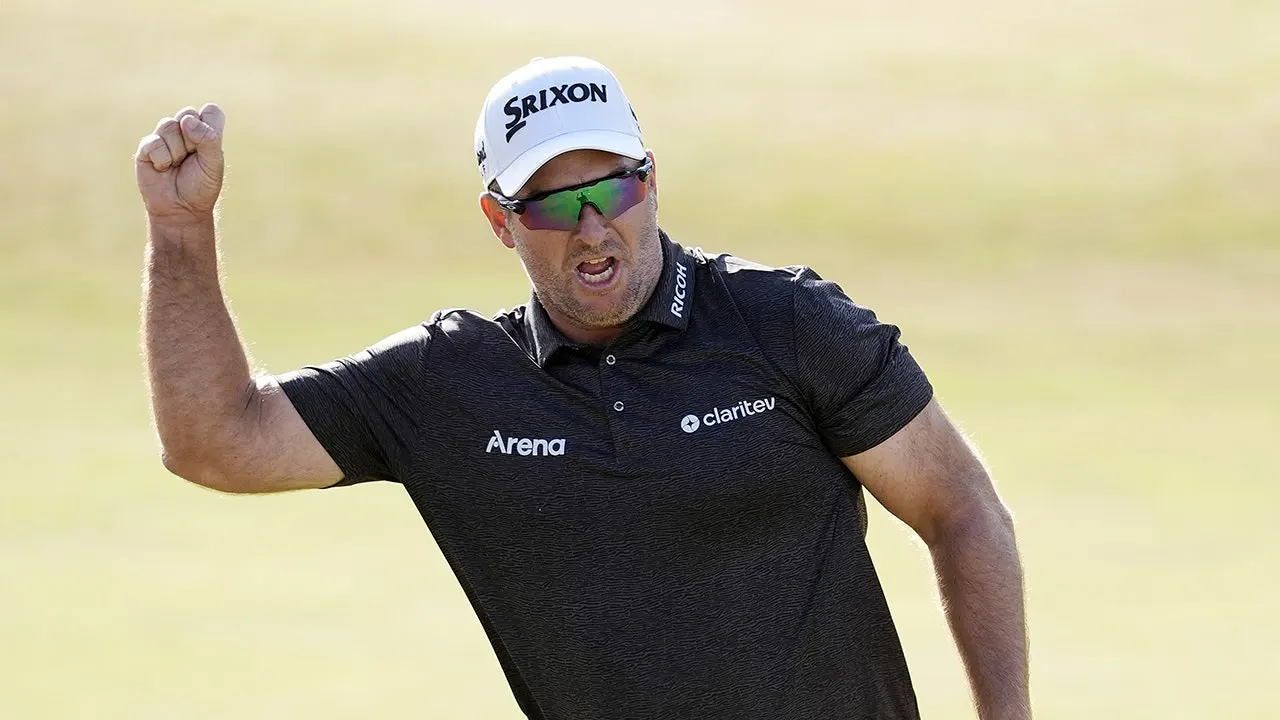
The final Sunday of a major championship is golf’s ultimate crucible, a place where years of grueling practice, silent sacrifices, and psychological battles boil down to a few high-stakes swings under an unforgiving sky. On the historic, windswept links of Royal Birkdale, 39-year-old New Zealander Ryan Fox found himself standing on the precipice of sports immortality, facing a moment that would test the absolute limits of his resolve. Moments earlier, Fox had stumbled on the par-5 17th hole—historically the easiest layout on the entire course—failing to secure a critical birdie after his aggressive drive unluckily trickled into a deep fairway bunker. Tied at nine-under-par with the clubhouse leader, American Cameron Young, Fox knew that his dreams of hoisting the legendary Claret Jug now depended on conquering the formidable par-4 18th, Birkdale’s most brutal and unforgiving hole. With the weight of his country’s sporting expectations resting squarely on his shoulders, Fox delivered a masterclass in poise, unleashing a thunderous tee shot down the center of the fairway and following it with a spectacular, razor-sharp approach that settled just inside twelve feet from the cup. As he stepped up to the ball and gently stroked the putt, watching it drama-drenchedly roll and drop into the cup for a championship-clinching birdie, the grandstands erupted. It was a career-defining triumph, ending Fox’s tournament at ten-under-par, one shot ahead of a heartbroken Young, and serving as a testament to the beautiful, unpredictable nature of a sport where destiny is forged in the face of immense pressure.
Behind Fox’s triumphant walk down the 18th fairway lay a trail of profound heartbreak and near-misses for the American contenders who had seemed so close to glory. Sam Burns, the 54-hole leader, entered Sunday with a two-shot cushion, looking like a man possessed after delivering one of the most historically dominant two-round stretches in the history of major championship golf. But the final round of a major is an entirely different beast, a mental chess match where past scars can easily resurface, and for Burns, those ghosts came calling on the front nine. Burns had previously tasted the bitter disappointment of late-round collapses at the 2025 U.S. Open at Oakmont and again at Shinnecock Hills, and his nightmare returned in a devastating three-hole stretch on Sunday when consecutive bogeys on the fourth, fifth, and sixth holes evaporated his hard-earned lead. While Burns scrambled to salvage his round, Cameron Young was quietly orchestrating a legendary comeback from seven shots back, tearing through the front nine with an astonishing, microscopic score of twenty-nine. Young looked primed to steal the tournament when he reached ten-under-par, only to find the menacing greenside bunkers on the 18th hole, leading to a costly bogey that forced him to wait anxiously in the clubhouse. For both Burns and Young, the day ended not with the joy of a trophy, but with the haunting realization of how agonizingly close they had come to changing their legacies, adding yet another chapter of resilience and sorrow to their respective careers.
The extraordinary drama of Sunday was the direct culmination of an unprecedented weekend of scoring that shattered Royal Birkdale’s historical defenses and rewrote the record books of championship golf. Typically known as a punishing, wind-battered fortress that humbles even the world’s elite, the English links playground surrendered a series of low scores that left spectators and historians in complete disbelief. Burns had ignited the frenzy on Friday with a mind-boggling, eight-under-par sixty-two, tying the men’s major championship scoring record and setting up his historic weekend run. In an unbelievable twist of fate, Australia’s Lucas Herbert carded a matching sixty-two on that very same Friday, and not to be outcoached, Ryan Fox himself fired a magnificent sixty-two on Saturday to rocket fifty spots up the leaderboard and earn his spot in the final pairing. To have three different players tie the all-time major scoring record in a single weekend at a venue as historically rigorous as Birkdale is a phenomenon that may never be replicated. This high-octane environment transformed the final round from a traditional, grinding battle against the elements into a relentless, fast-paced shootout where players knew that playing defensively was a fast track to obscurity, forcing Fox to play with the aggressive, fearless mindset that ultimately secured his victory.
Yet, beyond the personal triumphs and devastating heartbreaks on the final leaderboard, Fox’s victory signaled a massive, structural shift in the global balance of power within professional golf. For a long and suffocating period, American golfers had established a seemingly unbreakable hegemony over the sport’s most prestigious events. Initiated by Brooks Koepka’s dominant victory at the 2023 PGA Championship, American players went on an unprecedented tear, capturing seven consecutive men’s majors as a rotating cast of superstars, including Wyndham Clark, Brian Harman, Scottie Scheffler, Xander Schauffele, and Bryson DeChambeau, kept the rest of the world shut out of the winner’s circle. Even when European icon Rory McIlroy finally broke the streak with a legendary and emotional victory at the 25th Masters, the American dominance quickly resumed, with Scheffler dominating at Quail Hollow and Portrush, and J.J. Spaun locking down the U.S. Open at Oakmont. It was an era of unprecedented nationalist pride for American golf fans, who had grown accustomed to seeing the red, white, and blue dominating leaderboards around the globe, making the sudden and dramatic turn of events in the months that followed all the more shocking to the sporting world.
The first major cracks in the foundation of American dominance appeared not in the majors, but in the collective team formats and seasonal championships where international players began to rediscover their swagger. Tommy Fleetwood igniting the international resurgence by capturing the 2025 Tour Championship and the coveted FedEx Cup, a victory that injected massive confidence into his peers across the Atlantic. This newfound momentum became an absolute tidal wave during the subsequent Ryder Cup, where the European team handedly embarrassed the United States on American soil, putting on a clinic of cohesive, brilliant golf that left the visiting Americans searching for answers. As the calendar flipped to 2026, the international onslaught only intensified, with McIlroy successfully defending his Masters crown and England’s Aaron Rai capturing a breakthrough victory at the PGA Championship. When Wyndham Clark managed to halt the slide by winning his second U.S. Open at Shinnecock Hills, it felt like a desperate, heroic stand for American golf, setting up Royal Birkdale as the ultimate battleground where the U.S. hoped to reclaim its status, and the rest of the world hoped to cement a new global order.
By sinking that final, clutch putt on the eighteen green, Ryan Fox did far more than just fulfill a lifelong personal dream; he officially ushered in a spectacular new era of global golf by becoming only the second New Zealander to hoist the Claret Jug and the third in his nation’s history to win a major. His historic triumph meant that Wyndham Clark’s victory stood as the solitary American major win of the entire 2026 season, marking the first time since 2014 that American men failed to win at least two major championships in a calendar year. This dramatic regression highlights a profound shift in the sport, proving that the gap between the United States and the rest of the world has not only closed but that the international contingent is playing with a level of fearlessness and skill that is reshaping the game. With the upcoming Ryder Cup set to take place at the picturesque Adare Manor in Ireland—a venue where the United States will be desperately trying to snap a decades-long drought on European soil dating back to 1993—the pressure on American golf has reached a boiling point. Ryan Fox’s unforgettable walk into the sunset at Royal Birkdale will be remembered as the moment the crown was officially snatched away, leaving a beautifully diverse, deeply competitive world stage where the game of golf truly belongs to everyone.