


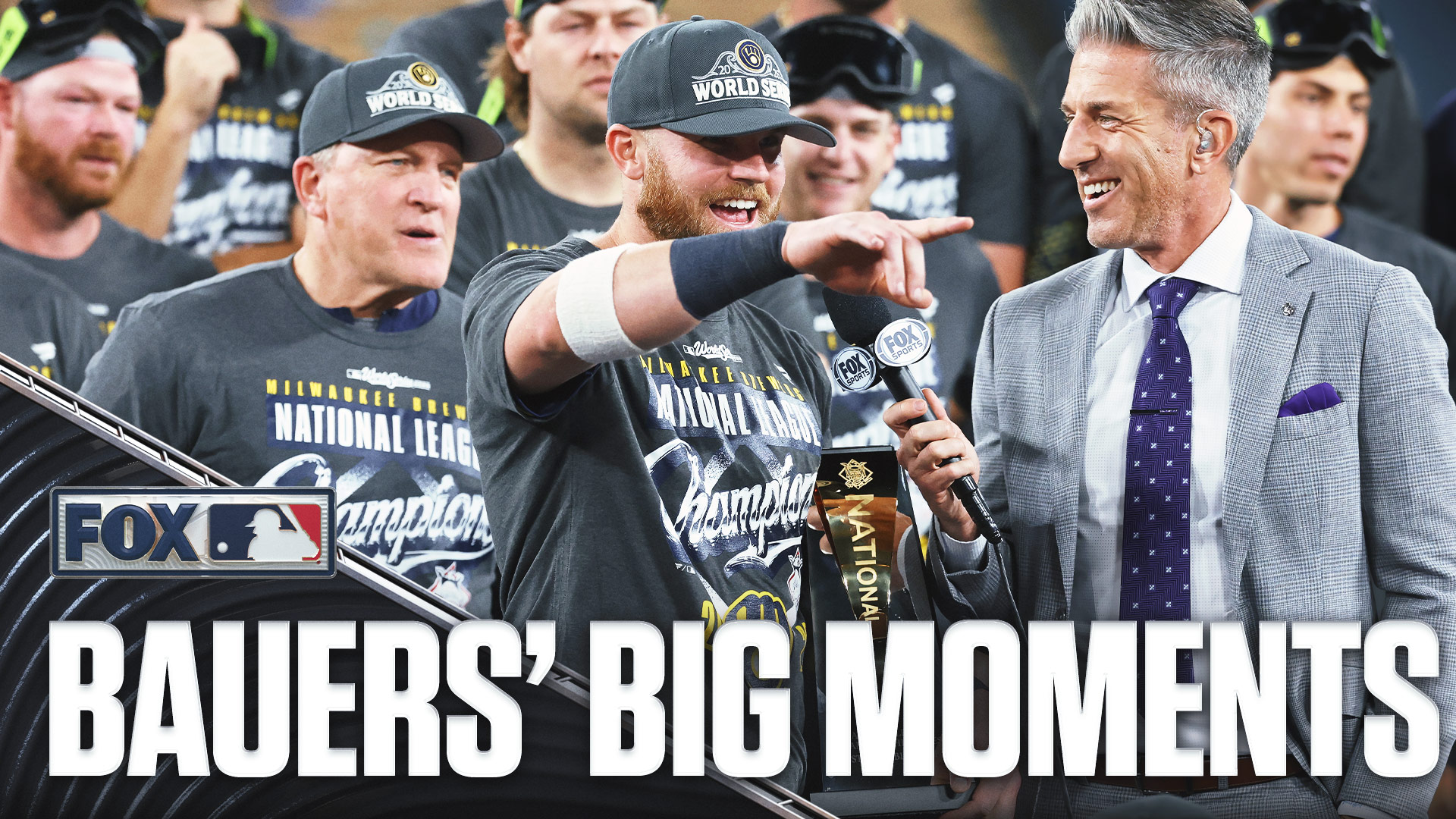
The noise at Dodger Stadium had dissolved into a strange, almost reverent stillness. What began as a hostile cauldron of blue-shirted hope ended with the visiting clubhouse a chaotic symphony of cheap champagne, beer-soaked hugs, and grown men weeping into the arms of trainers. The Milwaukee Brewers had defied every projection and silenced every skeptic, polishing off the Los Angeles Dodgers with a 6-4 victory on a Thursday evening that will echo in Wisconsin for generations. It had been 44 years since a Brewers team had reached the World Series, and for the players who formed a disbelieving dogpile on the infield dirt beneath the Southern California sky, the magnitude of the moment landed with the weight of every dead-end season, every August collapse, and every October heartbreak that had preceded them. The franchise that had been written off as a plucky Midwestern underdog, a team merely happy to be there, had done something far more dangerous: it had won. Sweeping the National League Championship Series had never been on anybody’s bingo card, and as the champagne stung their eyes, the Brewers seemed almost to be searching each other’s faces for confirmation that it was real. At the center of that beautiful mayhem stood Jake Bauers, a first baseman so unheralded that casual fans might have confused him with a spring training invitee, yet so vital to this run that the whole city of Milwaukee was poised to learn his name. By night’s end, he would not merely be a contributor to this historic feat; he would be remembered as the man who led them there, the unlikeliest of postseason heroes rising precisely when his team needed him most.
The announcement came with the finality of a curtain call: Jake Bauers, National League Championship Series Most Valuable Player. It was a sentence that, a year earlier, would have seemed absurd even to the man himself. When asked by MLB on FOX’s Alex Rodriguez to identify his favorite at-bat of the series, Bauers paused, not because he lacked options, but because the menu was too rich. There was the fourth-inning two-run double in the decisive Game 4, a ringing blow that sliced into the Dodgers’ early lead and announced that the Brewers were not going quietly. There was the iconic 12-pitch at-bat in Game 2, a patient, grinding masterpiece that chased Yamamoto from the game and set the tone for a series of deep counts and frustrated pitching changes. But when Bauers finally answered, he chose a moment of pure power and perseverance: the two-run homer in Game 3. That blast did not merely arrive on a hanging fastball; it was earned through an 11-pitch battle with Dodgers starter Blake Snell, a confrontation that swung between low-and-away sliders and high heat before Bauers finally connected, launching the ball into the right-field seats with a crack that seemed to release the breath of an entire fanbase. “That’s a special one. I’ll never forget that,” Bauers said, his voice still hoarse from shouting, his jersey still salted with champagne, his wife and parents standing beside him amid the on-field celebration. In that moment, with confetti falling and a trophy within sight, he looked less like a hardened professional and more like a kid who had just won the biggest prize of his life.
But the story of Jake Bauers is not a story of instant success or smooth trajectories. At 31, he is a journeyman in the truest sense, a man who has worn the uniforms of five different organizations and learned, often painfully, that baseball can be as cruel as it is beautiful. He was nearly done with the game in 2024, having reached the point where the doubt was so heavy that it outweighed the love. He had been traded, designated for assignment, and sent down, each transaction chipping away at the confidence that had once made him a promising prospect. When the Brewers came calling, they were not acquiring a star; they were acquiring a man at his lowest, someone who had stared into the void and wondered whether it was time to hang up his spikes for good. Yet out of that darkness emerged something unexpected: a player with nothing left to prove to anyone but himself. Bauers has transformed into a clubhouse leader, a veteran voice in a young room, and the kind of steady presence that championship teams are built upon. He hit 26 home runs and drove in 86 runs during the regular season, numbers that would have been career-best for him in a previous life, and he did it with a calm, almost defiant regression to the mean that coaches dream of. The journeyman had become a cornerstone. The man who had been discarded by team after team had found not just a home in Milwaukee, but an identity.
In the aftermath of Game 4, with the trophy hoisted and the celebration momentarily subdued, Bauers stood before David “Big Papi” Ortiz, the Hall of Fame slugger who has made a career of interviewing conquering heroes, and offered something far more vulnerable than a highlight recap. He spoke of the shrapnel of his past, the seasons spent fighting himself at the plate, the quiet nights when he wondered if he was good enough to belong. “I’ve been through a lot. Been through a lot in this game,” Bauers said, the words arriving with a sincerity that cut through the din of the celebration. “Doubted myself a ton, and somewhere along the way, I just let it go. I chose to be confident. I chose to believe in myself.” That self-acceptance manifested itself in the small but critical moments of Game 4: the two-run double in the fourth that trimmed the Dodgers’ lead, and later the bases-loaded walk in the fifth that knotted the score and tilted the momentum irreversibly toward Milwaukee. Those were not the products of reckless swings or desperate lunges; they were the calm, calculated moves of a hitter who had stopped fighting his own instincts. Bauers’ maturity, forged in the fires of rejection, had finally caught up with his talent, and the combination was devastating to opposing pitchers. He has become proof that a player can be broken and rebuilt, that confidence is not a birthright but a choice, and that sometimes the greatest redemption arcs in sports begin not with a breakthrough, but with a surrender.
Derek Jeter, never one for surface-level questions, wanted to know how Bauers stayed so serene amid the chaos of a pennant race racing toward its conclusion. In a sport that rewards relentlessness, how does a man who has survived five uniforms and countless slumps keep his heart rate steady with the bases loaded in the biggest game of his life? Bauers’ answer was refreshingly philosophical. He explained that calm is not the absence of fear, but the acceptance of it. He knows he will make mistakes, will fail more often than he succeeds, and will swing at pitches he will wish he had taken. Trying too hard, he said, is the death of execution; chasing pitches is what happens when anxiety takes the wheel. “If you’re trying too hard, you’re going to chase pitches. You’re not going to get the job done,” Bauers said. “It’s really just about letting the game come to me as much as I can, and just meeting it where I can.” The words carry the weight of a man who has learned that baseball is as much about managing the space between your ears as the space between the foul lines. He no longer views each at-bat as a referendum on his worth; instead, he sees it as an opportunity to meet the moment without forcing it, to let the game unfold and trust that his preparation will carry him through. That patient, almost Zen-like approach has become his signature, and it has transformed him from an anxious hitter into a postseason assassin. He is the calm eye of a hurricane, the veteran who does not flinch, and the Brewers have ridden that serenity all the way to the precipice of baseball immortality.
If there is a symbol of this improbable run, it might not be the MVP trophy or the champagne-soaked jerseys. It might be a t-shirt. Stu Bauers, Jake’s father, arrived at Game 1 wearing a shirt emblazoned with the words “Rake Bauers,” a father’s playful endorsement of his son’s hitting prowess. He then wore it again for Game 2. And Game 3. And, of course, Game 4. Whether the shirt is made of cotton or magic, the Brewers won every time the elder Bauers donned it, and superstition alone would have been enough to keep it glued to his back. “There’s no words that can put in the pride, the joy. There’s just no words. It’s amazing,” Stu Bauers said, his eyes glistening as he watched his son celebrate on the same field where legends had fallen. There is an unquantifiable sweetness in watching a father witness his child’s greatest triumph, especially when that child nearly gave up the game just a year before. Jake’s wife moved through the celebration in a blur of hugs and tears, his parents beside her, a family that had believed in him even when he had stopped believing in himself. The Brewers will carry that momentum into the World Series, where they will face a new opponent and a new crucible, but whatever happens next, they have already accomplished something transcendent. They have written a story of redemption, of a player who chose confidence over fear, of a team that refused to accept its own limitations, and of a father whose lucky shirt may well have been the secret ingredient all along. For Milwaukee, starved for baseball glory for 44 years, the wait is finally over. And for Jake Bauers, the man who nearly walked away, the moment is impossibly sweet—a reminder that the darkest chapters often lead to the most beautiful endings.