


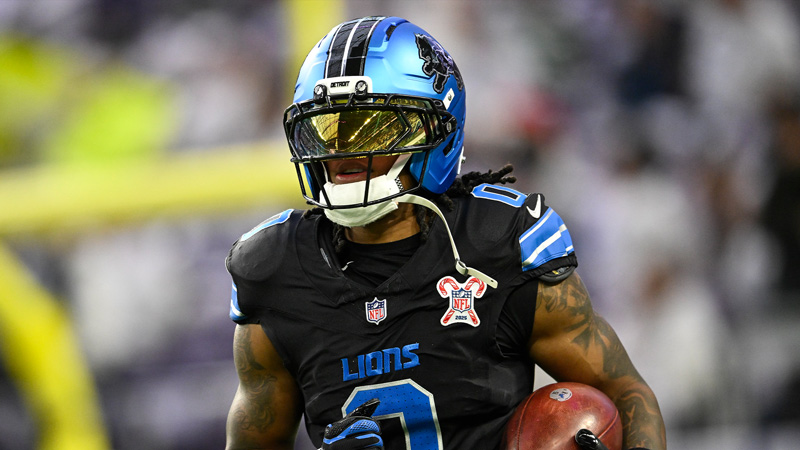
Jahmyry Gibbs has never lacked for confidence, and this offseason he is letting the world know exactly where he stands: at the very top. The Detroit Lions running back, who just signed the most lucrative contract ever given to a player at his position, was asked a simple hypothetical question—whether he would select himself as the No. 1 overall pick in a fantasy football draft—and his answer came with the kind of unvarnished certainty that defines elite athletes. “For sure,” Gibbs said, a reported smile stretching across his face as he spoke to reporters via the Lions’ team website. “I’m either going to make a lot of people happy or mad.” It is a classic running back quote: equal parts brash, playful, and dripping with the awareness that fantasy football is a game of unpredictable fortunes, where injuries, game scripts, and coaching whims can turn a sure thing into a weekly headache. But for Gibbs, the audacity of the claim is backed by something more tangible than bravado: a historic contract and a statistical résumé that places him among the most dynamic offensive weapons in the entire league. In an era when the running back position has been systematically devalued, when teams refuse to pay second contracts and committees have replaced workhorses, Gibbs just shattered the market, and he is not shy about reminding everyone that his production—and his fantasy ceiling—deserve equal recognition.
The deal itself was a seismic event in the NFL’s financial landscape. In August, the Lions signed Gibbs to a three-year, $67.5 million extension that carries a $22.5 million average annual value, the richest per-year figure ever recorded for a running back in league history. For a player who had already established himself as a Pro Bowler in each of his first three seasons, the contract felt less like a gamble and more like a coronation. His 2024 campaign, his second year in the league, was the true breakout: he rushed for 1,412 yards and an NFL-leading 16 rushing touchdowns, all while averaging a jaw-dropping 5.6 yards per carry, proving he could handle a featured workload with devastating efficiency. He followed that up in 2025 with another monster season, rushing for 1,223 yards and 13 scores on 5.0 yards per tote, while simultaneously functioning as a high-volume receiver out of the backfield: 77 receptions, 616 receiving yards, and five more touchdowns through the air. Those numbers are not merely good; they are the stuff of fantasy league winners, the kind of dual-threat production that only a handful of players in any given generation can offer. His career average of 246.5 carries per season since 2024 demonstrates not only durability but a coaching staff’s trust in his ability to absorb punishment while still maintaining explosive burst. Gibbs is not just a runner; he is a mismatch weapon, a chess piece who can align wide, slip out of the backfield, or take a handoff and turn a simple inside zone into a 60-yard house call. That versatility is precisely why he believes the No. 1 pick belongs to him, and it is why the Lions made him the highest-paid player at his position without hesitation.
Yet even Gibbs understands that individual brilliance can only carry a team so far, and this season, the structural reality of his situation has changed dramatically. For the first time in his NFL career, he enters a season as the undisputed, unchallenged alpha of the Detroit backfield. The Lions made that unmistakably clear during the offseason when they traded veteran running back David Montgomery, his thunder-and-lightning partner since 2023, to the Houston Texans. Montgomery had been more than just a complement; he was the bruising hammer to Gibbs’ scalpel, a tone-setter who averaged 187.3 carries per season during his three years in Detroit and whose physical style wore down defenses in the fourth quarter. Together, Gibbs and Montgomery formed one of the league’s most feared duos, combining for a staggering 401 carries last season alone, the only two Lions players to receive more than three rushing attempts on the year. Now, with Montgomery gone, the burden falls almost entirely on Gibbs’ shoulders—and that is exactly how he wants it. Behind him on the depth chart sit Jacob Saylors and Sione Vaki, two running backs with a combined total of just nine career NFL carries between them. The message from the front office could not be louder: this is Jahmyr Gibbs’ backfield, full stop. When asked about the impending workload, Gibbs did not flinch or hedge; he embraced the responsibility with the same easy confidence he brings to everything else. “I guess I’m getting most of the carries. I feel good [about that],” he said. “It’s nothing I haven’t done before. It’s going to be cool.”
That quiet assurance will be put to the test immediately, because the Lions are not merely asking Gibbs to carry a heavier load—they are asking him to help carry a franchise through a period of significant transition. The coaching staff that helped shape him has undergone a dizzying shuffle over the past two off seasons. Ben Johnson, the offensive mastermind who coordinated Detroit’s top-five rushing attacks in2023 and 2024, departed after the 2024 season to become the head coach of the Chicago Bears, taking his innovative scheme to a bitter division rival. The Lions promoted John Morton to replace him, but after a disappointing 9-8 season that saw them miss the playoffs for the first time since 2022, ownership and coaching leadership made the difficult call to move on from Morton as well. In his place arrives Drew Petzing, the former Arizona Cardinals offensive coordinator, tasked with reinvigorating a unit that slipped to 14th in the NFL in rushing yards last season after finishing fifth in2023 (135.9 yards per game) and sixth in2024 (146.4 per game).. The 2025 iteration managed just 120.1 rushing yards per game, a noticeable decline that exposed the absence of a coherent rushing identity. Petzing’s challenge is not merely schematic but psychological: he must rebuild the confidence of an offensive line, integrate a new system, and ensure that his best player—Gibbs—isn’t just productive but central to everything the offense does. For Gibbs, the arrival of a new coordinator brings both uncertainty and opportunity; he may not know exactly how Petzing plans to deploy him, but he knows the plays will run through him, and he has spent three years proving that when given the chance, he is unstoppable
The broader context of the Lions’ situation adds even more weight to Gibbs’ expanded role. Make no mistake: Detroit’s 2025 season was a profound disappointment, not because the team was bad, but because the standard had been raised so high in previous years. After back-to-back playoff appearances, including a run to the NFC Championship game after the 2023 season, expectations in Motor City were sky-high. The Lions had built a physical, aggressive, swaggering identity under head coach Dan Campbell, and their rushing attack was the heartbeat of that persona. To miss the playoffs entirely was a gut punch to a fanbase that had waited decades for relevance, and it sparked a winter of hard questions about everything from scheme to personnel. The trade of Montgomery, while financially prudent and a validation of Gibbs’ ascendancy, was also a symbolic admission that the offense’s identity must evolve. The franchise is betting its 2026 hopes on the principle that Gibbs can be not just a featured back but the entire engine of the attack—a player who touches the ball 20, 25, or even 30 times per game and still breaks tackles in the fourth quarter. That is a heavy burden for any player, but Gibbs seems almost eager for it. His fantasy football bravado, his “make people happy or mad” quip, reflects a deeper truth about his competitive nature: he thrives on being the fulcrum, the guy everyone is watching, the player who can single-handedly decide a game. The fantasy managers who draft him No. 1 overall will be betting on exactly that: that Gibbs’ volume rises, that his touchdown total stays in the stratosphere, and that the Lions’ new offensive coordinator recognizes what everyone else already knows—this offense runs through number 26.
All of which sets the stage for a season-opening showdown that feels almost too perfectly scripted. The Lions will host the New Orleans Saints at Ford Field on Sunday afternoon, a 1 p.m. ET kickoff broadcast on FOX, and there could be no more fitting stage for Gibbs to unveil his new reality. The regular season opener is always a moment of renewal, a blank slate where every team believes it can be great, but for Gibbs, it represents something even more personal: the first official chapter of his life as the undisputed focal point of an NFL offense, the first opportunity to justify a record contract, andhe first chance to show the world that his No. 1 fantasy football proclamation was not idle talk. He will jog onto the field knowing that a defense has spent all offseason game-planning specifically to stop him, knowing that the league’s smartest coordinators will try every exotic front, every simulated pressure, every gap discipline trick to limit his touches. And yet, if his career has taught us anything, it is that Gibbs remains unfazed. He has always run with a rare blend of patience and violence, vision and burst, flash and power—the ability to make a man miss in a phone booth andhen run through an arm tackle anyway. The smile he wears in press conferences is the same smile he wears after scoring from 40 yards out; it is a smile born of knowing something the rest of us are just beginning to understand. By the time the Saints arrive, the fantasy drafts will be completed, the hot takes will be flying, and the expectations will be at an all-time high. Jahmyr Gibbs does not seem bothered by any of it. In fact, he seems to be counting on it. He wanted the contract. He wantedthe carries. He wantedthe spotlight. And now, with the highest-paid running back deal in NFL history in his pocket and a depleted depth chart behind him, he is finally getting everything he asked for. Whether he makes millions of fantasy owners happy or mad over the course of the season remains to be seen, but one thing is already certain: he will not be shying away from the moment. The Lions are betting their season on him, fantasy managers are betting their drafts on him, and Gibbs—ever confident, ever smiling—is betting on himself, just as he always has. For a player who has averaged nearly 250 carries a year and scored 34 total touchdowns over the past two seasons, the only real question left is not whether he can handle the load, but just how high he can push the ceiling. If his own words are any indication,he intends to push it all the way to No. 1.